Written by: Sarah Fatima - Posted on: January 23, 2014 |  Comments
Google Translation: اُردو | 中文
It makes sense to visit some places over and over again because somehow you can never retain their full glory in your recollections for very long. Their splendor tends to spill over your carefully created memory banks and all you are left with is a constant longing to return.
Remnants of Mughal architecture in Lahore are examples of such glorious masterpieces. Whether one agrees or disagrees with the political standing of the rulers, the Mughal aesthetic has the desired effect on each and every one who experiences it.
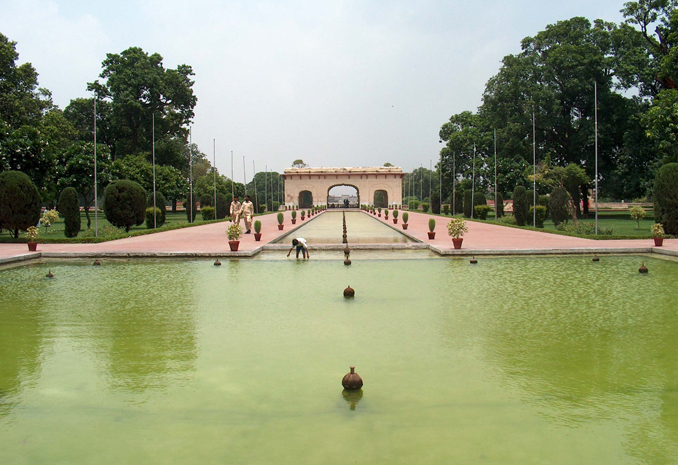
To understand this magical sense of wonder, set out on a walk through Emperor Shah Jehan’s Shalamar Gardens.
Even though the three-tiered mega structure’s beauty would be enough to grant it a unique value in its own right, there are other reasons to add to its fabled fame. Its construction time is said to be a record short period of one year, five months and four days between 1641 and 1642 AD. Then there is an intricate network of fountains and waterworks, which is a marvel of underground irrigation working simply on gravitational mechanics. This is a feat that still has researchers in awe.
 |
As you enter through the massive red brick walls that stand tall and proud like a guard over a treasure of immense value, you are greeted by an expanse of lush green grounds on both sides of brick paved paths littered with fountains. A hundred and five fountains to be exact. This is the first of three levels of the Gardens. It is called Farah Baksh, which means Bestower of Pleasure.
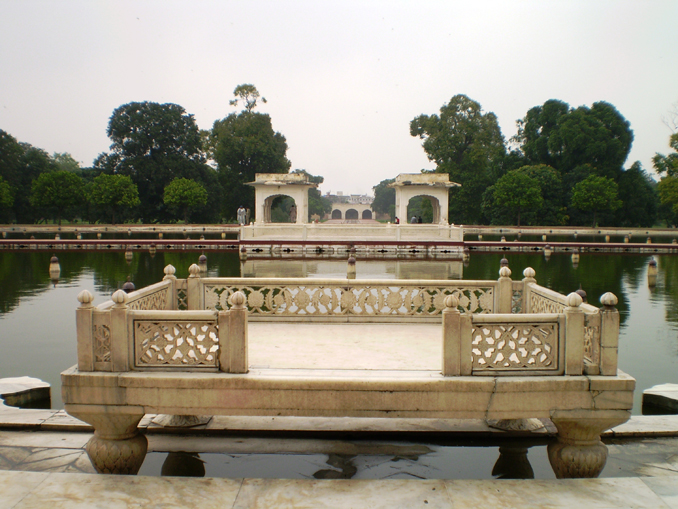
The mesmerizing flow of water from these fountains in a symmetrical pattern that you cannot comprehend at a single glance, guides you towards the pavilion parked at an apparent edge. As you reach the pavilion, a frenzied whirl of cool breeze even in the sweltering summer heat will surprise you as your eyes take into account the beautiful marble pool located in the center of the second tier of the gardens. This is the view reserved for the Empress and her party in the days of Mughal Glory. The top terrace was meant for the ladies of the Royal household.
Water flows underneath the terrace on a marble wall mimicking a waterfall leading down to the second step of the Garden. It makes a noise like the pitter-patter of monsoon rain and is appropriately labeled the ‘Sawan Bhadoun’, which is one out of a total of 5 water cascades. In the center of the pool, rests a marble throne.
Imagination simply takes its own course from this point as you inevitably try to remember a forgotten memory of a hundred and fifty two running fountains, an emperor in all his bejeweled splendor, seated in the center of a pool and pavilions on both ends housing groups of royal guests, entertainers and emissaries. The ‘Aiwaan’ is set on the second terrace, called Faiz Baksh. It means the Bestower of Goodness.
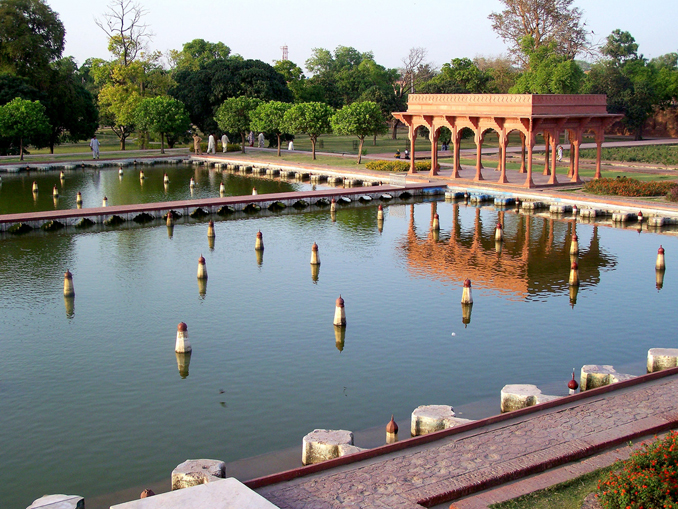
Over the edge of this lies the third and lowest terrace of the Shalamar Gardens, led into by beautiful ‘Chinikhanas’, which are styled arches, in a marble wall, made for lighting oil lamps. The intent is to make light dance of the reflective water pools. This last tier is called Hayat Baksh, meaning the Bestower of Life and in division of land, it is a replica of the top most tier of the Garden.
 |
The complete architectural intricacies of the Shalamar Gardens have been a subject of intense research and historians and architects alike continue to pen books and research papers on the subject. It is more or less agreed that Emperor Shah Jehan aimed to create a reminiscence of the Kashmiri hills, waterfalls and flora in the plains of Lahore with this Garden. The symmetry and order, alongside choice of construction materials, were also symbolic as with so many other architectural marvels of the era.
For those not interested in the fine details of architecture, the drama and romance of the gardens seems to know no bounds. As one floats through the terraces in a trance like state, there is a constant urge to try and fathom what it must be like to live surrounded by such ethereal beauty. Fruit bearing trees, flowering plants and shrubberies grace the surrounding green fields.
The trees are home to an array of birds and if one sits on the benches and waits, the resident parrots can be seen carrying their ancestors’ colors, still bright and vivid like the memories of the Garden walls.
Quiet and peaceful, the Shalamar Gardens rest like a jewel of Paradise, hidden away and held in place by towering walls. While the city of Lahore bustles and whistles at its manic pace right outside, inside, the wind carries music and laughter from old days. Tales of brilliance and majesty get retold with great aplomb to all visitors, new and old alike.
“Gulzaar-e-Hast-o-Bood Na Begaana Waar Dekh!
Hai Dekhne Ki Cheez Ise Bar Bar Dekh!”
(Do not look at the garden of existence like a stranger!
It is a thing worth looking at, look at it again and again.)