Written by: Prof. Dr Mamoona Khan
Posted on: April 23, 2026 |  | 中文
| 中文
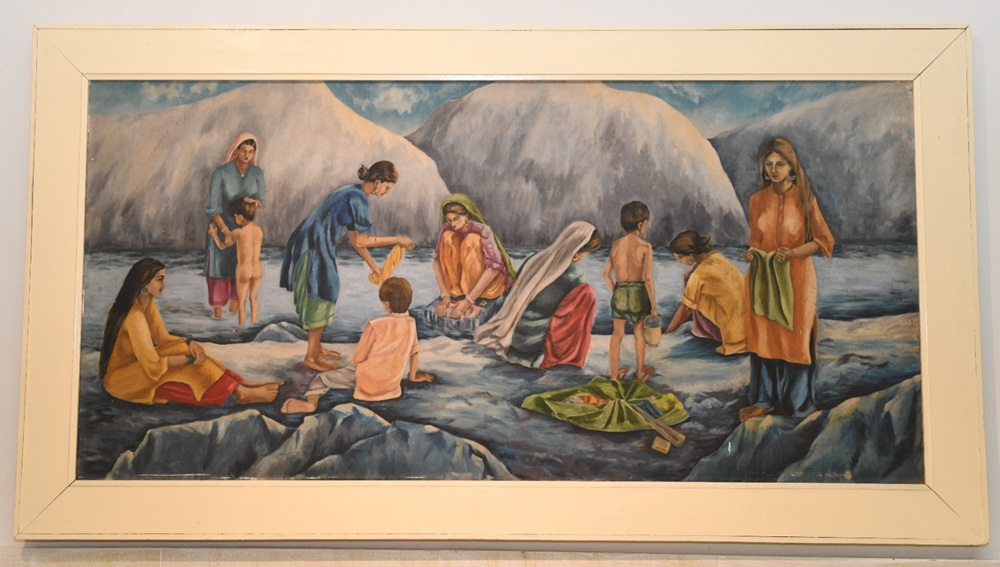
Rural Laundry by Mrs. Abida Ihsan
Societies witness many unsung heroes in various walks of life who have contributed profoundly within their respective fields, possessing the potential to grow yet remaining unrecognized due to their altruistic nature. Abida Ehsan, a pioneering artist of Pakistan and one of the earliest students of the legendary Anna Molka Ahmed, was enthusiastic after graduating from the University of the Punjab to excel in her field by exhibiting her works at various forums, but she ultimately satiated her creative instinct through the profession of teaching. The fields of feminine art and aesthetics in the Pothohar region of Pakistan are highly indebted to Mrs. Abida Ehsan, who promoted the discipline by initiating, in 1964, the Department of Fine Arts within the highly reputed institution of Rawalpindi, Government College for Women, Satellite Town. She further played a pivotal role in initiating and expanding this discipline in other colleges of the twin cities.
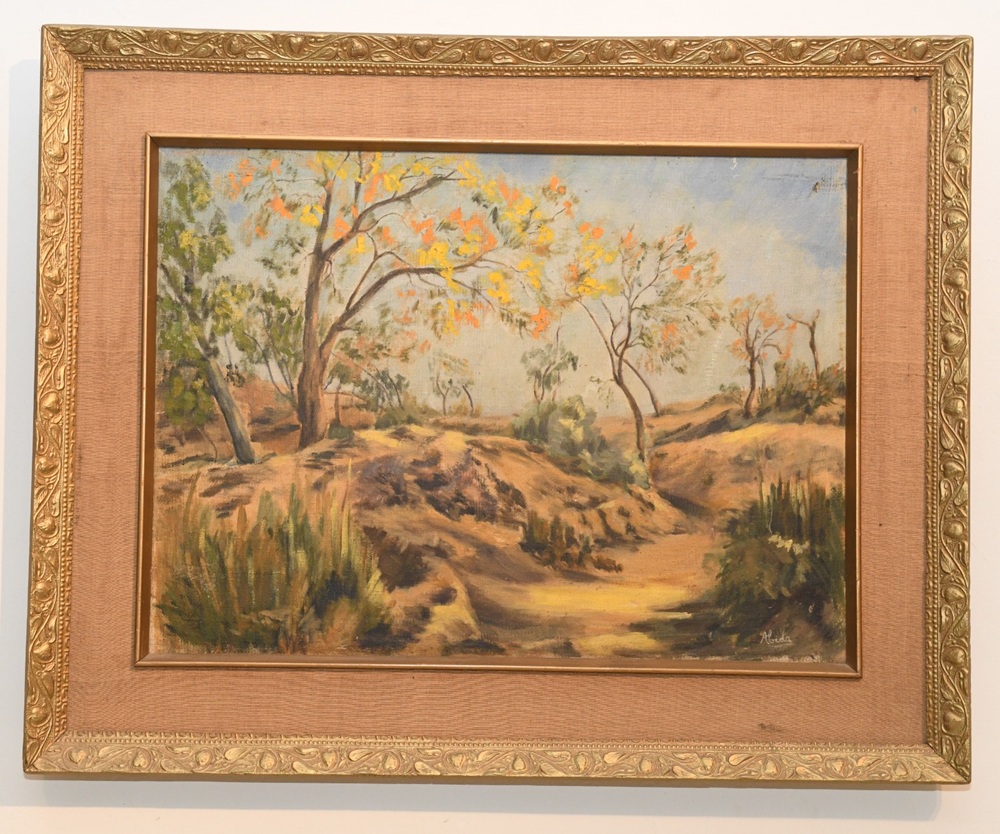
Landscape of Pothuhar-1 by Mrs. Abida Ihsan
She was born in 1933 in Gujrat with the maiden name Abida Kiyani. She completed her matriculation in 1948 from Government Girls High School, Montgomery. Opting for Fine Arts, she joined Lahore College for Women and completed her Intermediate and B.A. in 1950 and 1952 respectively. A subsidiary passion for literature led her to join Oriental College, Lahore, where she obtained a Master’s degree in Urdu literature in 1955. However, the very next year she returned to her true passion and joined the University of the Punjab for Fine Arts, acquiring a Master’s degree in the subject.
Immediately after completing her studies, she took up short assignments teaching art at the junior school of Aitchison College and then at Lahore College for Women. However, destiny awaited her in Rawalpindi, where after matrimonial ties with Raja Muhammad Ihsan, she joined the 6th Road College. The department excelled with the passage of time as she brought together reputed educationists in the field such as Mrs. Jamila Zaidi, Mrs. Tasneem Abbas and Mrs. Nadra Masood, and the team produced erudite graduates.
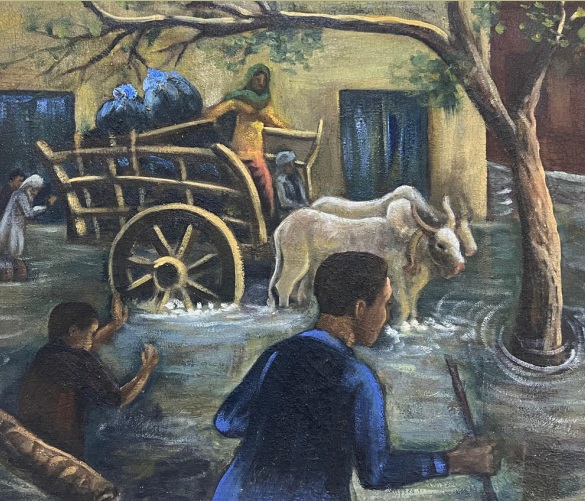
A painting by Mrs. Abida Ihsan
Within less than two decades, the team, headed by Mrs. Ihsan, worked tirelessly to elevate the status of both the department and the college, transforming it from a degree college into a postgraduate institution by initiating, in 1983, Master’s classes in Fine Arts. Presently, it is Rawalpindi Women University, the foundation of which was laid by the Department of Fine Arts with its Master’s program, as it served as a fountainhead for Master’s degrees in seven other disciplines, with the pivotal role played by Prof. Abida, who headed the department for a long time.
She is silent now, but her landscapes displayed at the National Art Gallery, Islamabad, from 29th March to 5th April, narrate the entire story of a hidden talent that remained in oblivion for long. The efforts of her two daughters, Ms. Samar and Ms. Tehreem, brought into being the long-awaited exhibition at PNCA, Islamabad. The inauguration ceremony was also unique, as the ribbon was cut by her one-and-a-half-year-old great-granddaughter, Rimelle Hasan Yayla.
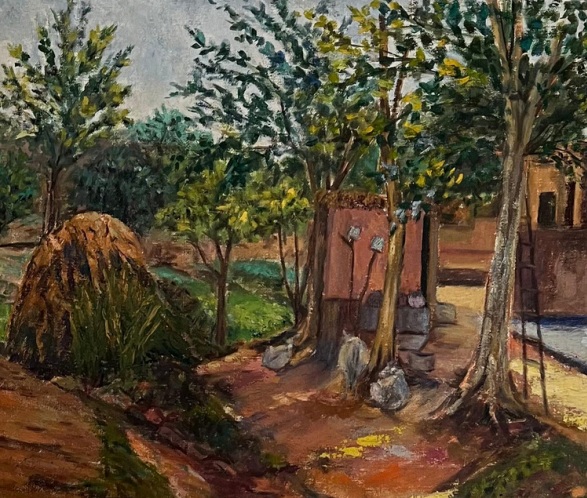
A painting by Mrs. Abida Ihsan
At Aitchison College, she was known as Miss Abida Hassan Akhter; at the 6th Road College as Mrs. Ihsan; and in Vista (the annual magazine of Fine Arts, University of the Punjab), she contributed as Abida Kiyani. From 1958 to 1961, she regularly contributed to Vista in the form of articles or documentation of her participation in exhibitions, presenting new works each time. Her reflections on budding artists at Aitchison, published in Vista (1961), record valuable historical insights along with a psychological analysis of their creative perception, stressing that the free expression of a child through art strengthens character.
Her teaching appears to have been research-based, as she defined in her article the materials to be used by different age groups, drawing and painting exercises, and even analyzed their priorities in perceiving various events or situations. While drawing the human figure, grade 1 students, she writes, would typically depict a large circle for the head, with arms and legs represented by vertical and horizontal lines, and small straight lines indicating hair. Preferences for drawing favorite animals varied across age groups; their imaginative landscapes and playful portraits of classmates were keenly observed and documented.
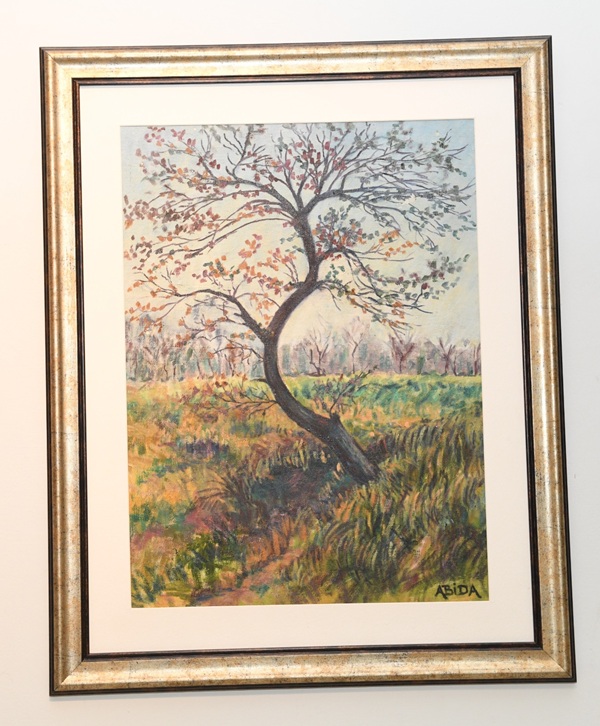
Acacia Tree
It was a time when statesmen from different countries visited the newly formed nation, often passing along the Mall Road, while children waving buntings to welcome them was a common tradition. She writes that they observed President Nasser of Egypt, Queen Elizabeth of England, and the Shah of Iran, among others, and painted these events as well. The colors of flags attracted them most, and they captured the colorful decorations along Mall Road, while rendering distinctive features associated with the visiting dignitaries. Her observations in these articles are minute and worthy of reading, not merely for visual enjoyment but also as guidance for art teachers.
Her zeal for promoting art was channeled through teaching at the college, and her own artistic practice, once regular, became occasional. Her works, collected from various sources, were displayed posthumously at PNCA, Islamabad. A major part of her life spent in the Pothohar plateau is reflected in her landscapes, natural objects, and characterization through portraits, mostly depicting the common people of the region, alongside the likeness of Anna Molka Ahmed, her mentor.
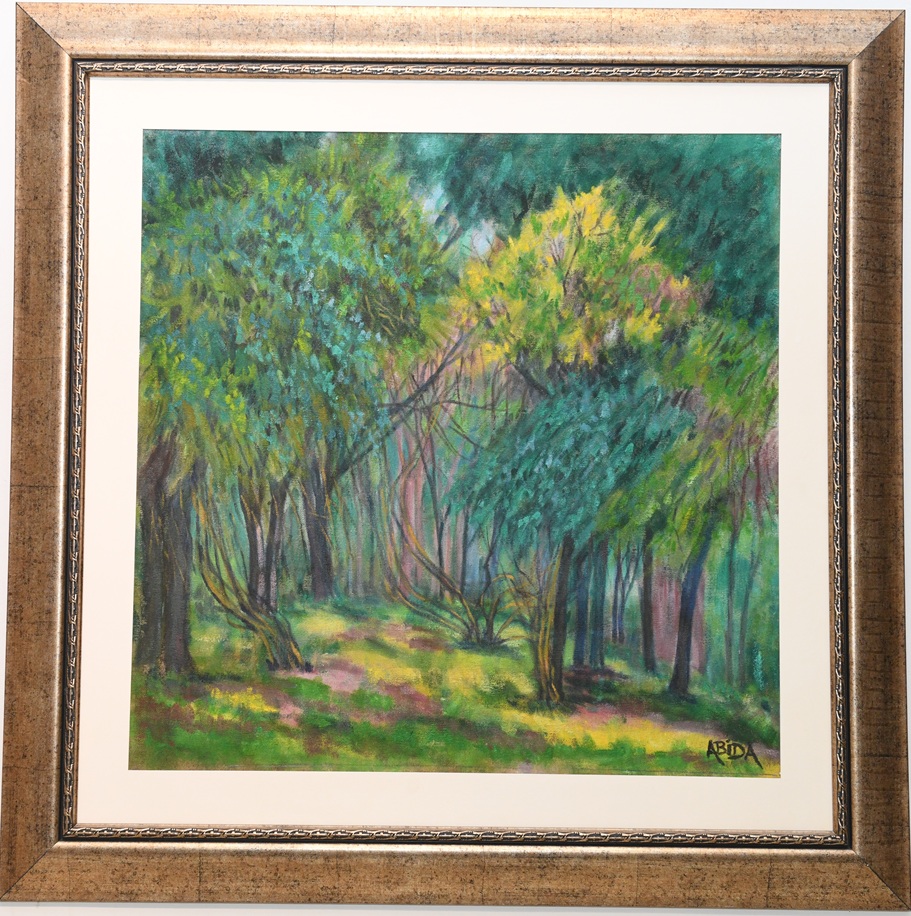
Spring
Quick brushstrokes, without prolonged detailing, paved the way for her calm and contemplative mode of expression, especially evident in her landscapes. A single twisted acacia tree composes an entire canvas with its dancing posture, representing autumn, almost bare, with a few leaves about to fall in the wind. A spirit of joy and optimism prevails in the twists and turns of its stem and branches, creating motion in an otherwise static landscape. Another painting renders the lingering yellow light of afternoon with a winding path fading into the distance. Yet another depicts the rugged land of the plateau, forming an interesting skyline with thatched huts on a large mound of earth, approached through a partly sloped path and partly rough staircase, with a beautiful combination of browns and greens. Spring scenes are also rendered impressionistically, depicting forests with dense foliage, where light penetrates through openings and illuminate patches of naturally growing vegetation.
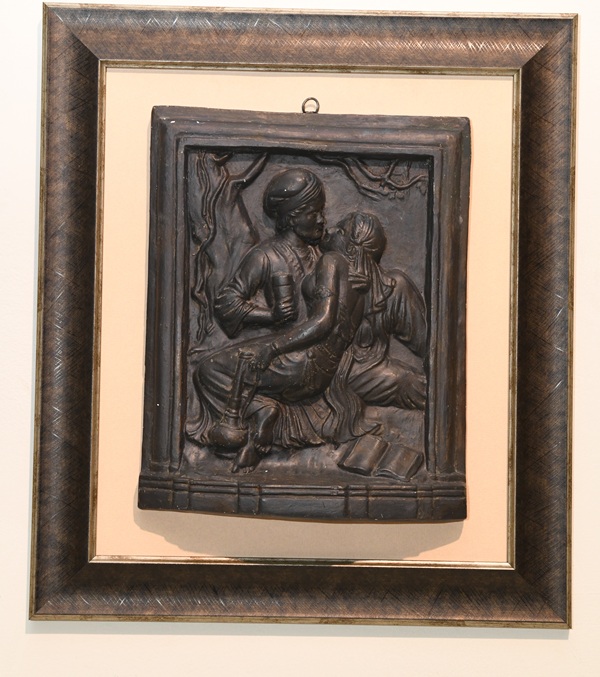
Relief Sculpture, Love Scene
Untamed nature attracted her most; even white lilies celebrating spring are rendered spontaneously, where the delicacy of petals is the focal point, observed minutely yet expressed with immediacy of strokes. Most attractive is the large canvas (3 ft × 5 ft) representing a rural genre of the plateau, where women are engaged in laundry work by a stream, surrounded by large boulders. Young and middle-aged women, in a variety of postures and angles relevant to their activity, are absorbed in their labor. Washing, dipping, squeezing, and drying clothes are all interwoven through compositional devices, directional lines, and gestures. Even children are naturally posed: one older child relaxing in the foreground, another holding a water pot, and a naked toddler stubbornly insisting on something while the mother attempts to console him. Accessories of laundry, arranged as still life in the foreground, include soap, a wedge-shaped washing baton, and colored packets placed on an untied ghathri (bundle), along with adornments of rural women such as rings, bangles, earrings, and amulets, all minutely observed and lovingly rendered. It recalls the Construction Scene of Khawarnaq Palace by the Persian artist Behzad. Besides painting, she also excelled in sculpture, which she taught devotedly to every batch of her students, evident from a single relief displayed in the exhibition depicting a love scene.
W. B. Yeats rightly said, “Education is not the filling of a pail but the lighting of a fire,” and Mrs. Ihsan kindled that fire not only within her students but also among the teaching community of the twin cities by helping initiate the discipline in their institutions, establish art studios, and devise curricula. She is remembered by all as a guiding presence and a beacon in the true spirit.
You may also like:
From the Horn of Africa to Bahria Town: Habesha Café Brings Centuries of Coffee Culture to Rawalpindi
(October 15, 2026)