Written by: Prof. Dr. Mamoona Khan
Posted on: September 19, 2025 | 
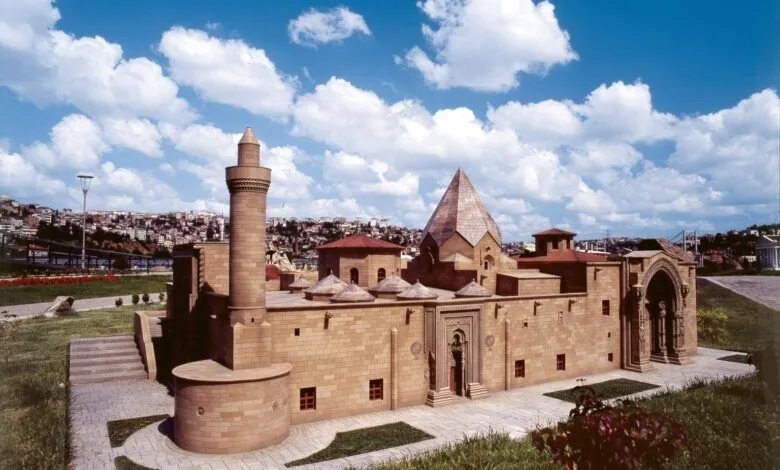
Divriği-Ulu-Camii (The Great Mosque of Divrigi)
Creativity is an innate human instinct that flows mutely within human spirit. It cannot be restricted or stopped, for being empowered to navigate its own course of resilience. Cultural norms of any society may regulate or restrict its domains but unbounded energy, the hallmark of its character pursues for novelties, discovering the unprecedented paths, creating marvels. The 13th century mosque of Divrigi is a living specimen of the vital creative energy empowering humans as artists. Apparently, it is a testament of the architectural engineering and aesthetic charm with which the ashlar masonry is converted into a symphony in stone for the intricacies and delicacies of its carved motifs. In reality, it is an amalgam of awe-inspiring formations. Figurative representation is restricted in the religious edifices of Islam and analogously avoided in the adornments of Divrigi mosque, still human figure emerges but in silhouette form, at certain times of day, providing a breath-taking experience for spectators. Because apparently, there is no form that can be produce the shadow of a human figure, making the monument unique of its kind.
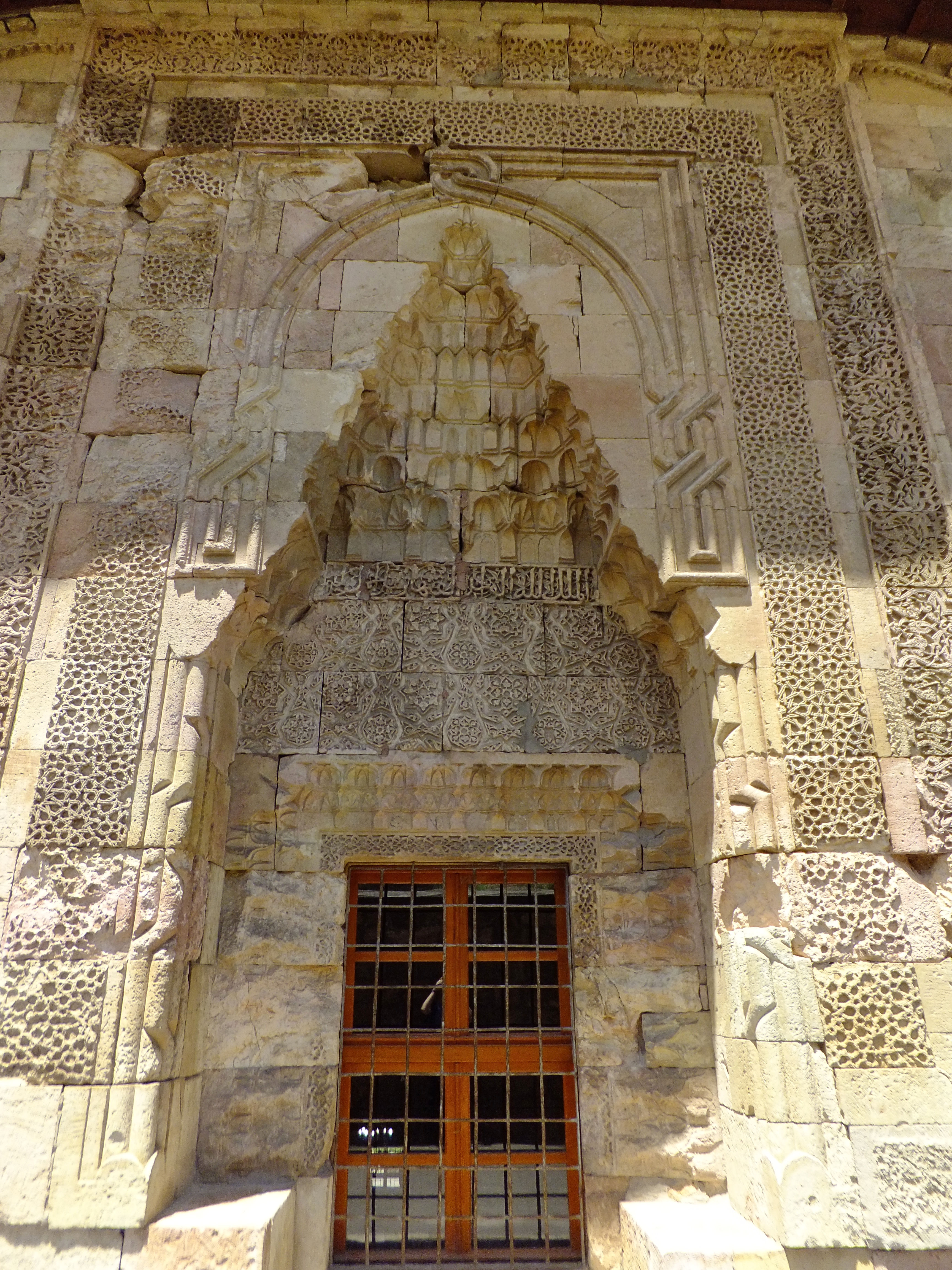
Eastern entrance portal
Divrigi Ulu cami (The Great Mosque Divrigi) is the oldest surviving complex of Anatolia, comprising a mosque and a hospital, commissioned in 1228-29 by the Mengujekid ruler Mahmet Shah and his wife Turan Melek, respectively. Mengujekid was the local dynasty (1072-1277), serving Seljuqs as vassals in Anatolia. The Divrigi mosque is a classical specimen of Seljuq stone carving, adored with intricate geometric, vegetal, floral, spiral vines, along with calligraphic patterns, reflecting prowess and ingenuity of the artists, who converted stone into the palpable softness of sinuous forms of nature. It is not only an insignia of beauty but mirrors the unification of cross-cultural influences that devised the novel Seljuq aesthetics. A harmonious fusion of influences including Persian, Armenian and Byzantine, is also a witness to its patron’s artistic vision. Ahment Shah hired best architects and artists from different cultures, as was the custom of that time, to create a unique visual and cultural tapestry. Constructed with the local material of yellow lime stone for its compatibility with geology of the region and also to blend with the surrounding nature, having capacity to keep the interiors cool. Each stone of the building is meticulously chiselled out, documenting dedication and skill of the artists, and of course of the patron, who envisioned it.
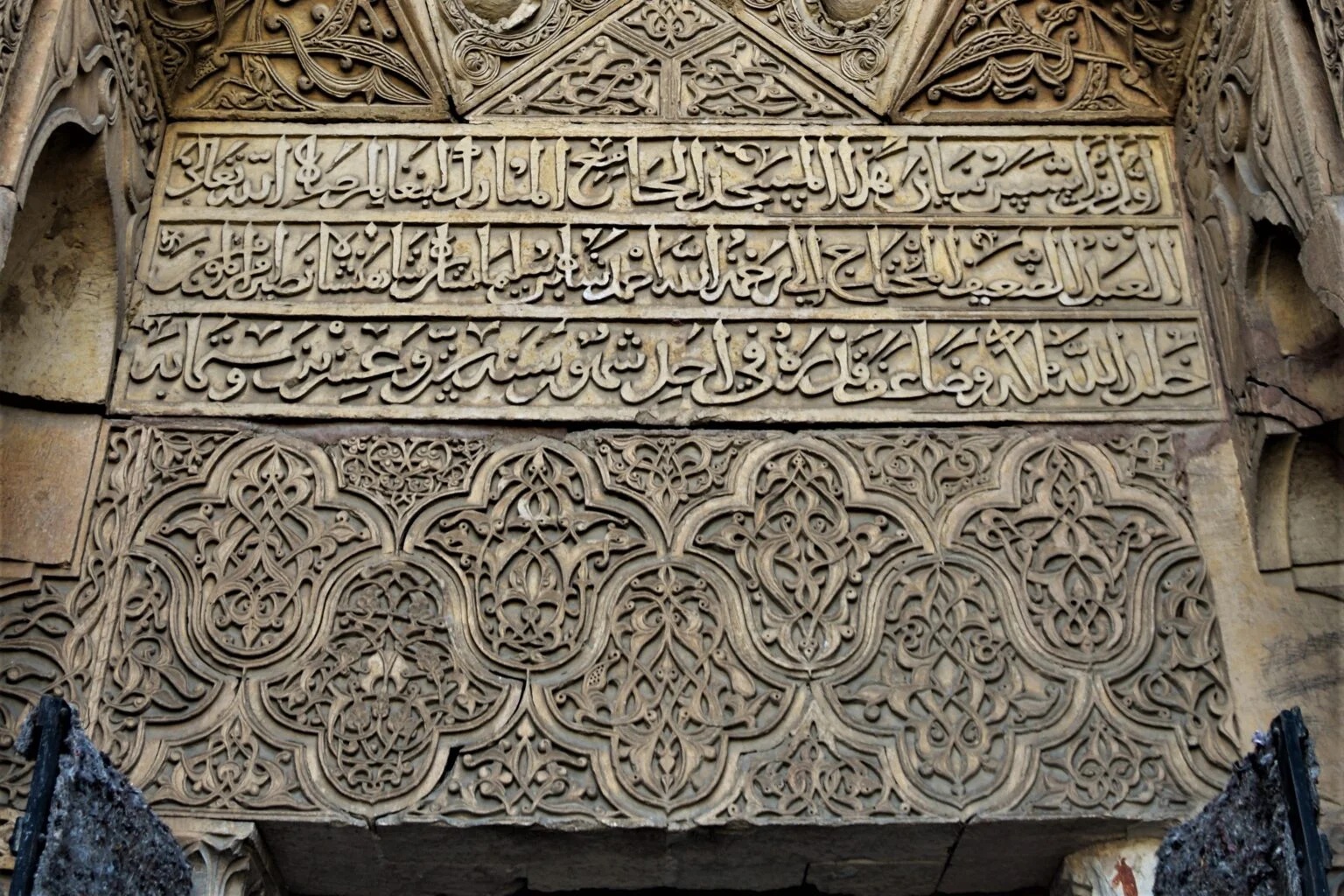
Calligraphy on the main entrance
Interior of the mosque, in addition, has spiritual-awe with soft light emerging from the carved windows and a lantern in the centre of the roof having imposing conical octagonal domes. The hypo-style prayer chamber, with groin-vaults have intricately carved tall columns and stalactite formations on brackets, give the feeling of majesty and serenity. The spectacular minbar to deliver sermon and mihrab, the prayer niche, are so marvelously carved that add grandeur to beauty.
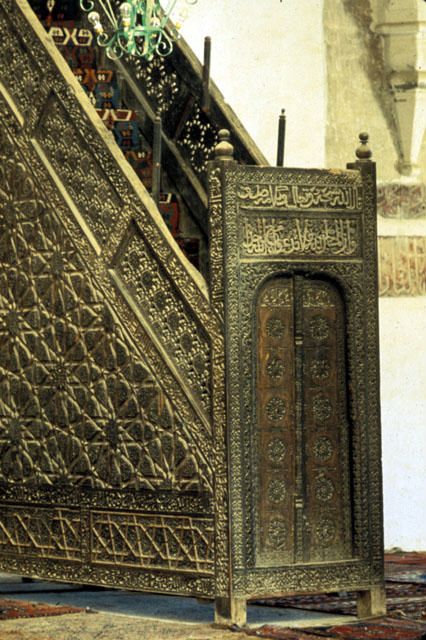
Minbar with inscription
Apart from the physical artistry, some astounding facts are attached with the mosque. The most amazing is a clandestine appearance of a human figure in the altogether non-figurative ornamentation. Among the two entrance portals on the western and northern sides of the mosque, the former that is the western one is covertly designed to generate articulating shadows of a human figure in different poses of praying. Silhouettes of a male or a female emerges that takes shape in different postures at various times of day, appearance of one at a time, but three different postures at different times, all seem to be immersed in religious reverence. Contemplating, praying, reciting a book and a fully clad female sitting in the position of folded legs in attahayat during namaz, make the western portal as the most spectacular of its kind. A little earlier than the namaz of Asar, a human shadow configuration appears on this entrance portal but after sometime it disappears. It is in the posture of saying namaz with folded hands, and just after a few moments it changes to the position of holding a book from its spine, while standing in a very humble way, as if reciting a sacred text. Book is also very realistically placed as half open, when held with four fingers under its spine and the thumb placed on the pages, a usual way to hold an open book in one hand while reading, but here it is like reverential recitation defined by the posture of the silhouette-figure.
Holding book
On the other hand, in early mornings from the opposite direction of the same portal another articulating shadow of a bearded man wearing a cap appears but without a book, standing submissively with folded hands, head and shoulders bent a little forward, the usual posture of saying Namaz. At another time of day, inside the spandrels of the arch of the same portal, there appears another silhouette of a fully clad female in veil, sitting with folded legs in the position of Attahayat while saying Namaz. It also appears to be an enthroned ruler to some of the spectators, majestically sitting on a high-pedestal throne.

Silhouette of fully clad women
Appearance of silhouettes of different human figures, all immersed in divine reverence is neither accidental nor a magical phenomenon but erudition of the creative brains, from the fields of science, mathematics, geometry, astronomy, art and architecture. It is recorded that for two years position of the sun and stars was studied, and after meticulous calculations direction of the mosque, its walls and carvings on the western portal were selected, and devised later. It resulted from the hybrid phenomenon not only of styles of adornments but the joint brain storming of scientists and artists concentrating on mathematical and geometric calculations brought into being something non-existent. It is said that the architect Hürrem Shah bin Muğis al-Hılatî after learning the entire studies and calculations of the scientists, initially experimented on plain walls to produce articulating silhouettes, by concentrating the position of sun, and after that with careful calculations produced this monument of unprecedented value.

Canopy of west portal
Furthermore, Divrigi mosque is a witness to many facets of history too. In the World War-II the treasures of Topkapi Sarayi were kept in a secret vault of Diivrigi mosque. In 1985 UNESCO added this edifice in the list of the World Heritage Sites.
You may also like: