Written by: Salma Chaudhry - Posted on: December 09, 2013 |  Comments | 中国 (Chinese)
Google Translation: اُردو | 中文
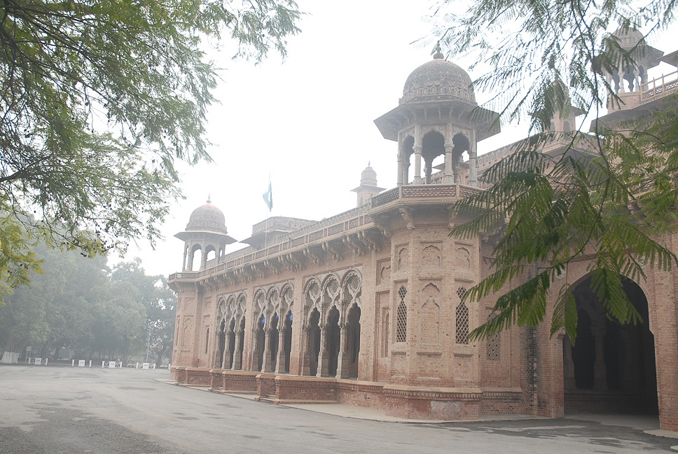
Colonialism emerged out of the desire of European countries to have unswerving political and economic control over the nations they wanted to rule. Education was one of the main ways to perpetuate their authority, and a foreign system that was inherently English in character was introduced in most British Colonies, including the Indian sub-continent. For the British command, one of the key motivating factors to institute the newly devised learning structure in the sub-continent was to assert its supremacy and extend the reign. The idea was to prepare an educated elite that would not only facilitate the smooth running of the organizational machinery of the Raj, but would also remain faithful to the mandate of the British Crown. These were the political and financial elite of the local population, and the opulence of architecture of the schools that were designed for them still depicts the living standard of the inhabitants. The sons of Rajas, Landlords, Sardars and Nawabs walked here in an atmosphere of extravagance and wealth bequeathed upon them as a reward for their allegiance to the Crown.
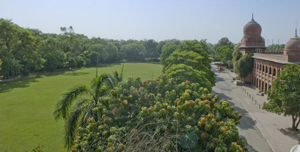 |
| Playing field in front of Gore Block |
This background information is to be kept in mind when one visits Aitchison College situated at the heart of Lahore. Walking past the campus, it’s impossible to keep your eyes off the gorgeous architecture and blossoming jade lawns located in an ancient city that already brims over with the picturesque Mughal and British construction. The design of the college, an amalgamation of British, Mughal and Sikh architecture, is incredibly striking: red-bricked campus buildings, attractively laid out gardens and lush green lawns that are at their finest during summer. The college is thus aptly known as the most beautiful college campus in Pakistan.
The Lahore Chiefs’ College, later named Aitchison College, was inaugurated on the 3rd of November, 1886 as an exclusive college for the elite or princely families. The idea was to train the royal sons of India to cope with the responsibilities that lay ahead of them as rulers of their respective states. This College was the third in line, the first two Chiefs’ Colleges being Rajkumar College in Kathiawar and Mayo College in Ajmer. Aitchison College was an expansion of the Wards’ School in Umbala, so that its scope could be amplified to include the rest of the province, and the city of Lahore, due to its location at the heart of Punjab, was unarguably the best choice to build such an institution. The proposal for the extension was put forward by Sir Charles Aitchison, the then Lieutenant Governor of Punjab and on 3rdNovember, the foundation stone of the main building was laid by the Viceroy, the Marquess of Duffer in and Ava, in a gathering of India’s nobility including the rulers of Kashmir and Bahawalpur.
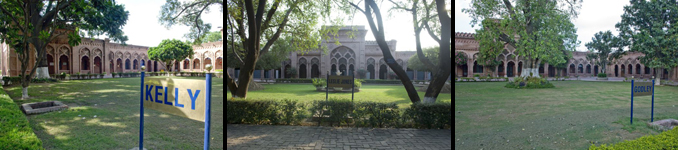 |
| Kelly House (Senior Boarding House) Leslie Jones House (day boy houses) Godley House (Senior Boarding House) |
The foundation stone can still be seen at the Old Building, which was the first structure of the school. Along with the main building, three boarding houses were also constructed as more funding came in. Kelly House was for the Muslims, Godley House for the Hindu and Sikh boys, and Leslie Jones House, added in 1888, was for the pupils paying reduced fees as well as those on scholarships financed by various districts. The names Kelly, Godley and Leslie Jones were accorded to the hostels to honor the role played by various principals, just as the college was named after its founder. Day scholar houses were added later. A mosque was built for the religious education of Muslim students in 1900, and a Dharamsala or mandir (Hindu temple) and a Gurdwara for the Buddhists were created in 1913. The mandir was revamped to hold the Principal's office after 1947. Religious education was made obligatory for Hindus and Sikhs. Till 1933, a rule existed that there should be separate boarding houses for Muslims, Hindus and Sikhs. However, from various accounts of the former students, it is evident that the college was the embodiment of complete tolerance and reverence for all religions. Religion began and ended inside the respective worship places, and students would never talk about each other’s religions outside their worship place. The boys were always expected to permeate a sense of tolerance towards other individuals and the curriculum was also designed with this in view.
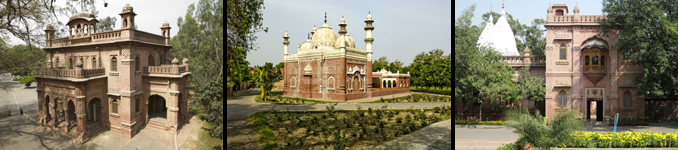 |
| Gurdwara Masjid Mandir |
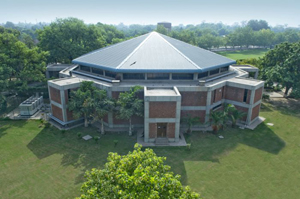 |
| Shamim Khan Hall |
The academics which began in 1886 were based on the British Public school system. Interestingly, the college still follows a British system, though a different one – Cambridge ‘O’ and ‘A’ Levels Examination to be precise. The Rajas were not to be taught for employment for they didn’t need any - they were already the born rulers of their lands - but to mould them into experienced administrators so they could serve the British intentions of ruling the masses. Aitchison College had a huge campus as compared to Umbala Wards’ Schools and to encourage the elite to enroll their sons at the college, Major General S. Black was commissioned as the first Governor General of the college. The institution, like all elite schools, soon produced in a body of pupils completely alienated from the common populace.
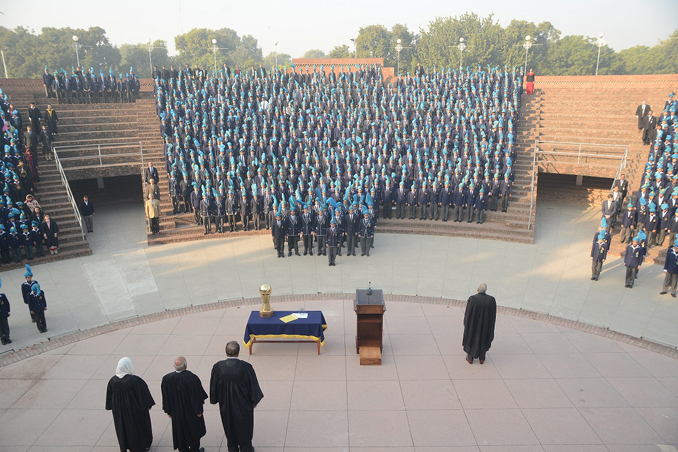 |
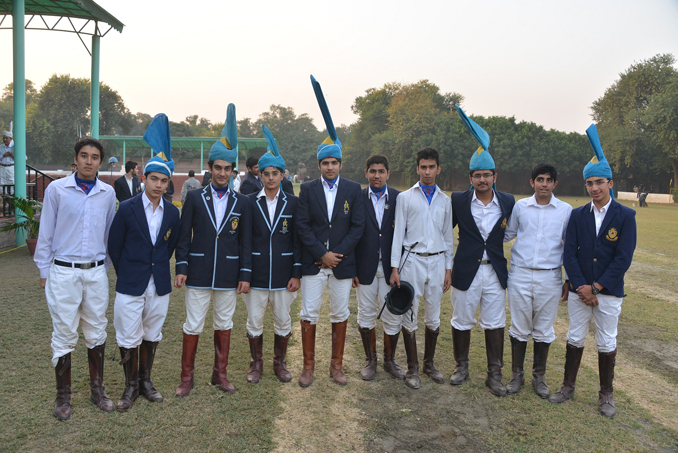
Of all the royal colleges, Aitchison is perhaps the only school which has kept its traditions alive to a certain degree. From the blue turbans that the students must wear at the morning assembly to the Chief Guest’s welcome by the equestrian squad on Founders Day, the college remains true to its age old customs. As one passes through the beautiful campus, two huge structures grab the attention; one is the Amphitheater and the other is the recently constructed Shamim Khan Hall. The college has the best sports facilities that any institution in Pakistan can provide. Moreover, spread over a land of 200 acres, the school has swimming pools, football fields, huge cricket grounds with pavilions, various hockey fields, beautifully constructed tennis, squash and basketball courts, as well as horse riding services with the college’s own stable.
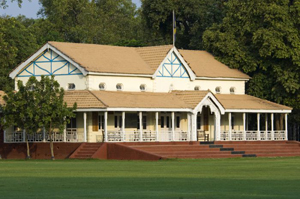 |
| Main cricket pavilion |
Aitchison College continues to serve as a learning house for the Pakistani elite and has maintained its status as the Chiefs’ College; amongst the graduates of the school to date, there have been many notable names including various Presidents, Prime Ministers, Ministers of State, Chief Ministers, National Hockey players and National Cricket players. But in the last few decades the trend has changed, and the college at the moment boasts diversity in the sense that many upper middle class families are now also sending their children to Aitchison.
Aitchisonians take pride in the fact that their college is one of the oldest institutions in the country, acknowledged nationally as a leading school for producing eminent leaders, entrepreneurs as well as sportsmen, and their sentiments are reflected in these lyrics of the college song:
 |
Humein jaan se pyara hai ye chaman
(These grounds are dearer to us than life)
Jahan hum ne seekha Ilm-o-fun
(Where we gained knowledge and skill)
Jahan hum huey Aitchisonian
(Where we became Aitchisonians)
Yeh inaam sab ki zuban pe hai
(This name is on everyone’s lips)
Humein fakhar apne nishan pe hai
(We are proud of our identity)
Information collected from the College Library archives and Commanding Success- Aitchison College (1886-2011)