Written by: Aleeza Rasool - Posted on: January 16, 2014 |  Comments | 中国 (Chinese)
Google Translation: اُردو | 中文
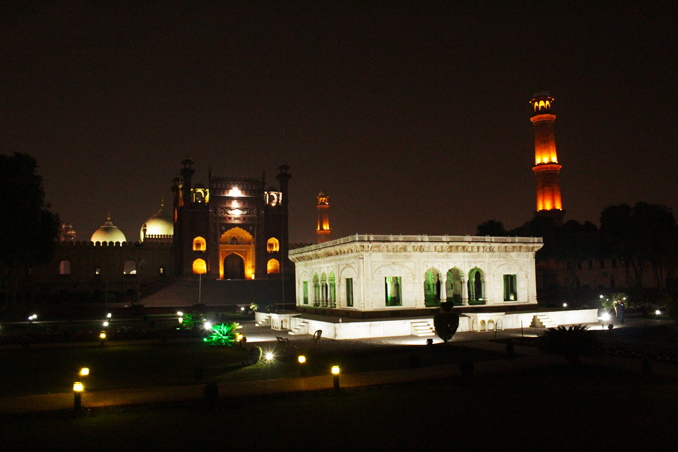
I have always been very fascinated by the beautiful garden located midway between the Alamgiri Gate of the Lahore Fort and the eastern entrance of the Badshahi Mosque. Surrounded by barbed wires and guarded by security personnel at all times, it had always given me the impression that it was closed for public viewing. However, this time I decided to be sure. Stepping over the barbed wire with my notepad and camera in hand I made my way to the security guard who had earlier been making hand gestures to me indicating that I was entering forbidden territory and was not allowed there. However, it did not take me too long to convince him that I was there for an assignment.
 |
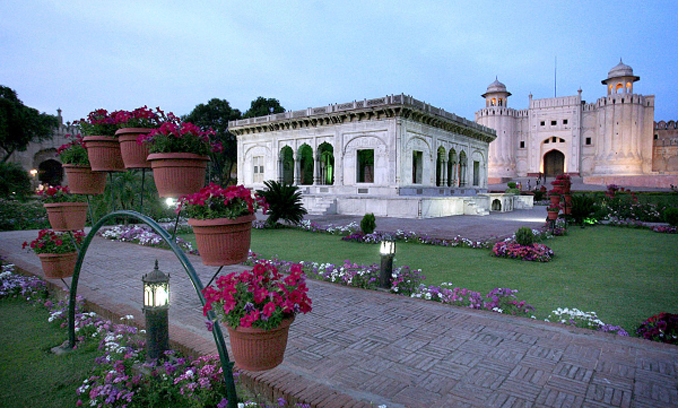
This rectangular garden is known as the Hazuri Bagh forms a sort of a basin between the elevated mosque on one side and the raised Fort on the other. The white marble structure located in its middle is known as the Hazuri Bagh Baradari or Ranjit Singh’s Baradari. It was constructed in the year 1818 under the orders of Maharaja Ranjit Singh.
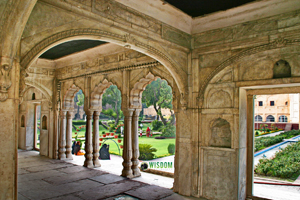
The word baradari literally meaning; ‘with twelve doors’ signifies a square structure with three entrances on each side, making twelve entrances altogether. The Hazuri Bagh pavilion, though it has more than three entrances on each side is still nonetheless referred to as a baradari, for the basic plan is nonetheless that one of the baradari. The side of the baradari which faces the Badshahi mosque and the one, which faces the Raushnai Gate, has four entrances, whereas the other two have five entrances. The baradari has been constructed on a raised platform with two sets of stairs providing access from each side. The façade of the baradari has been totally rendered in white marble, which was gathered by plundering various Mughal monuments in and around Lahore. The ornamentation technique used on the façade is mainly relief work (A decorative technique where stone or wood is carved out to create images), with jaliwork being employed in places. Elaborate arches have been carved out on the exterior of the baradari. These arches boast delicately rendered images of fruit dishes, vases and peacocks. Again, all of these have been done in relief. Moving into the baradari one sees that the baradari has a central portion and an outer portion. Sixteen beautifully ornamented pillars or columns, divide the central portion of the baradari from the outer one. Three archways on each side lead from the outer section into the central section of the baradari; thus it can be said that another baradari is enclosed within the main baradari.
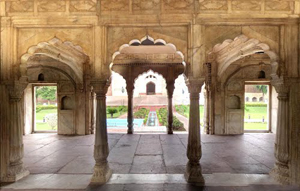 |
The ceilings within the baradari have been made out of plain planks of wood, except for the ceiling of the central portion of the baradari; which has been beautifully rendered in Sikh period ainakari (mirror work).The flooring within the baradari in similar fashion to the ceiling; has not been laid out in white marble; rather, it has been made out of stone. The reason for this was a shortage of white marble left for the construction of the baradari (Laal).
The area occupied by the Hazuri Bagh and the Hazuri Bagh Baradari has been historically very significant. Following the construction of the Badshahi Mosque under Aurangzeb’s rule; this area used to serve as the serae of Aurangzeb (Latif). Later years saw the conversion of this low flat area turn into the Hazuri Bagh under the orders of the Sikh ruler of Punjab; Maharaja Ranjit Singh. Sohan Lal Suri records that this garden was laid out at the orders of the Maharaja at the beginning of the new Bikrami year 1870 and expert gardeners were engaged for the purpose of laying it out (Naeem). A number of historians also say that Ranjit Singh ordered the garden to be laid out after he had confiscated the Koh-i-Noor diamond from Shah Shuja around the same time (Khan).The marble baradari within the garden’s centre was constructed five years later; that is in the year 1818 (Aijazuddin). Lieutenant William Barr who visited the Hazuri Bagh twenty years later gives a detailed account of what he saw:
In the centre of this square, which is laid out in gardens and terraces, is an elegant little building, erected by the Maharaja…The lower apartment is fourteen feet square, ornamented with looking-glass, gilding, and colours, most harmoniously blended and extremely rich. Light is admitted through Saracenic arches on pillars, and a verandah, eight feet broad, with a ceiling embellished in the same style of profusion, encompasses the whole, which is built on a chabootra some four or five feet above the ground. We ascend to an upper floor of similar size and shape, but even more beautifully and gorgeously ornamented; the four doors being decorated with ivory, inlaid in various devices, each being different from the other and all arranged with much taste. There is an apartment underground, where the Maharaja takes refuge from the hot winds and during the hours of recreation admits a few of his intimate friends (Aijazuddin).
 |
Robert Montgomery calls the Hazuri Bagh baradari the architectural chef d’aeuvre of Ranjit Singh’s reign (Montgomery). Within this baradari, Ranjit Singh used to sit in state and transact the business of the empire with his ministers and his sardars. Later, Maharaja Sher Singh, son of Ranjit Singh and Rani Mehtab Kaur, enjoyed the gilded pavilion for his not entirely private amours (Aijazuddin) as he used to hold his court and exhibit his state here (Latif). When the British assumed control of Lahore, they made this pavilion a bandstand from which music was played regularly on Sunday afternoons (Aijazuddin). Following on, the upper storey of the pavilion collapsed suddenly on the 19th of July, 1932. The debris was removed to the Fort and since that time it has been reduced to a single-storied level (Aijazuddin).
Often accused for lacking taste (Montgomery 107), Sikh period architecture did not have much to boast in terms of architectural achievement unlike the Mughals. But, despite this fact Ranjit Singh’s Baradari or the Hazuri Bagh Baradari stands proud amidst the Imperial Mosque of Lahore and the Lahore Fort as a reminder of the glorious rule of the Lion of Punjab. Presently, it is one the few structures within old Lahore, which are meticulously preserved and guarded. At nighttime it is lit up with green and blue lights; which make its white walls shine in the darkness of the night.