Written by: Amna and Yaver - Posted on: August 29, 2013 |  Comments
Google Translation: اُردو | 中文
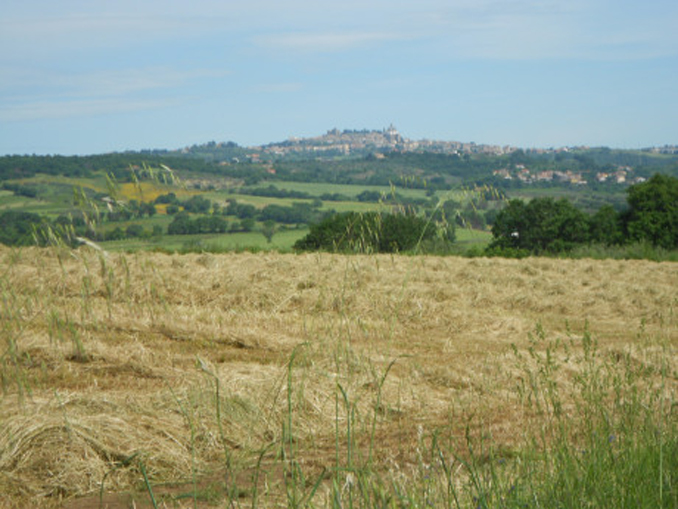
After the spectacular scenery of Tuscany and the region around Lake Bolsena, we were worried that Lazio would be relatively boring, especially after we had left the scenic crater lake of Bolsena. It was different, in some respects a lot more like northern Europe than Tuscany, but far from boring. The journey was much enlivened by the addition of our son Afzaal to our walking party, having just finished his final exams; he joined us on the 15th in Viterbo and brought a young man’s energy, a fresh pair of eyes and his capacity for enjoyment to us.
Viterbo
After a steep descent from Montefiascone, the walk to Viterbo was through gently rolling countryside. The fields were full of young wheat and potatoes, but interestingly, we saw fields of golden hay being harvested into large bales, giving a late summer feel to the countryside. Much more of the countryside in Lazio lies fallow, more of it is used for hay presumably to feed livestock and for the first time we saw drip and sprinkler irrigation in the fields. I was surprised to see extensive drip irrigation in olive groves – I had always assumed olives were a hardy dry-region plant, but perhaps the varieties in Lazio are different.
 |
While Yaver was walking down the hill from Montefiascone, I was going to take the bus to Viterbo, a mere 20 minute bus ride away. After waiting for the bus for an hour and a half, I had my first hitchhiking experience, without even sticking my thumb out! Apprehensively I sat in the car, first checking with Yaver if it was ok to do so! With my very limited Italian, and the old gentlemen’s non-existent English I found out that he was an ex policeman, and now was a farmer. All this while I was desperately telling him that my husband is walking and texting Yaver the make and model of the car! Thankfully saw Yaver’s green shirt about 2 km from Viterbo, and I literally jumped out of the car, shouting that is my husband!
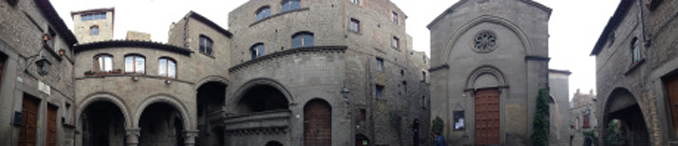
Viterbo is the capital of Lazio and has been a serious competitor to Rome as the centre of power in the past. When Rome was unsafe in the past, several popes located themselves in Viterbo, about 100km away, creating a second seat of power. A large city with universities, military facilities and industry, the old city of Viterbo is walled, and within it lies the neighbourhood of San Pellegrino, an almost intact fully preserved medieval town. We really enjoyed walking through its narrow streets. Buildings here have a greyer, less colourful appearance than in Tuscany, giving a sombre medieval feel to the town.
We had a memorable meal in a small, but highly imaginative restaurant run by chef Stefania Mancini. Amna had a black truffle risotto with a dollop of coffee gelato; the combination of coffee and truffle flavours was amazing. I had a vegetarian spaghetti carbonara with zucchini and Afzaal had a zucchini risotto with saffron and a salmon gelato, also incredible. All this may sound a bit precious, but the flavours were spectacular and the meals were filling.
It was here that we were introduced to the olive oil of Vetralla (a town we passed through later). It was sweet, fruity and lacked the bitterness and peppery taste of most of the other olive oils we tried. We savoured this olive oil another couple of times and resolved that we would buy some to take along. We then found that we couldn’t procure it anywhere outside the narrow region, in fact in Rome, we found people saying ‘Vetralla, where’s that?’ We will try and order some on line, but are also wondering if we can bring this wonderful local olive oil to the Dubai market.
Vetralla and Cura
We all walked together from Viterbo to the next stop Vetralla. There were several memorable things about this walk. At the start we followed several kilometres of secondary roads gouged deep between vertical walls of tufa, a soft rock formed from volcanic ash with embedded larger chunks of pyroclastic material. The rock can be cut like cheese and with an eye to economy, the road builders had cut a notch up to 10m deep with vertical sides.
 |
We were accompanied for 3km of this 18km walk by a lovely basset hound that would run ahead and wait for us barking encouragement for us to catch up. He seemed to know the pilgrim route, was completely at ease with us and really enjoyed his long morning walk with us before heading back home.
It was also on this walk that we entered what we believe to be one of the largest hazelnut growing tracts in Italy. We encountered dense hazelnut groves for the next 30-40 km. Next time you eat Nutella, it could well have come from here.
We actually stayed in a small town on the outskirts of Vetralla called Cura. Located on the crossroads of the Via Cassia. A lively little town with a very active central square. One of the funnier sights was that of the local community policeman shrilly blowing his whistle at cars parked in the wrong places, being summoned over by an elderly gentleman or lady who reminded him that they had known his grandparents and him since he was born. Needless to say no one took notice of his whistling and posturing with his notebook, but it all continued in a spirit of good fun.
Sutri
On our way from Vetralla to Sutri, we stopped for lunch of rosetti (see next post), cheese, pears and sardines next to a railway embankment. It was a quiet farm track and since everywhere else was damp, we chose to set our picnic out on the concrete pavement. As soon as we’d set everything out, this quite road seemingly became a major thoroughfare with farmers emerging from nearby fields, the railway underpass and all sorts of other directions, generally in Fiat Pandas, causing us to have to flag them to slow down, to move our picnic back and forth and generally wonder whether they had been hiding in wait for us.
Under Afzaal’s leadership we took a scenic alternative for the last few km of the route. We walked through an area of dense forest, with overgrown tracks, where apparently no one had walked for months or years. The tracks were overgrown with thistle and nettles and required much adroit footwork to navigate. It was a truly beautiful natural woodland environment in a valley between steep cliffs a stream and waterfalls along the way. Amna found dodging the thorns and nettles difficult because of her knee, but we all found it to be a very special treat. We later found out that it is a European protected environmental area of archaeological importance and may even have been closed off to the public. We are very lucky to have seen this virgin, native woodland!
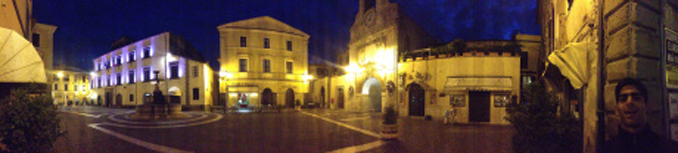 |
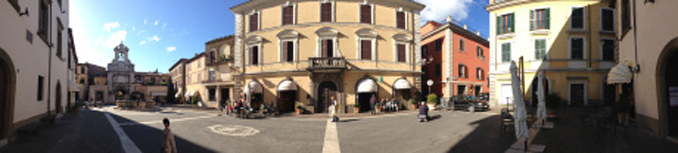
Sutri itself was a beautiful town, its central square had a picture book quality. As soon as we entered it, we felt a magnetic attraction and resolved that we would spend much of our time in that square. And we were not disappointed; from mid-afternoon until the evening, we saw the changing moods and uses of the square which acts as community centre in these small towns. Everyone gathers there at some time or the other. In the afternoon, mums sat at the bars enjoying coffee and gelato, while children played nearby in the marvellous offices of the Comune building courtyard, which contained the characteristic bee-emblem of the Barberini family. In the early evening, men gathered in groups all around the square, talking, sharing news and gossip, more fashionable ladies were there also but the mid-afternoon mums had gone home to make dinner. At around 7.30 the crowd thinned as people went off for their dinner. We got a recommendation from a gentleman with a lovely dog wearing a Harrods collar and leash, who had sat quietly watching the crowd like us – his recommendation was excellent and we had a memorable meal that evening.
The mood of the square was set by the changing light over the course of the afternoon and through to sunset. Perhaps the photographs below give an idea of how it changed. As the sun moved, people outside bars moved their chairs and tables around to catch the sun, it was like a minor tide of movement that happened almost imperceptibly.
Sutri is also home to some marvellous Etruscan remains that are in a poor state of repair. These include a an underground church, that was at one time a Roman temple to the Persian god Mithraeus and before that an Erruscan burial chamber. There is also a marvellous little amphitheatre and many other tombs carved out of the Tufa.
Some say that Sutri was the birthplace of the legendary Paladin Orlando (also known as Roland in northern Europe), for his mother Bertha, sister of Charlemagne, gave birth to him there on her way to Rome. Great poems were written about these mythical individuals ‘The Song of Roland’ in the thirteenth century and ‘Orlando Furioso‘ in Italian in the sixteenth. Orlando was the leader of twelve extraordinary knights known as paladins who on behalf of Charlemagne variously re-captured Rome, Constantinople and Palestine. Orlando, the leader of this group, fell in love with the pagan princess Angelica and, his madness (Furioso) arose from the fact that his love was unrequited.
Talking to the representative of the municipality, we were struck by how little publicised this little town is, even though it is less than an hour from Rome.
Link to Amina's blog: http://amnaabidi.wordpress.com/2013/05/25/walking-central-lazio/