Written by: Sirat Gohar Daudpoto
Posted on: March 31, 2026 |  | 中文
| 中文
Remain of a Mauryan era city at Bhir Mound in Taxila. Photograph by Hanifullah Khan.
The Greek rule was halted in territories around the Indus as a result of violent conflicts and geopolitical disturbances which occurred in the region after Alexander’s death in 323 BC. And finally in about 321 BC it was taken into control from Greeks by an Indian ruler Chandragupta Maurya and was made part of the Mauryan empire. Chandragupta became the king of India by overthrowing Nandas from Magadh, which was then the seat of power, around 322 BC. Within a few years, he succeeded to establish rule over a vast territory of the subcontinent. At its zenith, particularly during the reign of Ashoka the Great, the Mauryan empire covered almost the entire subcontinent, from Bangladesh in the east to Afghanistan and Pakistan in the west. It was the biggest Indian empire of local origin ever existed in the history of the region.
Map of the Mauryan Empire (c. 321-185 BC). By Simeon Netchev. World History Encyclopedia.
The Maurya, like the Achaemenid, also divided this region into different provinces and appointed governors. Their system of governance, administration and civil and military structures are clearly stated in historical treatise titled Arthashastra authored by Kautilya Chanakya, who is believed to have aided Chandragupta to become the king by deposing the Nandas. The state affairs of the Maurya empire were largely run according to Chanakya’s ideas, although there were made innovations and adjustments by some rulers owing to different social and geopolitical factors. With respect to the Indus region, Ashoka’a policies and the developments which took place during his reign points to this fact. However, the Achaemenid inspiration is very obvious in his socio-political activities in this part.
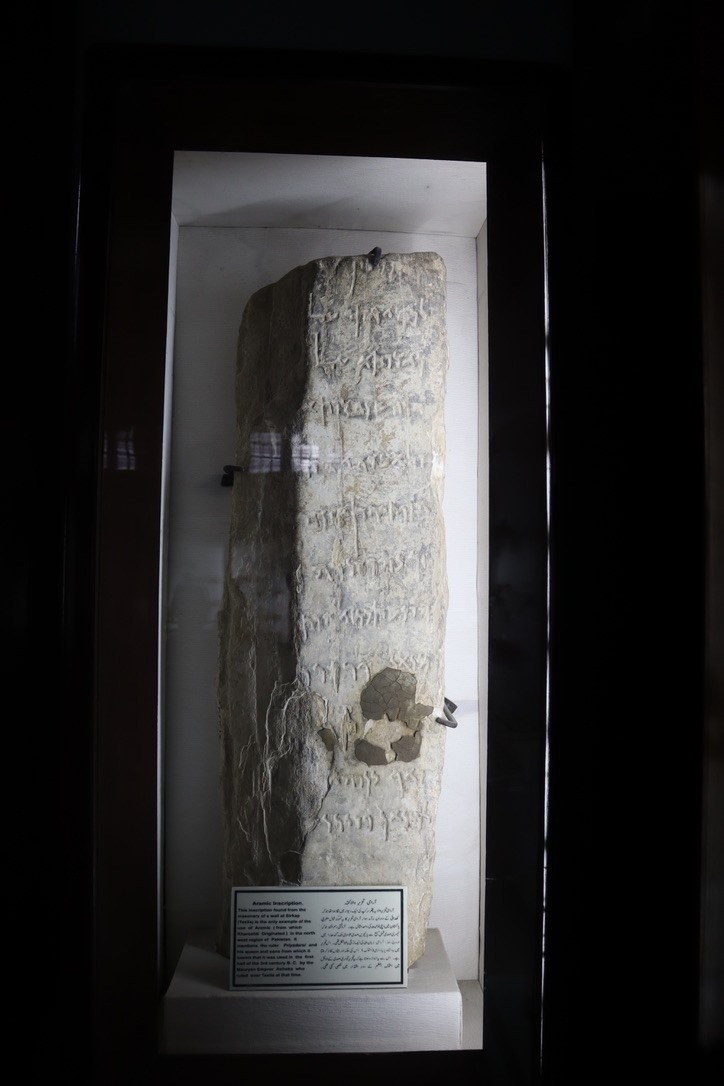
Aramic Inscription of Ashoka the Great (third century BC) found at the ruins of Sirkap in Taxila.
Ashoka put rock edicts on highways and at important localities on the same pattern of the Achaemenid royal inscriptions. He also invented the Kharoshthi script which was developed from the Aramaic script and introduced it in the western provinces of his empire. Moreover, another worth mentioning work to the credit of Ashoka was the advocation of Buddhism. As we know that he was a great follower of the Buddha and his teachings, he devoted himself for the cause of Buddhism. As part of his wider campaign for the propagation of the Buddhist faith, he also erected stupas containing the relics of the Buddha and put inscriptions and sent missions to preach the teachings of the Buddha in the region. On the other hand, Ashoka also encouraged other religious order such as Jain and Ajivika.
The Maurya emperors integrated the Indus country with the Gangetic world, through military, political and religious interventions. It remained under their control, for nearly one hundred and forty years, until circa 184 BC, when the commander of the Mauryan army Pushyamitra Shunga assassinated the dynasty’s last monarch Brihadratha Maurya.
Remains of a Mauryan period Buddhist stupa at Butkara in Swat.
Pushyamitra’s rise to power marks the foundation of the Shunga empire, which held sway over this region for about three decades. Shungas brought chaos to this country. Pushyamitra was a Brahman and one of main objectives was the revival of Brahmanism. He destroyed Buddhist establishments including stupas and monasteries all across the region, and built Brahmanical temples and other monuments. Shunga rule in the region was very destructive both socially and culturally. This must have provided grounds for invasion by the Indo-Greeks, who already present in the northwestern parts of the country. The Indo-Greeks were the people who came here with Alexander the Great and established themselves in Bactria. They captured the Indus country from Shunga and ruled here for about two hundred years till circa 10 AD.
You may also like: