Written by: Saram Maqbool
Posted on: December 04, 2025 |  | 中文
| 中文

The Kitchen Garden at Vision Pakistan
The Aga Khan Award for Architecture is one of the most prestigious titles an architect can hope to achieve. While there have been numerous winners in the past, it was Ar. Nayyar Ali Dada who represented Pakistan in the extensive list, having won the award for his Alhamra Arts Council in Lahore. This year, however, another architect whose work I have personally admired ever since I got into architecture myself has been bestowed this immense privilege. The architect is Saifullah Siddiqui, known for his DB Studios, and the project that’s given Pakistan this honor is Vision Pakistan.

A view of the Vision Pakistan building
At first glance, Vision Pakistan seems odd in the context in which it is placed. That is exactly why I personally enjoy its design. It’s located in the densely populated Ghauri Town in Islamabad, surrounded by monotonous blocks of concrete and brick. The location was chosen to ensure maximum ease of access via public transportation, since the building caters not to those who have the means to travel in their own vehicles, but rather those who have dealt with or are dealing with aggression, crime, depression, or drug use. The building, therefore, is more than a pretty picture – it is a vocational institution that gives men aged between 16 and 25 a second chance by teaching them tailoring, enabling them to improve the quality of their lives.
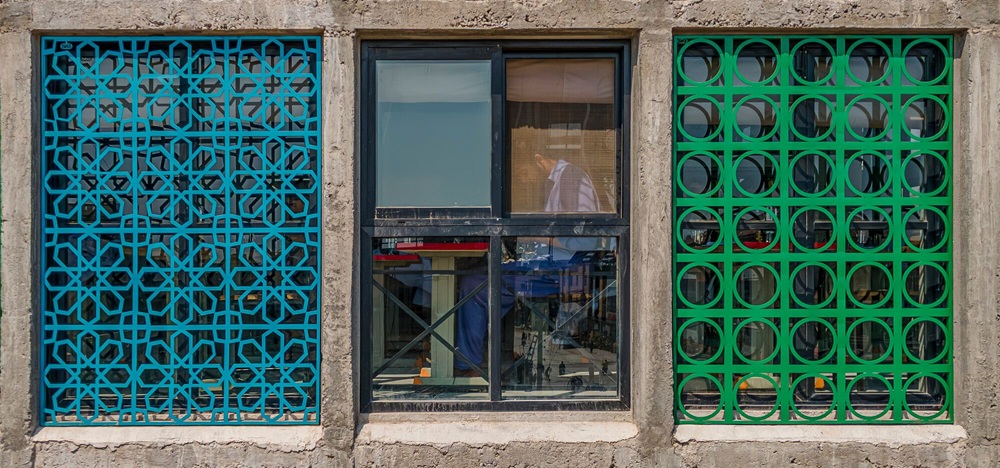
Metal screens inspired by local patterns
While the building does stand out in its context, it is not inherently flashy by any means. It’s conceived as a simple block of concrete with colorful screens covering most of the openings in its very geometric grid of columns and beams. These screens are not all the same, but follow a set of patterns that are inspired by either traditional jaali screens seen in the historic architecture of Islamabad or by certain Pakistani and Arab motifs. The colors used are taken from the neighborhood’s vernacular culture to bind the new structure into its context. Siddiqui chose to use exposed concrete as the primary construction material due to its ability to naturally change with time, as opposed to using something that would require regular maintenance. The result is a structure that showcases a fusion of modern, contemporary materials and the richness of traditional crafts, and of bare concrete walls accompanied by the festivity of bright colors that add life to both the exterior and the interior.

A fusion of modern and traditional architectural features.
The use of screens does more than just make the building look interesting. It also allows the building to breathe by bringing in natural light and air, but not so much that it would render the interior spaces unusable due to the harsh heat. There’s a central atrium that revives the courtyard effect of ancient havelis, taking all the hot air upward and out through ventilators. This use of passive energy-efficient methodologies is typical of DB Studios’ work. The layout of the facility is equally important. It is designed to accommodate 40-50 students along with tutors and management. There are five classrooms, designed with flexibility in mind so that new programs or uses may be added later on. The building also contains exhibition areas, offices, recreation spaces, a prayer area, and a kitchen garden maintained by the students. A central atrium connects all the different levels not only physically but also visually. Corridors are designed not only to provide circulation but also to be spaces of encounter, informal learning, and display.

The screens filter light while providing visual connectivity with the outside.
But more than any of this, the success of this project is measured more by its programmatic empathy. Siddiqui’s work has mostly revolved around human dignity rather than aesthetic novelty. His practice focuses on creating spaces that function well, first and foremost, while the form naturally develops. This is clearly visible in Vision Pakistan’s spatial connectivity. Classrooms sit next to workshops, while exhibition nooks let students showcase their work, and retail spaces connect formal training to real economic channels. The architecture of the building, therefore, becomes a device for economic activity. Its use of perforated screens encourages engagement between the building’s users and the context outside, breaking away from the sealed, separated institutional architecture of Pakistan. All this is what makes the design worthy of recognition by the Aga Khan Award’s jury, which has long recognized and celebrated the value of architecture that can strengthen the social fabric and not just create spaces that look and feel good.

Inside Vision Pakistan
Vision Pakistan is not just an isolated design exercise either. It encourages collaboration between charities, educators, and municipal bodies. The project’s program emerged from conversations with the community that it would ultimately serve. Its operation depends on strategies that are replicable. This is essential for long-term scalability, which differentiates Vision Pakistan from other socially oriented architecture that is celebrated at the moment of commission but later collapses under the burdens of maintenance and changing priorities. Safiullah’s design suggests that design must anticipate these constraints from the start.
If the Aga Khan Award has a habit of recognizing projects that connect architecture to cultural continuity, social inclusion, and environmental responsiveness, Siddiqui’s Vision Pakistan aligns perfectly. The project’s modest scale and measurable social outcomes offer an argument about what contemporary architecture can be, responsive, durable, and socially generative. For Pakistan’s architectural conversation, Siddiqui’s recognition signals a maturing of values: that the most consequential projects are often those that remodel daily life rather than skylines.
You may also like: