Written by: Muhammad Hamza
Posted on: November 24, 2025 |  | 中文
| 中文
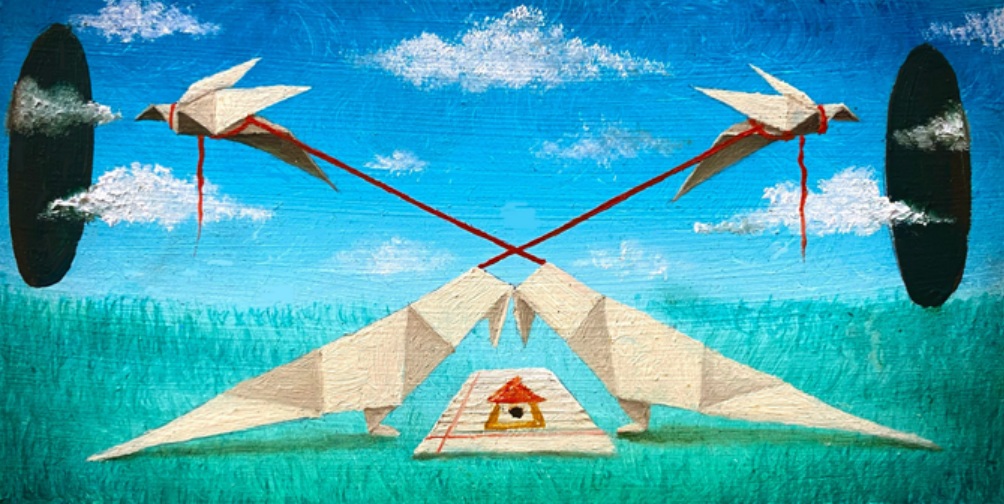
The red roof by Nabiha Gillani
In the heart of Lahore’s bustling art scene, Artsoch Contemporary Gallery opens its doors to “A Palm-Sized Universe,” a captivating group show curated by Samina K. Ansari. Running from November 21 to 28, 2025, this exhibition invites visitors into a tiny yet vast realm, where five emerging Pakistani artists transform the ordinary into the extraordinary. Drawing from the curator’s vision of a “digital phantom made real,” the works explore how our hands—tools of creation and distraction—hold desires, memories, and quiet rebellions. Confined to the scale of the palm, these pieces whisper warnings about love, loss, and the alchemy of attention in a distracted world. It’s a gentle revolution, urging us to pause and see the poetry in what we grasp daily. The result is a tender, thought-provoking display that feels both personal and universal, like secrets shared in a crowded room.
The show gathers Fatima Bukhari, Hamza Bin Faisal, Mudasir Chandio, Nabiha Gillani and Zaid Baloch—young talents whose practices blend tradition with bold innovation. Their contributions form a dialogue on prosthesis: extensions of the self that bridge the physical and the fleeting. As Ansari notes, these are not mere objects but mirrors reflecting our luminous, knowing grip on reality. Wandering through the gallery, one senses a shared intimacy, where upcycled scraps, painted screens, and layered oils become portals to inner landscapes. The exhibition’s strength lies in its restraint; each piece demands close inspection, rewarding the viewer with layers of emotion and craft.
Fatima Bukhari, a Bahawalpur-born interdisciplinary artist with a focus on sustainable design, reimagines discarded hardware as wearable poetry. Her work challenges ideas of luxury, turning industrial leftovers into symbols of comfort and unease. In “Forged Elegance,” Bukhari crafts a bracelet from nuts and wires that drapes like a chain of whispered secrets. The metallic forms interlock with a raw, unpolished grace, evoking the tension between strength and vulnerability. Each nut, once a forgotten fastener in some machine, now hugs the wrist like a lover’s hesitant touch—cold yet reassuring.
The wires twist subtly, catching light in fleeting glints that mimic the unpredictability of human connection. The uncertainty of that latch calls a sense on its own, It’s a piece that wears its history on its surface, reminding us how everyday junk can forge something elegant and alive. Bukhari’s touch transforms the brutal into the beautiful, inviting the wearer to confront the discomfort of adornment while celebrating its quiet power.
Equally compelling is “Grip of Grace,” where hardware nuts and jewelry wire form a cuff that grips without harm. Here, the forms cluster like gathered thoughts, their hexagonal shapes echoing the geometry as if it’s been woven through. The wire weaves through the nuts in delicate loops, creating a surface that feels both armored and exposed.
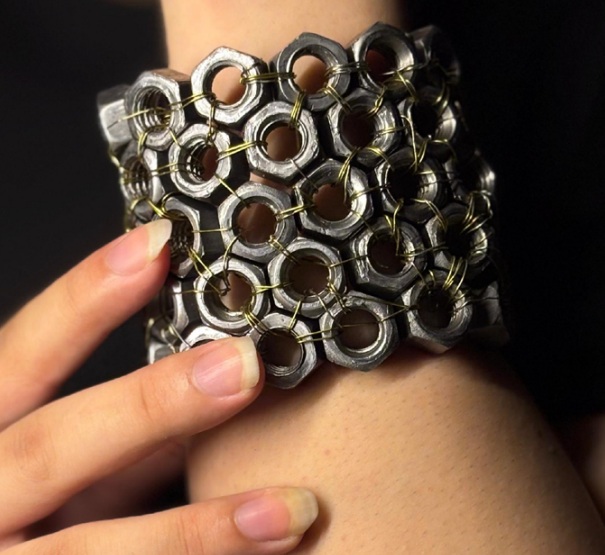
Grip of Grace by Fatima Bukhari
As it rests on the skin, the piece shifts with movement, its edges softening the boundary between body and object. Bukhari’s genius shines in this subtle play: the cuff doesn’t overwhelm but holds space for reflection, much like a hand paused mid-gesture. miniature wires are like subtle whimpers at times; they create more character to the piece. Through these works, she breathes new life into the overlooked, proving that grace often hides in the grit of the discarded.
Hamza Bin Faisal brings a painterly tenderness to the digital age. A Lahore-based miniaturist who graduated with distinction from the National College of Arts, Faisal runs a studio fostering love for contemporary miniature painting while experimenting with mixed media. His opaque watercolors capture the quiet poetics of home and belonging, turning handheld screens into sites of reflection.
In “Home.Screen. I,” Faisal paints a dark expanse pierced by faint text: “Home is where the heart is, but my heart is wandering.” The words float like ghosts on a black ground, their letters dissolving into the void as if typed in a late-night message left unread. Subtle gradients of navy and indigo evoke the glow of a phone screen in dim light, blurring the line between presence and absence. The answering tone creates that void of emotion; the contrast between the gentle reminder & a reality check is just that reminder fades, a check stays. It’s a meditation on unsettled states, the painting’s luminous surface flickers with unspoken longing, drawing the eye deeper into its emotional hush.
Faisal deepens this theme in “Home.Screen. II,” where urban silhouettes emerge from a starry haze of wires and windows. Silhouetted buildings huddle under a web of power lines, their lights twinkling like distant memories. A white square frames an empty space, perhaps a missing window or a paused video call, heightening the sense of suspended time. The gouache layers build a tactile slowness, mimicking the scroll of a feed that never quite satisfies. Faisal’s brushwork is intimate, each stroke a bridge between archive and mirror, inviting us to question what we hold in our palms: faith or innocence?
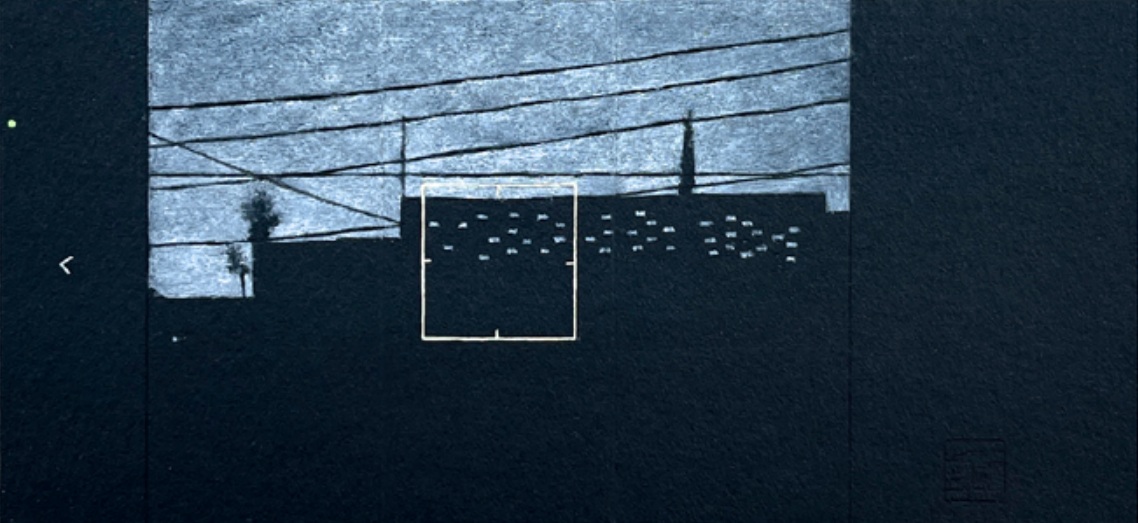
Home.Screen. II by Hamza Bin Faisal
Together, these pieces refract the handheld world, turning fleeting digital moments into enduring material presence.
Mudasir Chandio, an artist from Hyderabad Sindh who completed his BFA at Beaconhouse National University, delves into philosophical inquiries through textured oils. Living between Lahore and Mirpurkhas, his practice probes the politics of space and transformation, stripping away visual language to reveal interconnected ideas.
Chandio’s cement casts become canvases for existential musings, grounding abstract thoughts in raw, earthly forms. “You are not the sky” - presents a vast blue expanse cracked like parched earth, oil bleeding into the cement’s porous surface. Swirls of azure and white suggest endless heavens, yet the medium’s weight anchors them to something finite and flawed. It’s a reminder of impermanence—how we chase boundless ideals only to confront our grounded limits.
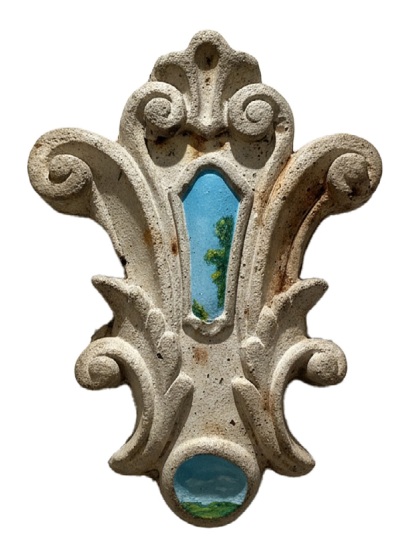
You are not the sky by Mudasir Chandio
In “Part of us I,” Chandio layers earthy tones on a tile, forming fragmented figures that merge with their surroundings. Human forms dissolve into geometric patterns, their edges blurring like half-remembered dreams. Browns and grays dominate, evoking soil and stone, while hints of red palpitate like hidden heartbeats. The work speaks to shared histories, where individual stories bind with a collective memory, much like roots beneath the surface. Chandio’s subtle buildup invites touch—fingertips tracing the tile’s cool relief, feeling the alchemy of paint and cement. These pieces, with their stripped-back narratives, challenge us to see beyond the self, embracing the transformative power of what binds us.
Nabiha Gillani, emerges as a voice folding language and light into origami-like structures. Her oils on lasani board capture fleeting architectures of emotion, blending narrative with abstraction.
In “STACKED,” Gillani piles forms in earthy stacks that teeter on the edge of collapse, oils in ochre and sienna building a precarious tower. Each layer suggests accumulated burdens—books, memories, or unspoken words—rendered with a buttery thickness that conveys both solidity and strain. The composition tilts slightly, mirroring life’s imbalances, It’s a portrait of resilience, where the stacked elements hold firm against gravity, much like the mind’s effort to organize chaos.
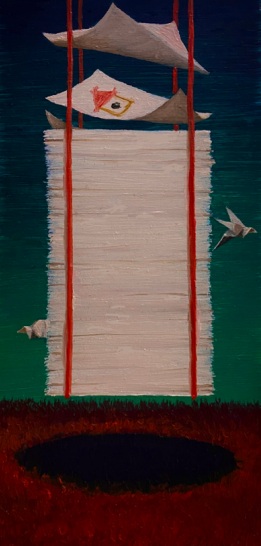
STACKED by Nabiha Gillani
Gillani’s “Grapevine” vines organic lines across the board, tendrils of green and purple twisting in a dance of growth and entanglement. The oil flows freely, pooling in vine-like curves that evoke whispered rumors or neural pathways. Leaves emerging in halves, their edges feathering into the background, symbolizing connections that nourish yet deteriorate, The warm undertones ground the whimsy, the depth carries its own charm in there; feels incomplete but turning a simple motif into a rumination on community and isolation. Through these works, Gillani folds the intangible into tangible form, her brush a tool for unraveling the folds of daily existence.
Zaid Baloch infuses the show with surreal dreams projected onto canvas. Based in Lahore, his oils trace retinal afterimages of nature’s fury and calm, blending the organic with the otherworldly. “Burning tree” ignites a lone trunk in flames of crimson and gold, branches clawing at a smoky sky. The fire licks upward in furious strokes, yet the tree stands defiant, Baloch captures the raw energy of destruction as rebirth, the heat palpable in every hue. It’s a gentle call to witness transformation—not as loss, but as vital force surging through the familiar.
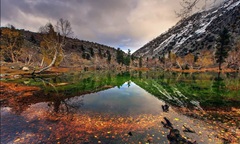
In “Green Oasis,” Baloch shifts to serene depths, a verdant pool shimmering amid arid surrounds. Layers of emerald and lime build a watery refuge, reflections rippling like hidden oasis in the mind. Subtle drips suggest movement, the canvas alive with the promise of renewal. Baloch’s touch is dreamlike, projecting inner visions onto outer forms, where drought meets abundance in harmonious tension. Reminding us that even in miniature, the surreal holds space for wonder.
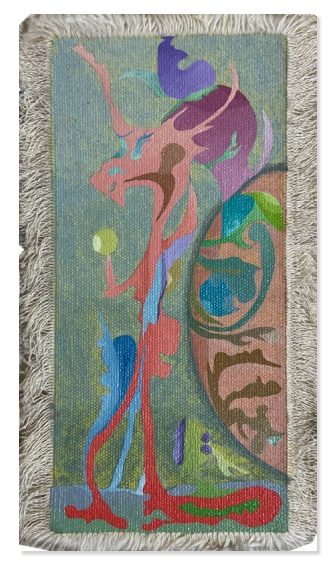
Green Oasis by Zaid Baloch
“A Palm-Sized Universe” succeeds as a quiet manifesto against distraction, the reality checks by each one them has a superset vibration. its Ansari’s curation weaves these voices into a coherent narrative that makes the call.
In an era of endless scrolls, the show demands we hold still, palm open, to rediscover the worlds we already carry. It’s not just art; it’s a gentle uprising of attention, leaving viewers with hearts a little less wandering, a little more home. cause home is where the heart is, daring to stay fair.
You may also like:
From the Horn of Africa to Bahria Town: Habesha Café Brings Centuries of Coffee Culture to Rawalpindi
(October 15, 2026)