Written by: Muhammad Hamza
Posted on: October 03, 2025 |  | 中文
| 中文
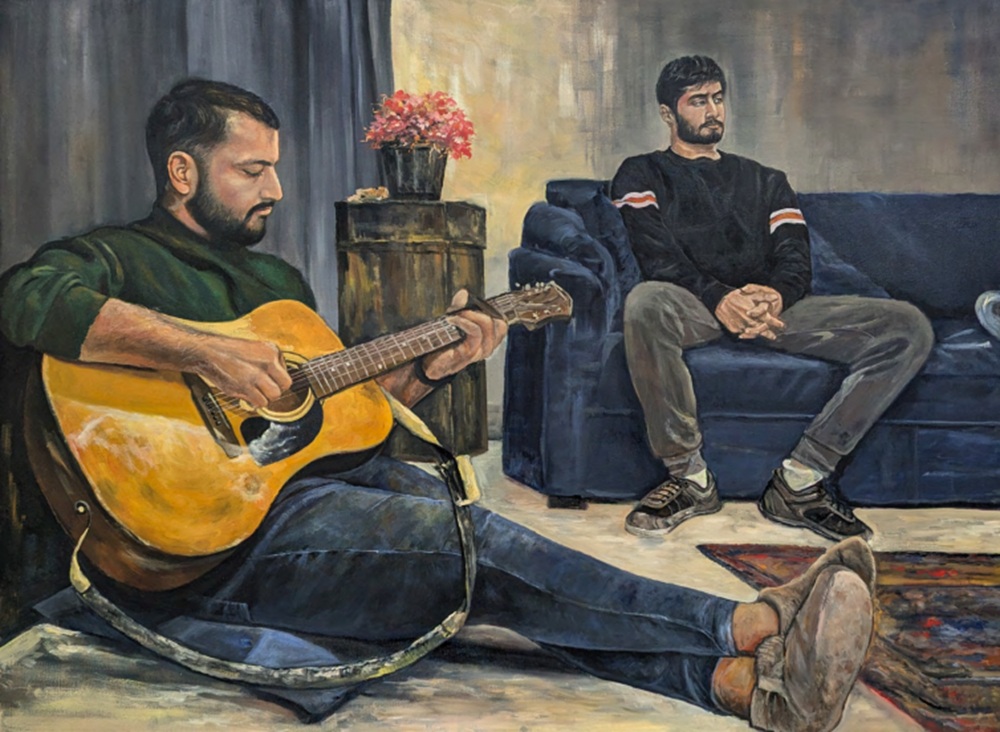
What the Hands Cannot Play by Muqeet Haider
In this episode of Art Review, Khaas Gallery in Islamabad hosted three exceptionally talented and imaginative artists, recent graduates who have refined their mastery of figurative expression in striking and original ways.
The figurative depiction of emotion, especially through facial expression, plays a central role, as does the illusion of movement within seemingly static scenes. These works invite viewers to engage from their own unique perspectives. Each artist has honed the ability to create resonant experiences using still or moving figures, whether draped in fabric, caught in casual repose, or, as in Lamia’s case, captured mid-hustle across intersecting frames.
Laamia Munir explores the transitions of body language and fleeting expressions—those nostalgic moments that often pass as mere glimpses, yet linger with silent depth. Her work, grounded in design, layered paint application, and careful observation, distills these transient instants into visual meditations on connection and introspection.
The centerpiece, Farmer’s Market Kinda Sunday, stretches across the wall like a frozen celebration. A crowd of friends in casual shalwar kameez and jeans gathers around a makeshift stall, faces lit up with shared laughter. One woman raises a yogurt cup in a thumbs-up, her partner beaming beside her. Market awnings and ochre signage dissolve into expressive swathes of emerald and terracotta.
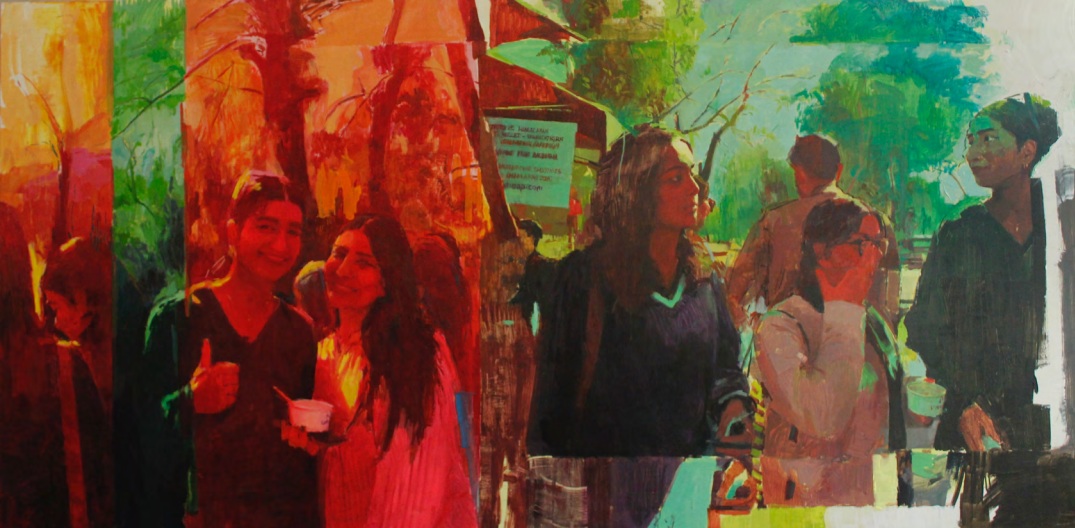
Farmer's Market Kinda Sunday by Laamia Munir
This “still” image pulses with life, evoking the vibrant chaos of a Lahore bazaar or an Islamabad flea market, spaces where communal ritual spills beyond the edges of the frame. It’s a tribute to collective effervescence, painted in fiery reds and sun-drenched yellows that warm the gallery’s cool white walls.
More intimate portraits anchor the rest of her display. Untitled I and Untitled II delve into abstraction, turning faces into emotional terrains. The first presents a woman in profile, her bronze skin set against a burst of purples, greens, and golds. Her emerald eyes slice through the canvas like unspoken questions. The brushwork folds like fabric, dissolving the figure into a dreamlike haze. The second continues this exploration, the warmer tones enclosing a contemplative gaze, lips parted mid-thought.
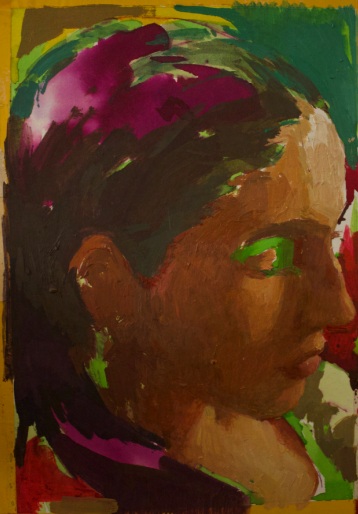
Untitled II by Laamia Munir
In I’ll Call a Cab, a solitary woman in a navy salwar stands poised in a sunlit doorway, her silhouette framed against an ochre wall. This scene balances thresholds: the green-tinged interior gives way to a whitewashed exterior, where bottles and shelves suggest the clutter of a modest home.
Munir’s split palette, cool teals melting into the figure, contrasted by the fiery orange doorway, captures a moment of liminal hesitation. Is she stepping in or out? The stretched shadow hints at motion, an understated “moving” within stillness. The piece speaks to urban solitude in Pakistan’s megacities, where agency flickers like sunlight through a crack. Munir’s quiet empathy shines: the woman’s posture, hand on hip, conveys strength without overt sentiment.
Displayed alongside Munir and Qindeel Usman, Muqeet Haider’s work evokes a subtle, almost reverent empathy.
His standout piece, What We Hold Back, anchors the exhibition with pastoral serenity infused with unspoken tension. Beneath a canopy of green, a woman in an orange dupatta sits on a worn bench, gently clasping the hand of a man in white shalwar kameez. Their gazes diverge, hers toward the horizon, his downward, framing a powerful silence amid a meadow’s soft expanse.
Haider’s palette of muted greens and golds casts the scene in dappled light, while the figures’ slight lean suggests an emotional undercurrent: the grip of memory, as delicate and fraught as clasped hands. Grounded in classical figuration, the work unfurls with quiet grace, revealing how identity often emerges through proximity rather than declaration.
In contrast, After a Long Day plunges into vulnerability. A dimly lit room holds a woman collapsed on a rug-strewn floor, her hand shielding tear-streaked eyes. Two male figures linger on the periphery, one in red, one in gray, like echoes of a long day’s toll. Haider’s thick impasto and somber palette imbue the canvas with emotional weight and textural depth.

After a Long Day by Muqeet Haider
His diptych in Still / Moving masterfully captures the tension between pause and propulsion. In the ambient light of Khaas Gallery, Haider’s oils linger on the unsaid, the gesture that holds, the silence that reveals. In an age of relentless flux, he reminds us that true movement often lies in stillness, where memory reshapes the self.
Completing the trio, Qindeel Usman’s canvases embody the exhibition’s central dialectic: stillness as a veil over internal flux. Her figures appear serene, yet pulse with quiet emotional undercurrents.
The expansive Nowhere Else to Be unfolds like a dream. Three women lounge across a large bed, enveloped in a landscape of textiles. Muted indigos, ochres, and seafoam greens wrap around their forms, clad in kurtas and jeans, as they exist in a state of unhurried communion. One cradles a phone like a talisman, another gestures mid-thought, while the third gazes into the distance, adrift in reverie.

Nowhere Else to Be by Qindeel Usman
Usman’s deft handling of fabric transforms the composition into a tactile maze. Pillows and quilts ripple in loose, expressive strokes, blurring outlines and evoking the suspended drift of an afternoon nap.
In One of Those Days, vulnerability deepens. A single figure lies curled, fetal, amid crumpled linens, her face partially obscured by tousled hair and shadows. Lavender tones and creamy folds wrap around her like a cocoon. Her arched body speaks of exhaustion, yet her partially open hand offers a quiet invitation to empathy. Usman’s muted palette, whispers of violet and taupe, heightens the emotional texture, suggesting that “those days” hold the beginnings of healing.

One of Those Days by Qindeel Usman
In Still / Moving, motion becomes a slow, deliberate language. Each artist captures subtle interventions, moments so precise and intense that they stir a static canvas into breath.
Together, Laamia Munir, Muqeet Haider, and Qindeel Usman offer works that speak through silence, inviting viewers into private moments of movement, memory and meaning. Their art is a quiet reminder to observe more closely: to glimpse, to pause and to feel the invisible tides that shape us.
You may also like: