Written by: Muhammad Hamza
Posted on: January 20, 2026 |  | 中文
| 中文

Churail and Thief of Joy
In the intimate setting of 8B2 gallery, Rehmat Zafar’s solo exhibition SUB SOUP invites viewers to sink slow and step soft into an aqueous realm where play becomes a radical act of resistance and world-building.

Churail
Drawing from the artist’s multidisciplinary background, spanning graphic design, illustration, printmaking, community organizing and explorations of the post-migrant and queer South Asian experience SUB SOUP presents a cohesive yet delightfully unpredictable collection of mixed-media works created in 2025. Executed primarily in acrylic paint, pen, and marker, these pieces operate as contemporary mono-prints infused with automatic drawing, time as a deliberate medium, and a joyous refusal of rigid interpretation.
Zafar’s Artist Statement frames the exhibition as “an invitation into the realm of the subconscious through playful mono-prints.” She positions play not as mere whimsy but as essential to resilience: a way to reclaim agency against inherited static systems. By embracing spontaneity without judgment and valuing process over projection, the works become living spaces where thoughts and questions unfold. Each piece emerges in three stages initial automatic color fields, incubation through time away, and the return where forms and figures surface organically, making the show feel both deeply personal and universally accessible.
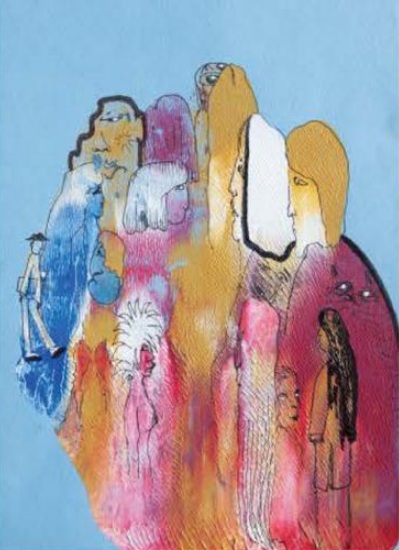
Searching
The visual language of SUB SOUP is immediately striking: saturated hues collide in joyous, sometimes chaotic harmony, while biomorphic shapes, hybrid creatures, and fragmented figures float, tangle, and dissolve across the surfaces. The palette oscillates between electric primaries, deep oceanic blues, tender pastels and earthy reds, creating an underwater soup like density There is a deliberate tension between figuration and abstraction enough recognizable motifs to draw the viewer in, yet enough distortion to keep them pleasantly disoriented.
Here are a few standout works that capture the spirit of the exhibition:
Consider searching, where fluid blue forms twist and reach outward in a restless quest, their edges bleeding into surrounding space like thoughts seeking embodiment. The composition feels alive, as though the central figure is perpetually on the verge of discovery or escape. The humanoid body scapes are quite the contrast with a few miniature faces bulging from corners that fade in the blue background.
bird brain, presents a whimsical yet oddly coherent expression of a facial appearance. its head swollen with colorful thoughts or memories. the bird shaped skull features a few migration stories, and diasporic consciousness renders through the brain.

Bird Brain
Birds recur throughout the exhibition as symbols of freedom, fragility, and transformation echoing the post migrant experience Zafar frequently explores. A few many other animals that have been a staple for this exhibition.
Rehmat’s fondness of desi culture fusion showcases her unique ability to stylize the environment of animals like cow in RASA, which is quite one of the most prominent artworks in the exhibition; the compilation of such fauna on a canvas that expresses as childlike drawings & renders like a veteran show the critical skill that requires for the one to explore their childhood memories; the color palette is indeed versatile and unique, the merging of animals to abstraction mellows the viewer to engage at best & fixate to make up the jigsaw puzzle into one, there are wings that compliment the torso of cow that also turn into a bird with a croc underneath; psychedelic much? It truly plays with the mind & humbles the viewer.

Rasa
Dodo, meanwhile, introduces a tender melancholy. The extinct bird, rendered with affectionate distortion, becomes a symbol of loss, nostalgia, and perhaps the endangered aspects of cultural identity in diaspora. Yet Zafar infuses even this sensory piece with vibrant life as bright feathers and playful outlines that refuse pure mourning; a blast from the past is what it’s all about at times as she has been extracting the pigments and symbolic recognition from the experiences encountered in life. Chiriya Ghar & Intiqal stand as larger anchors of the exhibition. These expansive canvases feel like full ecosystems: overlapping creatures, architectural fragments, and swirling patterns suggest both shelter and movement, home and departure. The scale allows the viewer to become immersed, almost swimming through the painted soup. Gentle observations cost more than farsighted ones; it’s all in the details, Rehmat exclaims the narrative as to be seen up-close.

Chriya Ghar
The gallery holds a larger hall where artworks feel like blobs of paint; a child’s playground as canvas; the over drawn features & elements are what makes each piece stand out on its own; colors on repeat are seen vividly enough enlivened with more brewing in creative mergers of animals to an ode of charismatic characters. Intimate works like blue friends, strawberry t-rex, and bubble to the surface offer moments of pure delight. The strawberry t-rex is particularly charming, a prehistoric giant reimagined as a sweet, fruit headed creature, blending menace and tenderness in a way that feels like a movement called Zafarian. it’s a unique signature that is seen in a few many framed concoctions.
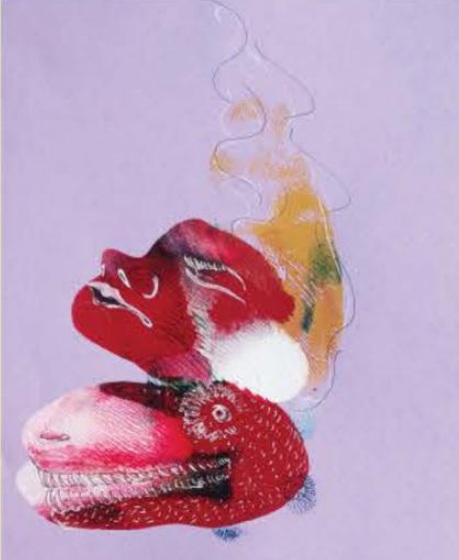
Strawberry t-rex
These pieces remind us that play can be subversive: by rendering the absurd and the monstrous with affection, the artist challenges hierarchies of seriousness & possessed.
The recurring use of hybrid forms part human, part animal, part plant speaks to the artist’s interest in polyps and the gaps between flesh and representation. Figures often appear doubled, fragmented, or emerging from one another, suggesting multiplicity of self, community and belonging.
Titles such as churail, family, thief of joy, and ghost of growth add poetic layers, hinting at folklore, intergenerational bonds, emotional theft, and the haunting persistence of personal evolution. Nostalgic patterns reek of absurdity in silent murmurs, a reality check to a certain nature of behavior; pieces have spoken on their own behalf; the processes have become more complex with each material used in the series, crayons have played their vital role to bring the story to unravel in brightened yet subtle textures and pleasing details.

Ghost of Growth
Visually, the exhibition has its own unique scent that resonates with traditions of automatic drawing while covering with layer over layer, from crayon to ball pen to marker to paint, it’s all distinctly contemporary and rooted in South Asian diasporic aesthetics. The bold outlines, layered transparencies, and unapologetic color recall both folk art styles and the expressive freedom of creationism peaks.
What makes SUB SOUP particularly compelling is its quiet activism. In a world that often demands productivity and clear narratives, Zafar defends the right to play, to incubate, to not know immediately what a work means. The time-based process mirrors the slow unfolding of diasporic identity: not linear progress, but purging for righteous revelations, and revisions. there’s a high key note to creating a stroke that renders a few many mantras and explores with fading memories.
Rehmat words it out as, ‘I arrived at this process as I sought to bridge a distance within myself. I undertook it with intention, as I see the work of acquainting with and drawing from the subconscious as imperative to the work of liberation. When we allow ourselves to play without preemption we access that which we suppress. Fundamentally, we cannot move towards what we do not dare to investigate. We cannot heal that which we cannot imagine as fortified. The time to imagine, to build beyond ourselves, and to meaningfully reach for one another across all that we share is now. We must act.’
In the end, SUB SOUP succeeds as both a personal dream journal and a collective call to protect imagination; knowing the fact that there’s a certain texture being put out; we all know you’re not allowed to touch artworks; but with these series; the artwork breaches in to touch your soul whilst you stand apart; as it radiates the flux of light & life.
Through these vibrant, subconscious landscapes, Rehmat reminds us: there’s a sense of longing that comes forth after you’ve seen yourself in true colors; psychedelic realms speak to us with expressions that resonate in the visual experience through these imageries. The soup is a comforting concoction, brewed by the spectators itself but a shared experience of life.
You may also like:
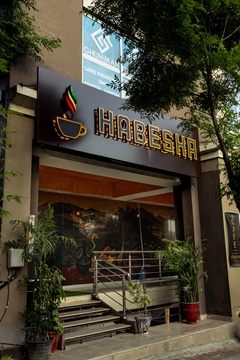
From the Horn of Africa to Bahria Town: Habesha Café Brings Centuries of Coffee Culture to Rawalpindi
(October 15, 2026)