Written by: Muhammad Hamza
Posted on: July 04, 2025 |  | 中文
| 中文
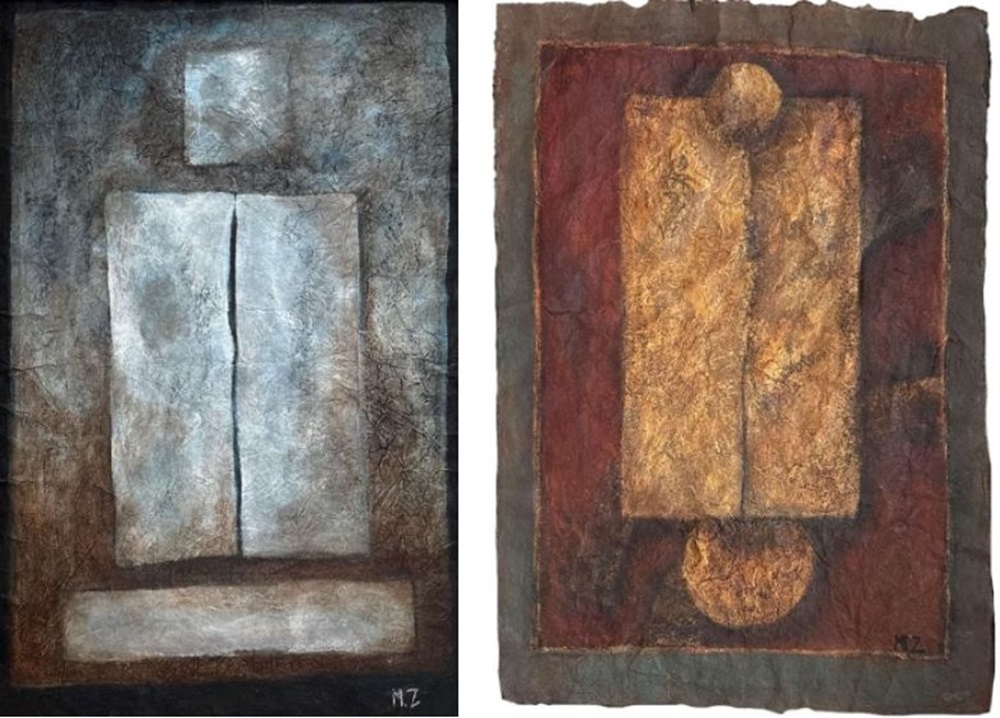
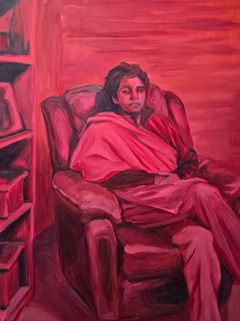
Untitled by Mobina Zuberi
Something about evolving ever up to time art styles, an abstract and figure practice genre of seasoned veteran artists, has been curated by Dr. Arjumand Faisal at Gallery 6. The theme consists of tradition and nostalgic patterns of modernism, ranging from the contemplative to the confrontational, excerpted from unique art styles. It is a collective engagement with cultural memory, the politics of identity and the dynamic terrain of modern expression through every artist’s respective exploration.
Masood A. Khan brings a layered, experimental practice that spans portraiture, abstraction and landscape. Through translucent overlays and expressive brushwork, Masood crafts emotionally resonant pieces that oscillate between form and dissolution. His signature use of transparency becomes more than a visual device. The layered transaction of elements is a process of creating a value to the thought that has been expressed by Masood. His artwork is a metaphor for vulnerability, memory and introspection. Khan’s compositions invite viewers to look beyond the surface, to engage in a quieter form of seeing that feels intimate, personal and profoundly human.

Untitled by Masood A. Khan
Sarfraz Musawir revives the classical tradition of watercolor with masterful precision. His works often focus on nomadic desert life, capturing its rhythm, resilience and dignity with narrative realism. With subtle tonal gradations and intricate attention to detail, Musawir reconstructs fleeting moments and lived experiences into timeless scenes. His artwork serves as an homage to tradition and heritage, even as it addresses themes of migration, impermanence and identity. Through his delicate brushwork, memory is made everlasting and settles through time.
A.Q. Arif offers meditative landscapes, as seen in Dastaan, that act as visual sanctuaries. His serene oil paintings, rendered in earthy tones and diffused light, transport the viewer into spaces of reflection. Rooted in both the spiritual and the historical times of togetherness, Arif’s compositions carry an understated reverence for nature and place. His minimalist approach, marked by soft transitions and harmonious compositions, creates an atmosphere that transcends the purely visual, evoking instead a sensory and almost mystical stillness. His work suggests a kind of timelessness, bridging memory with immediacy.

Dastaan by A. Q. Arif
Jamil Baloch offers a more confrontational and conceptually driven practice. His work draws deeply from regional narratives, natural forms and global political realities. Employing a wide range of media including sculpture, mixed media and installation, Baloch navigates issues such as displacement, violence and human struggle. His artworks are often stark yet poetic, weaving the symbolic with the visceral. With a strong command of materiality, he resists artistic boundaries, allowing each medium to carry its own emotional and intellectual weight. In his work, grace emerges not from serenity but from resilience and resistance. The strokes are as alive as they can ever be.
Shaista Momin creates dreamlike scenes populated by women and pigeons, symbols that within her world become metaphors for longing, freedom and the feminine psyche. Her gentle palette, surreal juxtapositions, and softly rendered figures evoke the textures of folklore, myth and internal landscapes. Momin’s artwork is both poetic and psychologically charged, offering glimpses into a world where reality and imagination blur with figurines as seen. She creates spaces of reverie, where the quiet power of femininity and the weight of cultural inheritance coexist.

Untitled by Shaista Momin
Mobina Zuberi, with her finely calibrated sense of form and color, occupies a different terrain altogether. Her canvases are a balance of structured geometry and fluid chromatic play. Often abstracted yet emotionally potent, her works offer lyrical meditations on space, rhythm and sensation. Zuberi’s modernist approach in the artwork is sensibly apparent in her compositional clarity and formal refinement, yet her paintings remain intimate. They invite the viewer into a world of quiet harmonies and subtle tensions. In her hands, abstraction becomes a language of feeling.
Sumera Jawad explores the depths of human emotion with an unflinching gaze. Drawing from personal experiences and social observation, she gives voice to stories often left untold. Her figures, predominantly female, are more than aesthetically compelling. They are vessels of inner life, emotional complexity, and quiet strength. Jawad’s artworks confront societal silences, creating space for empathy, dialogue, and reflection. In her practice, grace becomes a form of honesty, a confrontation with truth, however uncomfortable or painful. In the artwork Power, this is reflected in the text Parastdam, meaning I loved you well.
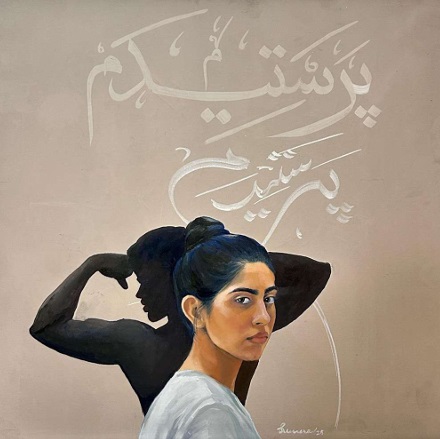
Power by Sumera Jawad
Tabinda Chinoy turns her lens to the symbolic interiors of upper-class urban life. Her figurative portraits of women and domestic spaces probe questions of power, societal expectation and selfhood. Through nuanced compositions and narrative layering, Chinoy reveals the tensions beneath the surface of privilege where cultural memory, gender politics and personal identity intersect. The artwork, a dreamlike state yet grounded in imagery, explores the constraints imposed by tradition, even within seemingly liberated settings. It makes the personal political and the intimate visible.

The Casanova, His Damsel, Her Bird by Tabinda Chinoy
Shammi Ahmed’s artwork predominantly features female figures, but her stylistic approach is uniquely her own. Through semi-realistic forms, fluid lines and strong textures, she captures the complexity of modern life. Her subjects, often caught in moments of quiet introspection or ambiguous activity, suggest layered narratives beneath the surface. The crossing paths of abstraction and realism in Shammi’s work mirror the oscillation between control and chaos that defines contemporary experience. Her practice is attuned to the rhythm of life, the push, where it all settles on one horizon.
Wahab Jaffer brings a dynamic energy to the exhibition with his bold, expressionist approach. His canvases, often centered around female forms, navigate myth, identity and transformation with unrestrained attention. Vibrant colors, gestural brushstrokes, and symbolic motifs converge to create visually arresting and emotionally charged works. Jaffer’s artwork 8 Birds speaks to the power of metamorphosis, both personal and collective, celebrating the fluidity of identity and the enduring spirit of change. The duality of the portraits is a powerful dynamic as seen.

8 Birds by Wahab Jaffer
This exhibition is a collection of stories and nostalgic imageries that draw the viewer to interpret them according to their personal experiences. Yet the layered dispositions can carry a significant impact and influence upon the immersive narrative. The collection of artists is as responsive and respectively contemporary and old at the same time. While deeply rooted in their contexts, they transcend boundaries to speak to universal truths.
You may also like: