Written by: Muhammad Hamza
Posted on: April 28, 2026 |  | 中文
| 中文
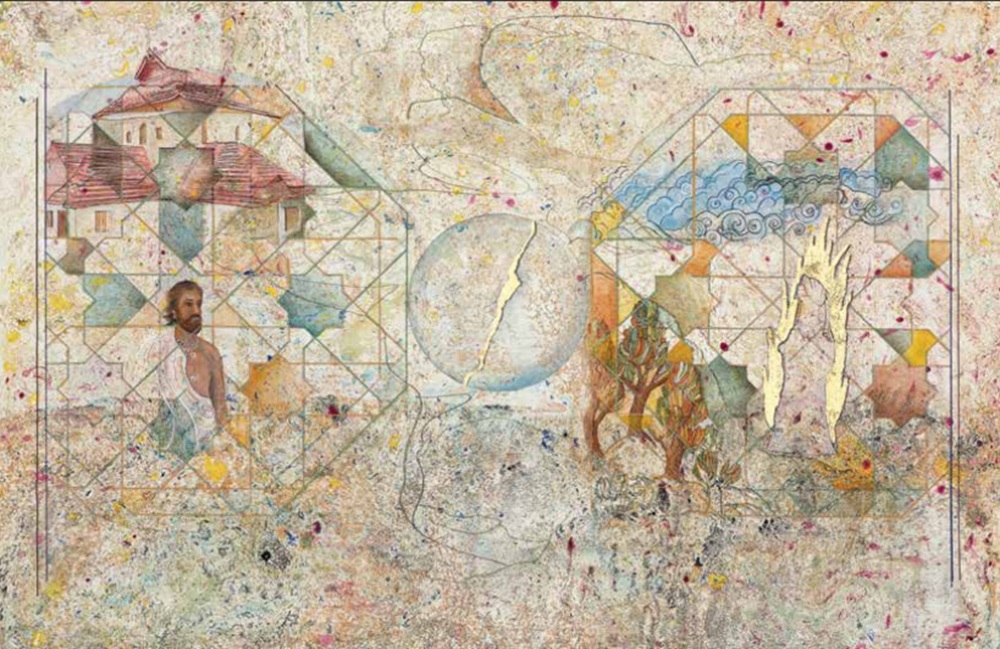
Charaman by Shireen Bano Rizvi
In the heart of Karachi, the exhibition What Remains opened its doors in April 2026 at Mainframe Gallery. Curated by FS Karachiwala, this two-person show brings together Shameen Arshad and Shireen Bano Rizvi. Their art asks a simple yet deep question: what stays with us when people leave home, when borders appear, or when life pulls us between old and new worlds? Arshad’s works feel personal and close, made with fabric, stitches, and soft velvet that seems to hold memories in every thread. Rizvi’s paintings glow with layers of color, gold and ancient patterns that connect faraway cultures and times. Together, the selected pieces create a quiet conversation about identity, loss and what refuses to fade away. No big answers are given, just space to sit with the feelings of longing and belonging.
Shameen Arshad’s The Architecture of Leaving pulls you in right away. On a deep teal velvet background, thin white lines trace the streets and buildings of a city map. Scattered throughout are small embroidered birds, each one framed in red like tiny windows looking out. The birds fly in all directions, some heading away from the map, others circling above it. The velvet feels warm and heavy under the hand, as if it carries the weight of real homes left behind. Arshad uses hand embroidery and appliqué with care, stitch by stitch, to show how migration changes a person’s inner map. The city lines look like fading memories, while the birds suggest souls or hopes taking flight. Viewers sense the quiet ache of departure, not just leaving a place but watching part of yourself scatter across distances. This piece captures the hybrid life many Pakistanis know: roots in one land, wings in another.
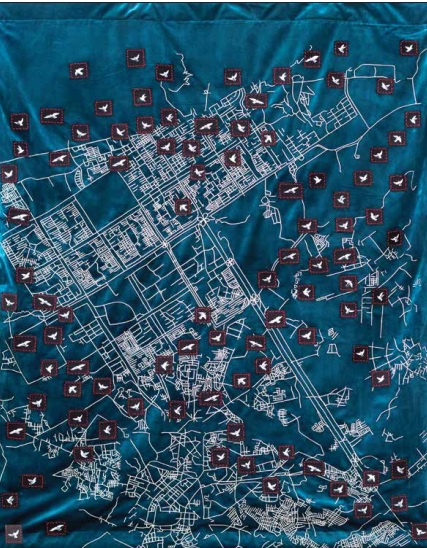
The architecture of leaving by Shameen Arshad
A soft green border with faint map sketches frames a dark central panel. Inside, pale white lines form the shapes of houses and buildings, stacked like blocks that are slowly dissolving. Some shapes look solid, others ghostly and see-through, as if drawn with charcoal and then stitched over. The work feels calm on the surface but heavy with emotion. Arshad mixes hand embroidery, acrylics and canvas on velvet to mirror the slow, private act of remembering. The title hints at silent goodbyes, people slipping away without drama, yet their absence leaves empty spaces in families and hearts. The geometric houses stand for the structures of daily life that get packed up or left behind. Through this piece, Arshad gently explores the fracture in identity that happens during emigration. It is not loud grief but a soft, lingering one that stays with those who go and those who stay.
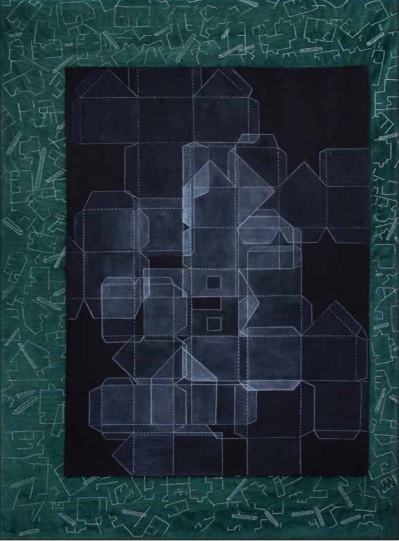
They leave in quiet lines by Shameen Arshad
Arshad shifts the mood with bold red and black. White outlines of houses and arched buildings fill a dark center, while a flock of reddish-pink birds bursts across the scene, flying outward. The borders repeat tiny house patterns in white, like wallpaper from an old home. The birds, carefully embroidered, seem alive and urgent, as if carrying messages or memories to new shores. Arshad’s use of chalk marker, acrylics and appliqué on velvet gives the work a texture that begs to be touched. It feels like a story of departure, families packing their lives and heading out, unsure of what waits ahead. The contrast between the patterned red edges and the busy black center shows the push and pull between staying rooted and moving forward. This piece makes you feel the excitement and sadness of new beginnings, reminding us that every outbound journey reshapes who we are.
This piece stands out for its simple yet powerful split design. The top half glows in rich red velvet, covered with rows of white embroidered birds flying upward in neat lines. The bottom half shows an earthy brown surface with delicate map lines and black-framed birds placed like scattered stars or landmarks. The two parts feel connected yet separate, like day and night or homeland and a new country. Arshad’s hand embroidery turns each bird into a tiny story of travel. The work speaks of life lived between two worlds, the warmth of Pakistan’s sun and the different light of distant places. It captures the discomfort of in-betweenness that Arshad often describes in her art. Viewers can almost feel the pull of two suns, two homes, and the quiet strength it takes to keep moving while holding onto pieces of the past.
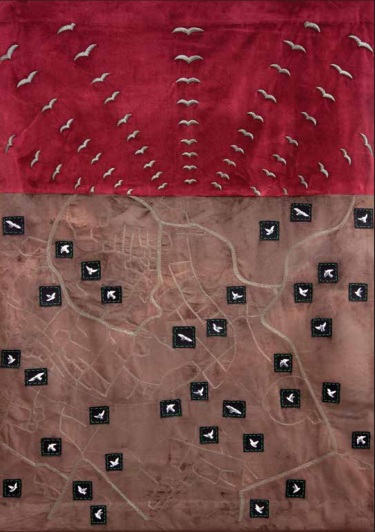
Between two suns by Shameen Arshad
Shireen Bano Rizvi’s paintings offer a different kind of light. Where Arshad stitches personal stories of leaving, Rizvi paints bridges across time and cultures. Her works in the show use pigments, watercolors, oils, gold leaf and fine pen lines to blend clear images with dreamy abstraction. Sacred geometric patterns, triangles, stars, and interlocking shapes act like threads that tie old civilizations together. Rizvi learned miniature painting and Mughal styles at the National College of Arts, but she makes them fresh and personal. Her pieces feel luminous, as if history itself is glowing on the paper.
Draws the eye with its soft, layered background of splattered colors and gold. A bearded man sits quietly near geometric frames that look like windows into other worlds. A cracked globe floats in the middle, surrounded by trees, buildings, and flowing lines. Gold leaf catches the light, making parts of the painting shine like ancient treasures. Rizvi moves between clear forms and soft abstraction, showing how cultures once flowed freely like water across maps. The man seems deep in thought, perhaps a traveler or a dreamer holding onto shared roots. The work feels hopeful yet fragile, a reminder that even broken things can connect us. Through this painting, Rizvi suggests that identity is not locked in one place or time but woven from many histories.
Bursts with energy and movement. Swirling blue waves fill the scene, carrying orange fish and a sturdy wooden boat. A figure stands on the boat, while stars and geometric shapes float above and around like guiding lights. Fine pen lines add tiny details to the waves and stars, and splashes of color make the whole piece feel alive. The title echoes ancient flood stories, like a vessel carrying life through storms. Rizvi uses these sacred patterns to link myths from different lands, showing how humans have always faced change together. The painting feels both ancient and new, a visual poem about survival and the things we carry across uncertain waters.
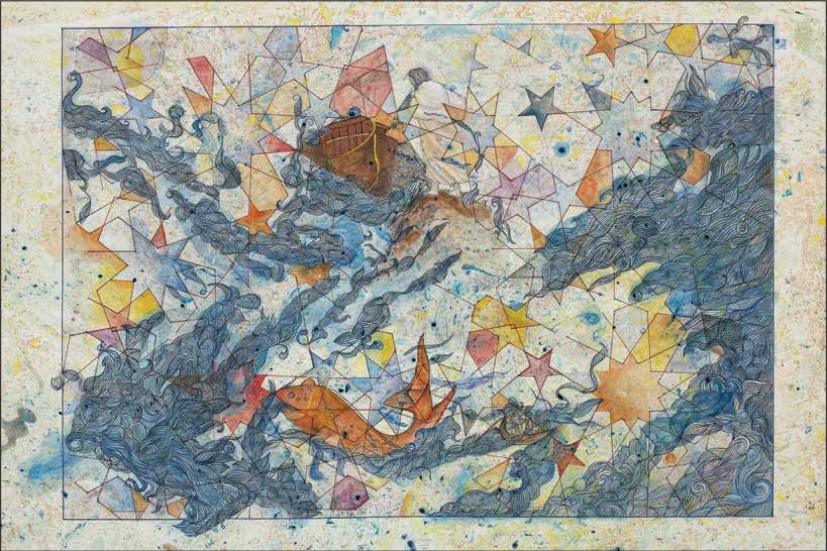
Ma-Nuh by Shireen Bano Rizvi
Raft o Bood (The Existence of the Past)
This piece brings together grand architecture and glowing patterns. Old buildings with arches and balconies appear alongside figures on horseback and people gathered in quiet groups. Over everything floats a web of colorful geometric shapes, leaves, stars and flowers in greens, blues and warm oranges. Paint splatters add a sense of time passing, yet the patterns hold it all steady. Rizvi’s title suggests that the past still lives, and her work proves it. The sacred grids act as bridges between history and today, between one culture and another. The painting invites us to see how our shared past refuses to disappear. It sits lightly on the eye but lingers in the mind, full of the same quiet wonder that runs through the whole exhibition.
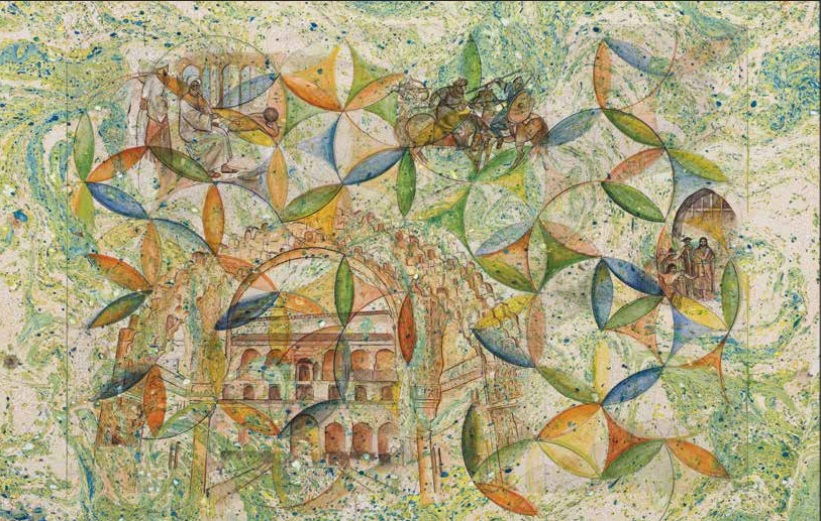
Raft o Bood by Shireen Bano Rizvi
What Remains, both artists show, is not just loss but also strength, memory, and the gentle geometry of belonging. In a world that moves fast and changes borders often, their art asks us to pause and notice the threads that refuse to break. What Remains does not try to fix the fractures of identity. Instead, it offers a warm, thoughtful space to feel them and perhaps to find comfort in how much still endures with gentleness.
You may also like:
From the Horn of Africa to Bahria Town: Habesha Café Brings Centuries of Coffee Culture to Rawalpindi
(October 15, 2026)