Written by: Muhammad Hamza
Posted on: December 10, 2025 |  | 中文
| 中文
Between Black and White
Tahir Zaman’s solo show, Between Black & White, at Khaas Contemporary Art in Islamabad, feels like stepping into a quiet storm. Born in 1994 in the rugged Northern Areas of Chitral, Pakistan, Zaman draws from his roots to craft works that whisper about the tough realities of life: things like social divides, political pressures, and the shaky ground of our environment.
Zaman’s art isn’t loud or obvious. He uses simple materials like rose thorns, threads and burned paper to build abstract shapes that mix beauty with danger. His artist’s statement lays it out clearly: he looks at how power, unfairness and strength show up in people and nature. Rose thorns stand for the sharp side of pretty things, how something lovely can hurt. Web-like patterns suggest traps or connections that hold us in place. And his organic lines mimic nature’s wild growth, hinting at both freedom and control. The show’s title, Between Black & White, captures this perfectly. Black and white aren’t just colors; they’re symbols of clear choices, but Zaman blurs them to show life’s messy grays, where good and bad tangle, where the weak push back against the strong.
The Oath
Walking through the gallery, the air feels thick with tension, yet calm. The works hang simply, letting the materials speak. Zaman doesn’t tell you what to feel; he invites you to pause and reflect on the walls we build around each other, the quiet harms in our world, and the tough beauty of survival. In a time when Pakistan grapples with class gaps, political unrest, and climate worries, his art feels urgent but gentle. It’s like a thorn pricking your finger, just enough to wake you up.
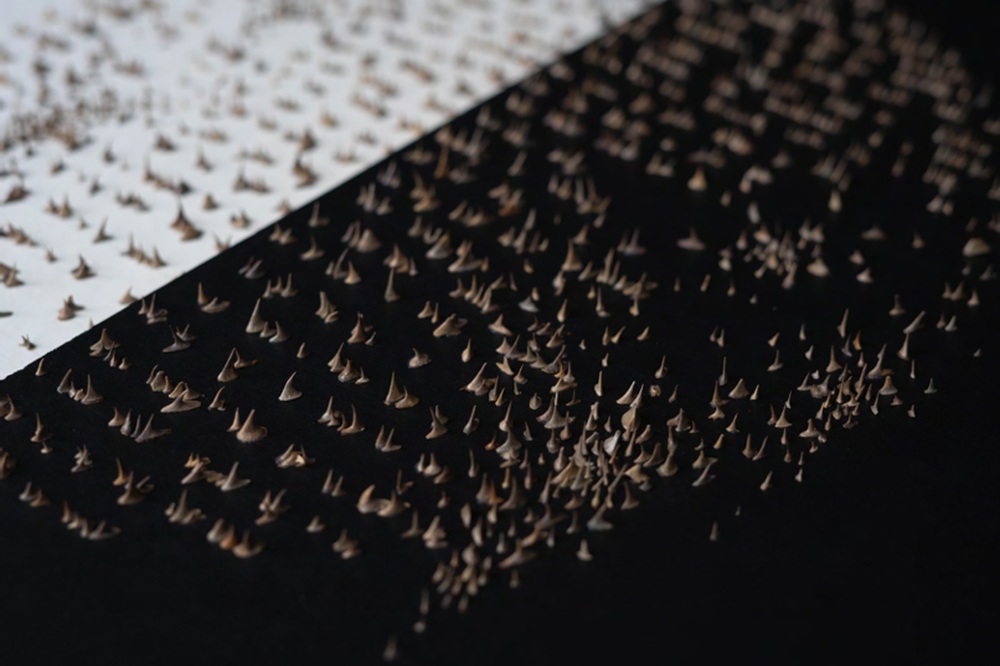
One piece that hits hard is Rose Thorn I (2025). Here, Zaman clusters real rose thorns into a tight, spiky mound on paper. Up close, it’s a storm of points, each thorn a tiny weapon glinting under the light. They look fragile, like they could snap, but together they form a wall that’s hard to ignore. This work echoes Zaman’s ideas about power and violence. The thorns are nature’s defense, beautiful in their curve but deadly in their jab. They make me think of social barriers, how the rich and powerful create spikes that keep others out, yet those same spikes show the fight in the overlooked. In a country where class lines run deep, this mound feels like a quiet protest: pretty from afar, painful up close. Zaman’s choice to leave them raw, without polish, honors the mess of real life. It’s not a pretty sculpture; it’s a raw symbol of how inequality stings, inviting us to see the resilience in something so small and sharp.

Silent Storm 1
Rose Thorn on Wasli Paper (2025) brings in the black-and-white split that names the show. A perfect circle of thorns sits dead center, half on stark white, half on deep black. The thorns themselves fade from light to dark, like shadows creeping across skin. This divide isn’t clean; the circle overlaps the line, thorns spilling over like secrets crossing borders. Zaman plays with fragility here: the paper’s soft wash lets the thorns sink in, almost disappearing into the surface. It speaks to environmental precarity, that shaky balance where nature fights back against human mess. Imagine floods in Chitral, Zaman’s home, washing away homes but leaving thorny plants to cling on. The black side feels heavy, like authority pressing down, while the white hints at empty hope. Yet the circle unites them, suggesting that beauty and harm are two sides of the same bloom. Standing before it, I felt the pull of those dualities: how power divides us, but shared struggles might weave us back together.

New Home (detail)
Rose Thorn II (2025), a looser scatter of thorns that spreads like veins across the page. Unlike the tight cluster of the first, this one breathes, with gaps where light sneaks through. It’s web-like in its spread, thorns linking in faint lines that mimic roots or fences. Zaman’s material play shines here; the thorns are pressed flat, their edges softened by time or touch, turning weapons into whispers. This piece digs into class structures, those invisible lines that sort people into haves and have-nots. The empty spaces between thorns feel like the cracks in society where the poor slip through, yet the connections show how we’re all tied in the web of economy and politics. It’s poetic, how something so simple evokes resilience: thorns don’t grow alone; they cluster for strength. In Zaman’s hands, they become a map of survival, reminding us that fragility isn’t weakness, it’s the start of pushback.
New Home, from his Rose Thorn series, builds a swirling circle of handwritten scrawls that look like thorns but are ink marks on wash paper. It’s chaotic, words blurring into shapes that could be nests or knots. This work feels deeply personal, like Zaman’s research into how language controls us, stories told by the powerful that trap the rest. The nest shape suggests home or safety, but the thorny script twists it into something confining, a web of rules and expectations. Tied to socio-political power, it reflects how narratives in Pakistan, about caste, gender or land, build invisible cages. Yet there’s poetry in the form; the ink’s flow has a rhythmic beauty, fragile lines that invite you to read your own story into them. Environmental threads weave in too, the nest as nature’s fragile hold against storms. Zaman prioritizes process here, letting the marks build organically, so the piece feels alive, pulsing with the tension between exclusion and belonging.
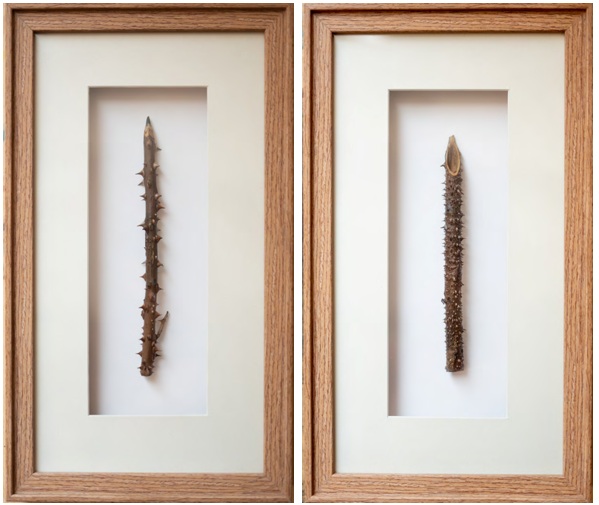
Rose Thorns (2025) stands out in its framed simplicity. Two glass cases hold a thorny branch and a single pencil-like stem, preserved like relics. The wood frames add a touch of formality, like they’re in a museum of forgotten defenses. This diptych explores authority’s dual face: the branch, wild and spiked, versus the stem, straight and tool-like. It hits on inequality: how nature’s raw power gets tamed into objects of control, like laws or borders drawn on maps.

Forgotten Memory
In Pakistan’s context, it evokes land disputes in the north, where thorny bushes mark contested ground. Zaman’s sensitivity to material makes it sing; the thorns catch light, turning harm into shimmer. It’s a meditation on resilience too: the branch endures, bent but unbroken. Hanging quietly, it pulls you into reflection on those subtle forces that govern us, beautiful in their stark truth.
Zaman’s Pyro Blading series takes us deeper into abstraction. Pyro Blading, Blue (2025) is a burned-paper circle, threads charred into a blue-tinged web against black. The burning process leaves holes like wounds, yet the form holds, a fragile mandala of smoke and ash. This piece screams environmental distortion: fire as destroyer and creator, mirroring climate fires that scar landscapes but spark new growth. The blue hue adds a cool calm, contrasting the heat of creation, much like beauty amid violence. Web-like, it traps light in its gaps, symbolizing how power networks rule us: think corporate webs or political alliances that leave holes for the vulnerable to fall through.
Broken Heart (Pyro Blading)
Zaman’s experimentation with fire feels research-driven, each scorch a test of limits. It contributes to discourses on ecological tension, urging us to see the entangled beauty in ruin.
The Shooting Star 2
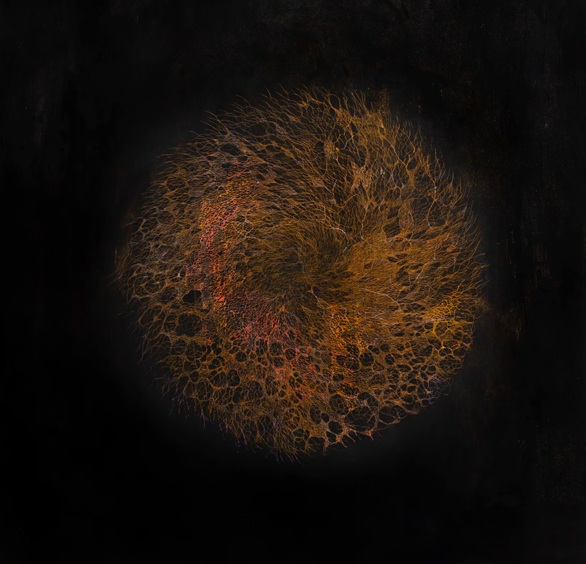
Equally compelling is Pyro Blading, Gold (2024), where golden threads form a radiant orb, burned edges glowing like embers. This one’s warmer, almost jewel-like, but the char marks reveal the cost of that shine, destruction baked in. It plays with class beautifully: gold as wealth’s symbol, woven from humble paper, hinting at how inequality glitters over suffering. The web structure evokes collective experience, threads linking like social ties strained by greed. Fragility meets authority here; the piece could flake away with a breath, yet it commands the wall. Zaman constructs a visual language that’s poetic, inviting thoughts on exclusion: who gets the gold, who burns in the making? In our world of rising divides, it feels like a golden thorn, pricking at complacency.
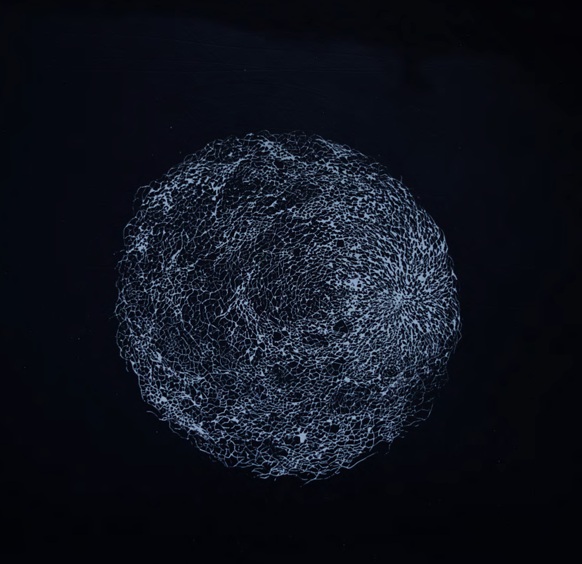
The Shooting Star (2024) closes the loop with a white web on black, threads spun into a starburst that shines softly. It’s the most hopeful, a beacon in the dark, but the burns add shadows, reminding us stars are born from explosion. This ties back to resilience—nature’s way of glowing through scars, much like communities enduring political storms. The star shape suggests aspiration, yet its web base grounds it in connection, not isolation. Zaman’s form prioritizes sensitivity; the white pops against black, blurring boundaries like the show’s theme. It reflects on hierarchies: visible stars of power, invisible webs below. In this piece, he offers no easy answers, just a light to guide reflection on our shared, tangled path.
Zaman’s Between Black & White isn’t just an exhibition; it’s a conversation starter. By picking thorns and threads, he turns everyday hurts into profound symbols, blending abstraction with real-world weight. His works don’t shout; they simmer, drawing you into the gray spaces where power meets pushback, beauty brushes violence. In Pakistan’s vibrant art scene, Zaman adds a vital voice, one that’s gentle yet fierce, local yet universal.
your senses will erupt a satire course of longing action but also a spark of wonder at how fragility fuels strength. In a world of black-and-white debates, Zaman reminds us: the truth lies in the weave between & beyond the boundaries of our political imagination.
You may also like: