Written by: Sana Shahid
Posted on: September 23, 2025 |  | 中文
| 中文
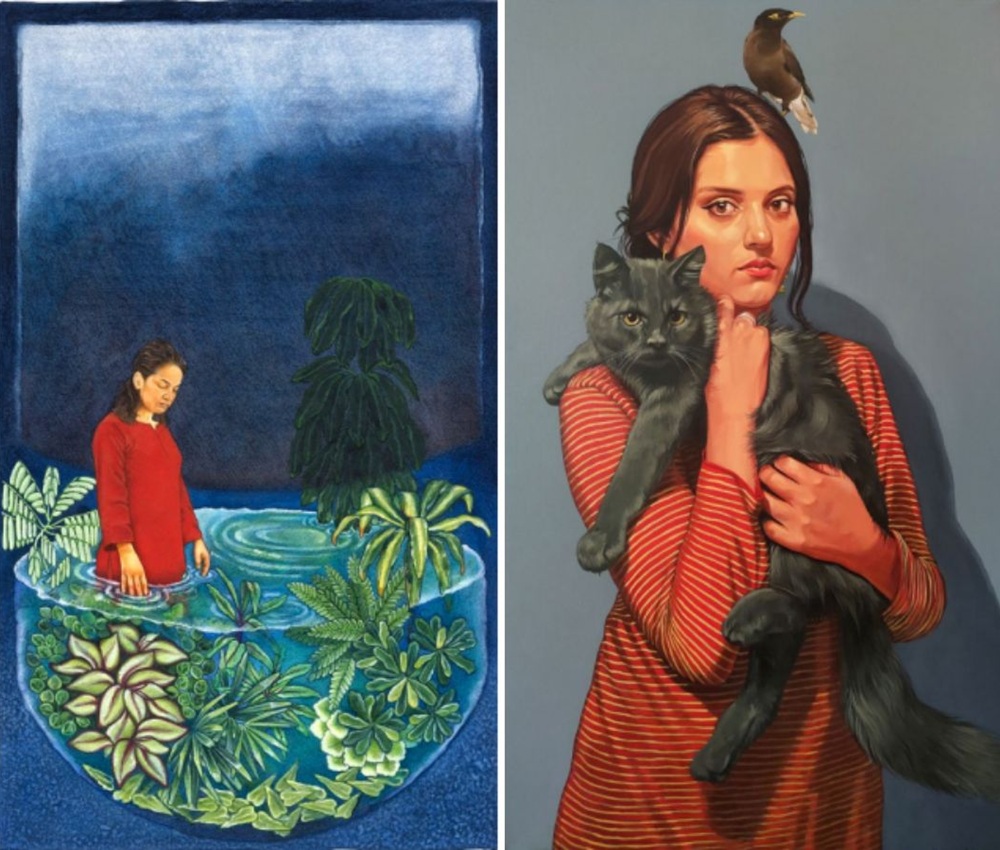
'Elegy of the Drowned' by Mizna Zulfiqar and 'Affinity' by Ali Azmat
The exhibition Beyond DNA 2 unfolds like a sequence of mutations where each artwork is a variation, each gesture is a coded message that both reveals what it means to inherit. DNA, here, is not only biology. It is rather a memory, trauma, resilience and imagination spread across the canvases with painted brush strokes.
Attiya Shaukat’s ‘Soul that lives within’ and ‘Hurts you, blesses you’ are perhaps the most literal yet haunting manifestations of the exhibition’s theme. Made with human hair, thread and gouache on graph paper, they take DNA out of the abstract and root it in the tactile. Hair becomes both an archive and a relic, something that carries memory, age and identity. The shape she constructs is not a sterile diagram from a textbook but a fragile, almost trembling form, suggesting that what we inherit is never fixed, but always entangled with pain, resilience, and the persistence of life itself.
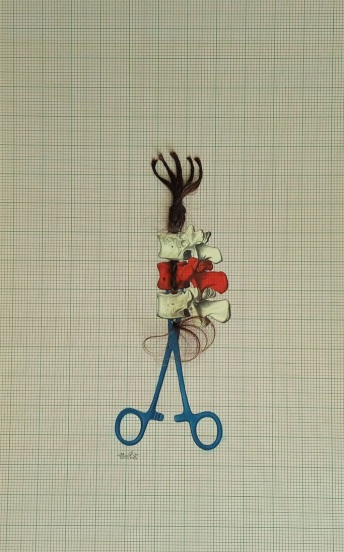
'Hurts you, blesses you' by Attiya Shaukat
From there, the show moves towards the lush surfaces of Mizna Zulfiqar’s ‘Elegy of the Drowned’ and ‘Subterranean Bloom’. Painted in gouache and watercolor on wasli, her plants breathe with an uneasy vitality. They bloom in saturated greens and deep washes, yet they are not simply botanical studies. They are elegies and resistances, fragile ecosystems that flourish despite suffocation. Just as DNA pushes life forward, Mizna’s imagery insists that growth is never passive, it is willful, even in hostile conditions.
If Shaukat and Zulfiqar root their imagery in organic material, Adeel uz Zafar turns toward the artificial. His diptych ‘PERSONA’ shows toy soldiers, enlarged, monochromatic and bandaged like egyptian mummies. These are not playthings; they are wounded masks, symbols of the personas that humans inherit and inhabit deep inside. In Zafar’s hands, DNA becomes a metaphor for the roles forced upon us, roles scarred by violence, history and expectation. The soldiers are grotesque reminders that what we inherit is not only physical traits but also wounds, burdens and narratives of conflict.
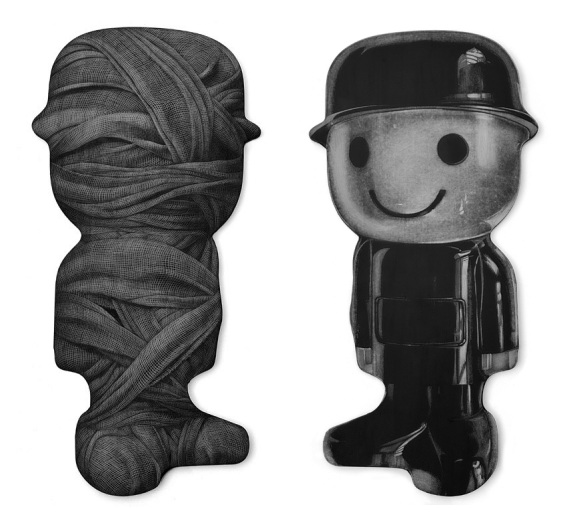
'PERSONA' by Adeel uz Zafar
In Kishwar Kiani’s ‘Repeat Offender’ and ‘Space Between’, the artworks take on a sculptural, almost scientific tone. One is a charcoal drawing, dense and intimate, while the other is a stainless-steel structure mimicking cellular composition. Her work suggests that while science might seek to stabilize and define life, unpredictability is always embedded within it. DNA, she argues visually, is less about certainty than about chances, mutations and improvisations. The coldness of steel gives way to fragility; the permanence of drawing reveals the instability of form.
Muhammad Zeeshan brings us closer to intimacy with ‘He is my witch’ and ‘She is my witch’. Painted in acrylic on canvas, his small portraits combined with organic growths, as though emotions themselves have erupted into physical form. Love, longing, desire, these are not abstractions but rather tangible presences. Zeeshan seems to suggest that DNA does not only dictate eye color or stature; it encodes our attachments, our hungers, and our vulnerabilities. His witches are not otherworldly figures but reflections of how relationships can possess and transform us.
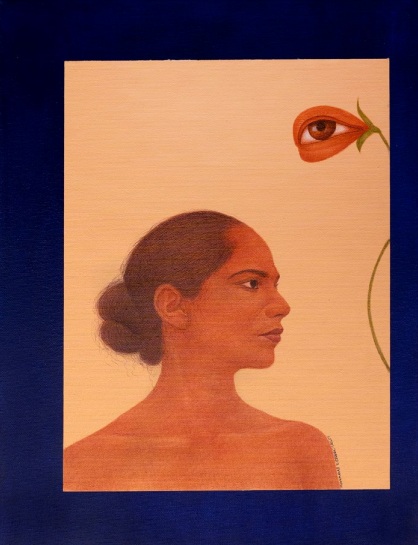
'He is my witch' by Muhammad Zeeshan
Ali Azmat’s paintings ‘Nostalgia’ and ‘Affinity’ bring the conversation back to the human figure. His acrylic canvases, populated by figures and animals, hover between the intimate and the mysterious. Nostalgia, with its self-portrait holding a family photograph, captures the weight of belonging and memory. Here, DNA is not a biological code but an emotional inheritance, the stories passed down through family images, gestures and silences. Affinity carries the same tenderness, a reminder that what binds us is not only what runs in our blood but also the relationships we cultivate.
Rahat Naveed Masud’s ‘A Self Portrait’, ‘Diluting Pain’ and ‘The First Raindrops’ are lush with oil pigments, yet restrained in mood. Her garden and home interiors are not neutral spaces; they are thick with personal and cultural histories. In ‘Diluting Pain’, the self is framed in an environment heavy with symbolism, while ‘The First Raindrops’ feels like renewal. Masud shows how ordinary domestic life can carry layers of politics, memory and longing. Her DNA is one of everyday rituals yet in those rituals, entire histories unravel.
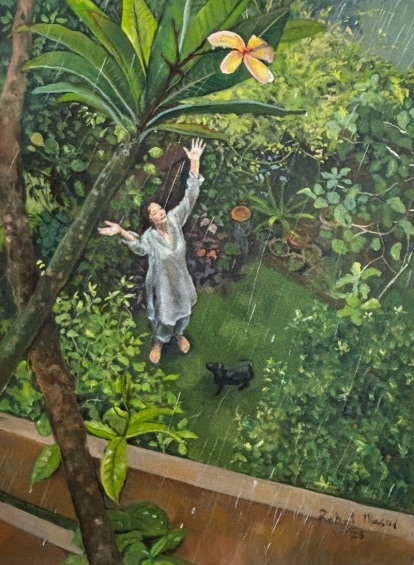
'The First Raindrops' by Rahat Naveed Masud
Where Masud captures the layered ordinary, R.M. Naeem paints a sharper intimacy in ‘Silent Monologue’ and ‘Sacred Silence’. His portraits resist easy interpretation; gazes caught between confrontation and withdrawal. They reveal identity as something perpetually negotiated between silence and speech, presence and absence. DNA, here, becomes a metaphor for the tensions of selfhood, where intimacy always carries with it a risk of erasure.
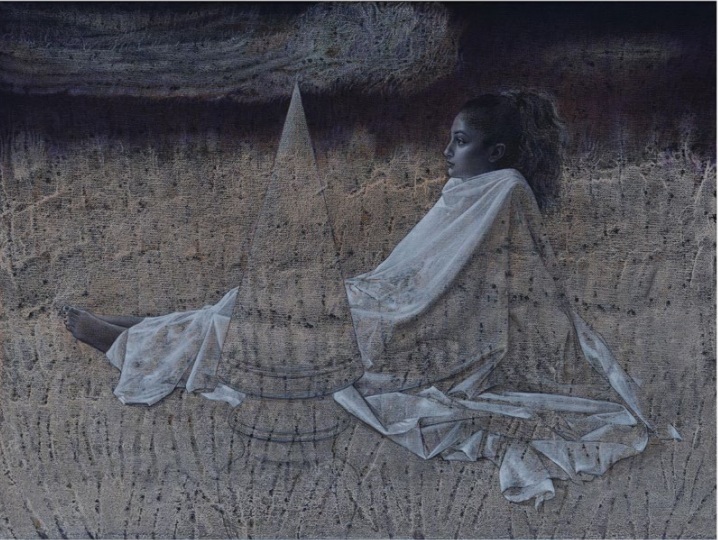
'The Sacred Silence' by RM Naeem
Mudassar Manzoor, in ‘One-ness’ and ‘Sacred Flux’, paints ephemeral, gold-laced compositions that resemble molecular constellations. His wasli works feel alchemical, merging the material with the spiritual. DNA, for him, becomes a cosmic pattern, a reminder that the microscopic and the metaphysical are never far apart. His paintings feel like prayers written in pigment, fragile yet eternal.
Sana Arjumand’s ‘The Healing’ and ‘The Aligning’ explode with color, their worlds populated with doe-eyed figures and birds afloat in ornamented seas. Her canvases hum with mystical energy, suggesting identity as something fluid, something capable of reinvention. In her world, DNA is not a prison but a current capable of alignment, misalignment and transcendence. Her paintings remind us that selfhood is both inherited and imagined.
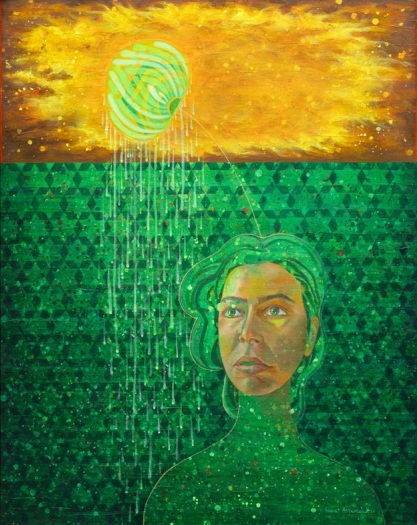
'The Aligning' by Sana Arjumand
Across these works, a collective statement emerges. DNA is not a closed book, not a destiny written in invisible ink. It is a landscape, fragile, unpredictable, full of wounds and blooms, memories and silences. Each artist shows us that what we inherit is not only our physical code but also our histories, our generational traumas, our rituals and our longings. The exhibition insists that art, like DNA, is both archive and possibility: it remembers, but it also mutates, resists and creates.
You may also like: