Written by: Muhammad Hamza
Posted on: August 11, 2025 |  | 中文
| 中文
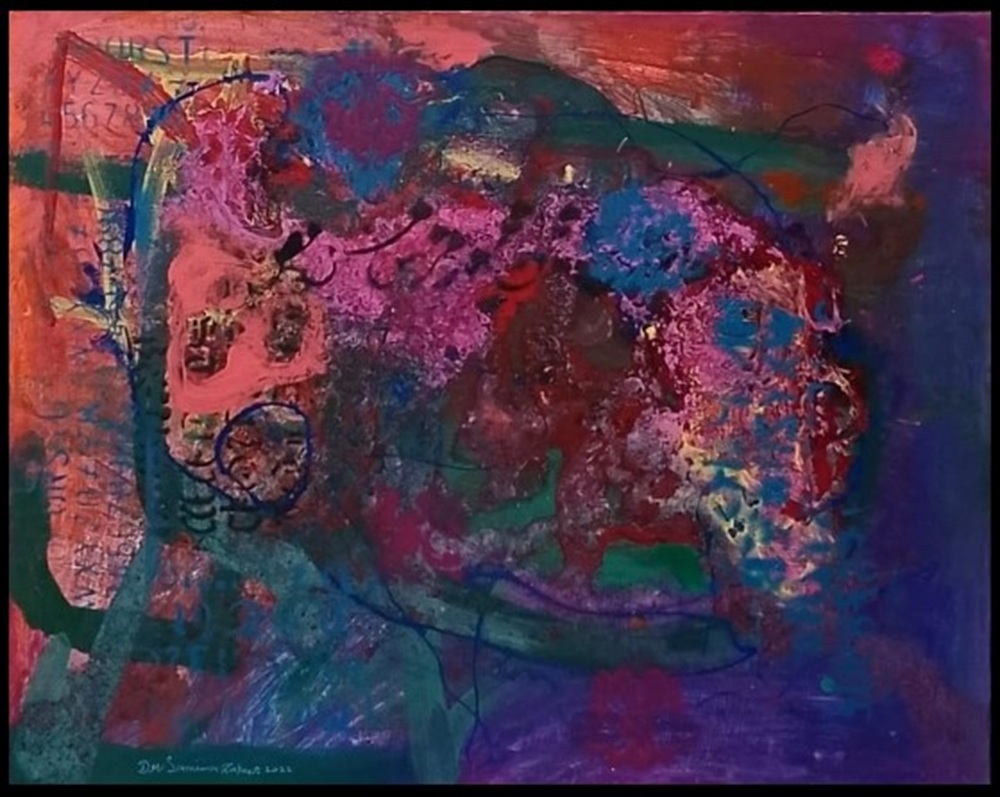
Identity 4 by Samina Zaheer
In this week’s exhibition at the Pakistan National Council of Arts, inspired by the mystic tales of Lake Saif-ul-Malook and curated by Nageen Hayat, the curator remarks: The work symbolically describes man’s spiritual pursuit in search of a Divine Beloved, i.e., “Infinite Reality.”
The protagonist’s quest to find and unite with the fairy in this tale is not merely the pursuit of earthly love. Rather, it is the journey of the human soul in search of “Divine Reality,” a path destined to encounter a series of trials. The concept is built around various corporeal and spiritual stages of travel before the final union with the Divine Beloved.
We now turn to a selection of the six artists and their works presented in the gallery. The series consists mainly of abstract pieces with touches of mixed media.
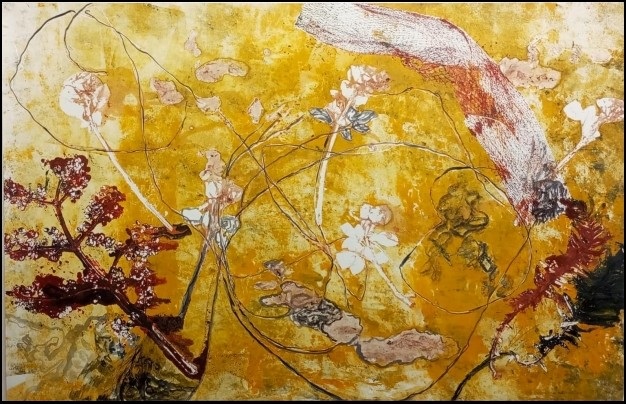
An artwork by Naila Hussain
Her abstract language speaks for itself, and the artwork’s ambiguity invites endless exploration. The central figure could be a self-portrait fragmented by life’s experiences, with warm tones symbolizing vitality and darker lines representing challenges or boundaries. Text fragments may be personal notes or cultural references, etched into the surface in a manner reminiscent of the “sgraffito” technique, adding a tactile depth to the visual story.
For the viewer, it may resonate differently, perhaps as a reflection of one’s shifting identity or as a celebration of creativity unbound by form. The fragmented forms and obscured figures suggest the multifaceted nature of identity - cultural, personal and spiritual - blurring the boundaries between self and collective.
This piece evokes a sense of timelessness, bridging ancient tales with today’s globalized world. The figures appear as if engaged in a dialogue between past and present, while a map bears witness to their journey. A drum may symbolize a call to unity or remembrance, resonating with contemporary conversations on cultural preservation amid rapid change.
It is a refined blend of tradition and innovation, inviting viewers to explore its narrative depths. Whether interpreted as a celebration of heritage, a critique of globalization or a personal homage, its mixed-media richness and cultural grounding make it an absorbing work.
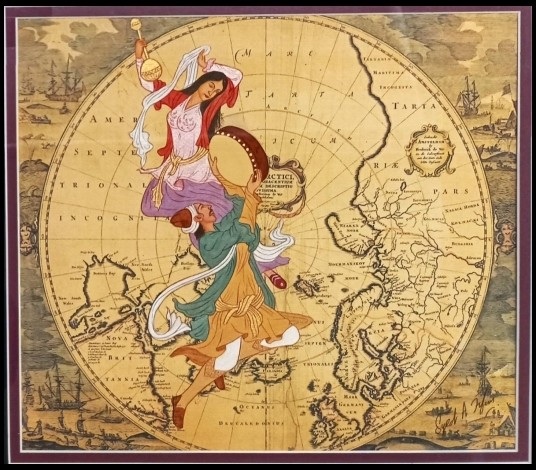
Saif-Ul-Malok & Pari Badi-Ul-Jamal by Syed A. Irfan
The bold colors and fluid lines suggest movement, perhaps evoking the ecstatic states brought about by Sufi music and dance, particularly the whirling of the Mevlevi Dervishes rooted in Rumi’s teachings. Faisal’s work draws viewers into a transformative experience.
Swirling patterns and an emerging face may inspire a shift in consciousness, urging a step beyond the ego, akin to the Sufi notion of annihilating the self to achieve unity with the divine. The face could depict Saiful Malook, his beloved Badi‘-ul-Jamal or even the divine presence itself. The interplay of chaos and order reflects the Sufi paradox of finding stillness in movement, a dance of the soul.
Seen differently, the swirls could be sound waves, carrying the viewer into a meditative state much like the sama of the whirling Dervishes. Divine Music 1 becomes a rich tapestry of Sufi spirituality, artistic experimentation and cosmic insight.
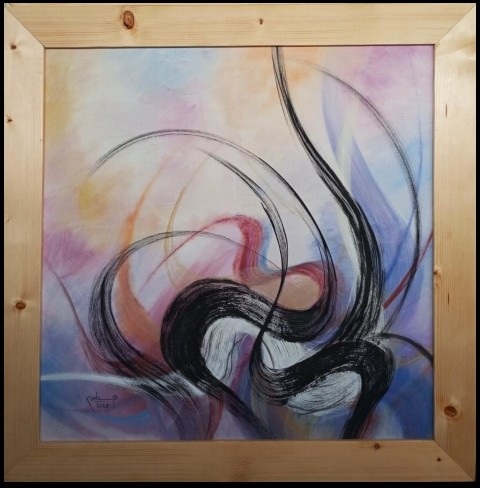
Divine Music 4 by Faisal Kuhzad
Hassan recalls this piece as stemming from a “seaside memory” and the “soundtrack” of waves, yet it abstracts these elements into a non-objective form. This transformation aligns with Abstract Expressionism’s emphasis on evoking universal emotions over literal depiction. The balance of “tension” and “stillness” suggests a dynamic interplay, perhaps the tension of memory meeting the stillness of abstraction. A ship-like form could symbolize a journey through memory or the subconscious, while the absence of a light source reflects a search for meaning within ambiguity. The contrast between grounded, weighty strokes and ethereal light creates a push-pull rhythm, echoing the artist’s movement from specific inspiration to abstract resolution.
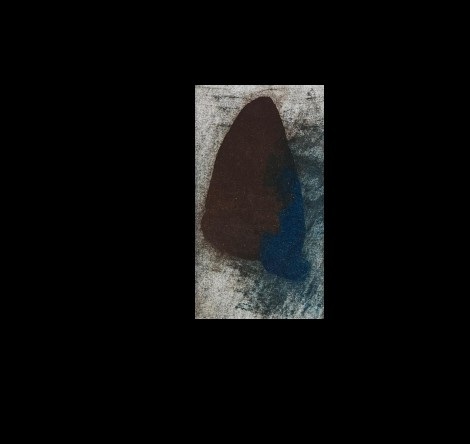
Light without Source by Mehmood Ul Hassan
Shahab’s Bird Series extends themes from earlier exhibitions such as Avian Humanoid and Ethereal Bond, where birds embody the deep bond between humans and nature. The composition also carries traces of his early portraiture, evident in expressive human faces that retain classical grounding while transforming into symbolic forms.
This progression mirrors his career’s shift from portraiture and landscapes toward explorations of human–avian relationships, perhaps shaped by his travels and artistic encounters. The Bird Series is a layered meditation on spirituality, identity and the human–nature connection, enriched by gongbi-like precision and huaniaohua-inspired motifs, leading viewers into a contemplative space where human and infinite converge.
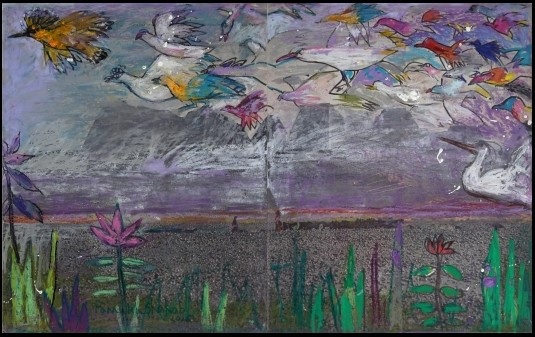
Bird Series by Farrukh Shahab
Her work presents a vivid interplay of earthy yellows, deep greens and muted browns, evoking a landscape abstracted from nature, possibly inspired by succulent gardens or wild terrains encountered in her travels. Bold brushstrokes and textured layers give a sense of movement, despite the title’s paradoxical nod to stillness.
Naila delves into “emotions and perceptions” shaped by the “external environment and internal landscape.” This duality, nature outside and reflection within, resonates with the language of contemporary art. Motion in Stillness becomes a textured, vibrant exploration of nature and emotion, inviting viewers to lose themselves in its layers, like wandering through a dawn garden, still, yet alive with possibility.
This year has seen a notable surge in abstraction within figurative and animal forms, evolving to greater complexity. Artists have increasingly turned inward, exploring emotions and developing new techniques to capture and hold the viewer’s attention. This exhibition feels like a point of transition, offering vivid, contemporary visuals that invite reflection and a rethinking of perspective.
Abstract art exists to open paths no one has yet explored, a journey toward affirming the worthiness of existence.
You may also like:
From the Horn of Africa to Bahria Town: Habesha Café Brings Centuries of Coffee Culture to Rawalpindi
(October 15, 2026)