Written by: Sana Shahid
Posted on: November 07, 2025 |  | 中文
| 中文
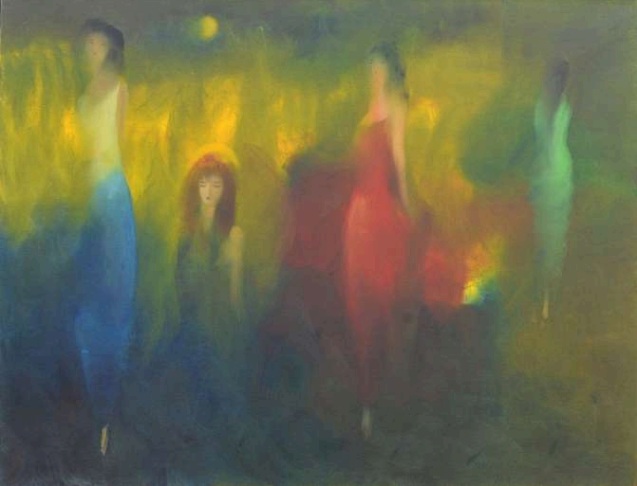
The Crucifixion of Eve
Walking into In Trinity Together, Raja Changez Sultan’s retrospective exhibition, feels like stepping into someone’s living memory breathing in color and silence. The Pakistan National Council of the Arts has turned its gallery into a kind of inner landscape, where every canvas seems to remember something the world has forgotten: the stillness beneath chaos, the beauty beneath burden.
Raja Changez Sultan’s art doesn’t shout; it hums. Each painting feels like a conversation between poetry and paint, both trying to describe what the heart can’t. He is one of those rare artists who dissolves boundaries between image and word, myth and moment, pain and peace. His brush carries the sensitivity of a poet; his poems hold the rhythm of a painter.
The journey begins with ‘The Divided Self’ faces half-formed, eyes that seem to hold entire stories, and emotions that linger between knowing and confusion. These portraits don’t tell you who the person is; they ask who you are. Sultan’s early work in this series explores the idea that each of us lives many lives within one body. The lines blur, the colors fragment, and in that brokenness, you see truth, quiet and brutal.

The Divided Self
‘The Crucifixion of Eve’, the series that seems to be at the center of this exhibition. It takes one of the most sacred symbols of sacrifice and turns it into a mirror. Here, Eve is not condemned; she is reborn, a symbol of endurance rather than guilt. The figures are not tragic but transcendent. The canvas holds the weight of centuries of silenced strength, turning pain into power.
Raja Changez Sultan once said that he paints what he feels, not what he sees. That idea breathes fully in ‘A Thousand Faces of Eve’. The faces are infinite, women seen not through the eyes of society but through the tenderness of empathy. Some look away, others seem to stare back at you, quiet yet unflinching. There is subtlety in the way he paints as though he is trying to portray a rather positive and a brighter side to what history has overlooked.

A Thousand Faces of Eve
The landscapes that follow in ‘The Himalayan Odyssey’ shift the tone completely. These are not mountains as geography they are mountains as emotion. The whites and greys move like waves; the blues melt into silver. There’s no horizon, only light. You begin to sense what Sultan means when he writes, “The mountains teach you silence.” Standing before them, you can almost hear the wind whistling through them, not loud, but endless.
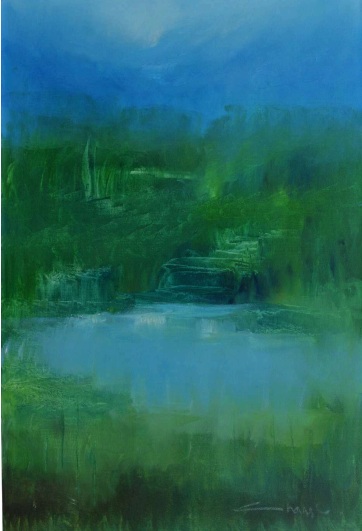
The Himalayan Odyssey
The exhibition flows into ‘The Wood Nymphs’, where myth and reality fold into one another. Women appear from shadow, half-rooted in trees, half-lost in air. Sultan’s charcoal work gives them a ghostlike tenderness as they are both present and disappearing. You feel as if you’ve caught a glimpse of something sacred, a reminder that humanity and nature were once inseparable.
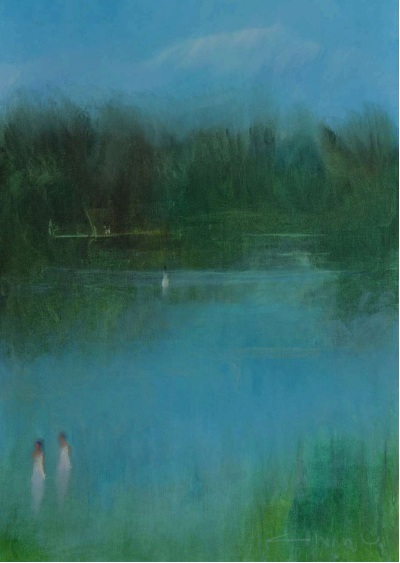
The Wood Nymphs
In ‘Birds of Paradise’, the quiet becomes lighter. Small, delicate silhouettes float across luminous skies, captured mid-flight. They are not painted with precision but with feeling, their shapes more like memory than anatomy. The birds are metaphors for freedom, innocence and rebirth. They remind you that hope, too, can have wings.

Birds of Paradise
The exhibition closes with ‘The Three Graces’. Here, the figures are fluid, moving together in soft rhythm. They represent creativity, generosity, and harmony, the timeless qualities that connect human experience across centuries. Their presence feels like a calm after the storm, a resolution that doesn’t erase the struggle but transforms it into balance.

The Three Graces
Throughout the exhibition, Sultan’s connection to poetry remains visible. His verses are placed beside his paintings, not as explanations but as echoes. They complete the thought the brush began. Together, they create what he calls a “trinity” - word, color, and feeling.
Noor Fatima, the curator of the show describes the exhibition as “a dialogue between the painter and the poet within him, a journey through identity, myth, and emotion.” She explains that curating this show was like piecing together fragments of one vast soul. “Each series is a reflection of a different self, yet they all flow into one another. It’s less of a conclusion and more of a conversation that never ends. Raja Changez Sultan’s art holds both poetry and pain, it invites you to stand still, to feel, and to see beyond the surface.” She quotes.
That sentiment finds harmony with the words of Mariam Ahmed, Director of the Visual Arts Division, who reflects on Sultan’s legacy: “His work is not only about what it shows but what it stirs inside you. Raja Changez Sultan doesn’t paint answers, he paints questions that stay.” The Director-General, Muhammad Ayoub Jamali, calls this retrospective “a celebration of an artist whose vision has shaped Pakistan’s cultural imagination for decades.”
Those words ring true as you move from one gallery to the next. Every room feels like a shift in tone, yet each is part of the same story, a lifelong dialogue between self and spirit. Sultan’s art is deeply rooted in Pakistan’s landscape and mythology, but it speaks a universal language of emotion. His paintings don’t ask for understanding; they ask for surrender.
When you finally step outside the gallery, daylight feels strange too sharp after so much color and calm. You carry something invisible with you: a stillness that is not empty but full, a reminder of what art can do when it refuses to stay on the surface.
You may also like:
From the Horn of Africa to Bahria Town: Habesha Café Brings Centuries of Coffee Culture to Rawalpindi
(October 15, 2026)