Written by: Anum Zaeem
Posted on: July 30, 2025 |  | 中文
| 中文

Kamran ki Baradari
In the shadow of Lahore's bustling streets lies a testament to architectural brilliance that has weathered centuries of neglect and transformation. Kamran ki Baradari, named after Prince Kamran Mirza, brother of Emperor Humayun, stands as one of the most underappreciated monuments of the Mughal era. This sixteenth-century pavilion, with its distinctive blend of Persian and Indo-Islamic architectural elements, offers visitors a rare glimpse into the sophisticated aesthetic sensibilities of the early Mughal period.
The baradari was constructed during the reign of Emperor Akbar, serving as a summer retreat for the royal family. Prince Kamran Mirza, for whom the structure was named, was a complex figure in Mughal history, a talented military commander and patron of the arts who eventually fell from grace due to his political ambitions. The pavilion he commissioned reflects the cultural synthesis that defined the early Mughal empire, incorporating elements from Persian, Central Asian and local architectural traditions.
Located in the Kamran's Baradari area of Lahore, the structure originally formed part of a larger garden complex that extended toward the Ravi River. The strategic positioning allowed for cooling breezes during the harsh summer months while providing panoramic views of the surrounding landscape. Today, while the gardens have largely disappeared beneath urban development, the baradari itself remains a powerful reminder of the Mughal commitment to creating spaces that harmonized with their natural environment.

Aerial view of Kamran ki Baradari, Ravi ki Dulhan, the complete monument complex surrounded by lush gardens and pathways.
The pavilion's design exemplifies the baradari style, a twelve-door structure that maximizes airflow and natural light. The building rises from a raised platform, its red sandstone and brick construction creating a warm, earthy palette that shifts subtly with the changing light throughout the day. The proportions are carefully calculated to create a sense of grandeur without overwhelming the human scale.
The most striking feature is the series of pointed arches that define each facade. These arches, known as four-centered or Tudor arches, represent a departure from the traditional Islamic pointed arch, reflecting the evolving architectural language of the Mughal period. The spandrels between the arches are adorned with geometric patterns executed in carved stone, their intricate designs casting complex shadows that animate the surface throughout the day.
The roof structure demonstrates remarkable engineering sophistication. The central dome, though modest in scale compared to later Mughal monuments, is perfectly proportioned to the building's overall dimensions. Supporting smaller domes crown each corner, creating a rhythmic skyline that speaks to the Mughal understanding of architectural harmony. The transition from the square base to the circular dome is achieved through squinches, an architectural device that the Mughals refined to create some of their most elegant interior spaces.
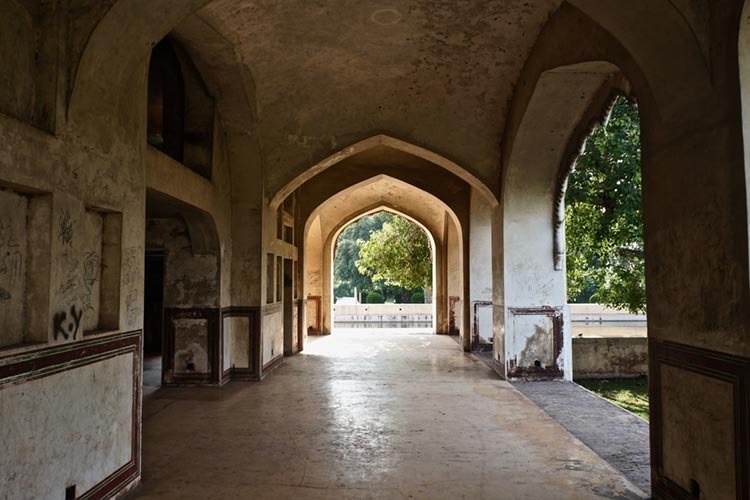
The arched corridors of Kamran ki Baradari frame a view of the surrounding gardens.
Inside, the baradari reveals its true genius. The central hall soars upward, its height accentuated by the interplay of light and shadow created by the dome's fenestration. The walls, once decorated with fresco paintings and intricate tile work, still bear traces of their original splendor. Geometric patterns in blue and white tiles create a sense of rhythm and movement, while the remaining fragments of calligraphy speak to the Mughal love of poetry and literature.
The twelve openings that give the baradari its name create a fluid relationship between interior and exterior space. This architectural concept, borrowed from Persian garden pavilions, allows the building to breathe with its environment. During the hot summer months, the strategic placement of these openings creates cross-ventilation that naturally cools the interior spaces. In the cooler months, the openings can be partially closed with screens or curtains, creating more intimate spaces for gatherings.
The floor plan reveals careful attention to both ceremonial and private functions. The central space would have served for formal gatherings, while smaller alcoves provided areas for more intimate conversations. The proportions of each space are mathematically related, creating a sense of visual harmony that extends from the smallest decorative detail to the overall building mass.
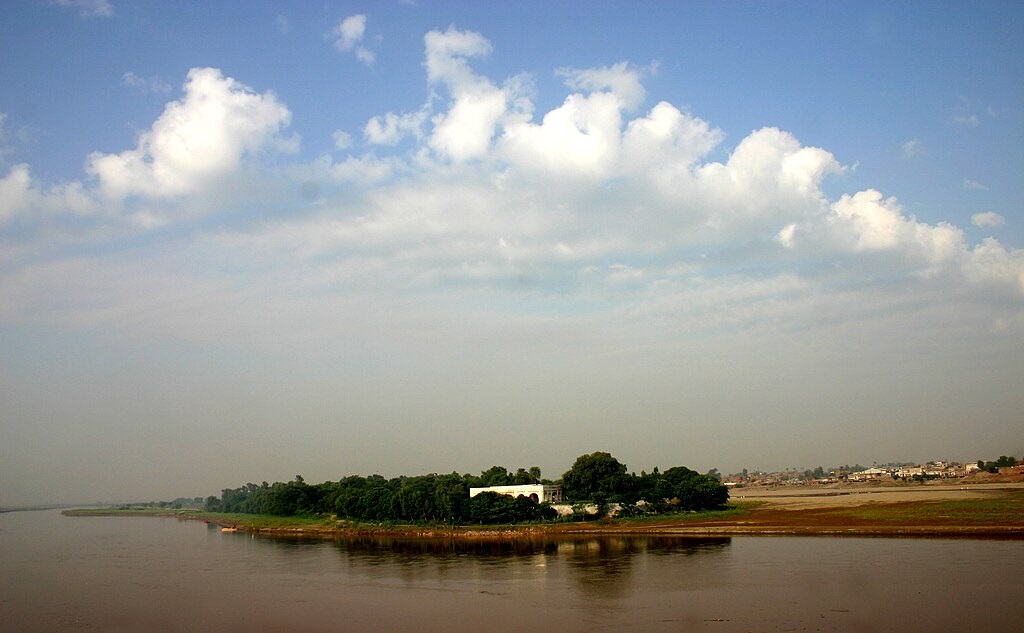
Kamran ki Baradari's pavilion is now on an island in the middle of the River Ravi.
The surviving decorative elements showcase the extraordinary skill of Mughal craftsmen. The stone carving demonstrates a level of precision that transforms hard sandstone into seemingly delicate lacework. Floral motifs, geometric patterns and calligraphic inscriptions are integrated into a coherent decorative program that enhances rather than overwhelms the architectural forms.
The use of contrasting materials creates visual interest while maintaining overall unity. Red sandstone provides the primary structural material, while white marble accents highlight key architectural elements. The interplay between these materials creates a subtle polychromy that changes throughout the day as the angle of sunlight shifts.
Original tile work, though fragmentary, reveals the sophisticated ceramic techniques employed by Mughal artisans. The predominant blue and white color scheme reflects Persian influence, while the geometric patterns demonstrate the mathematical precision that characterized Islamic decorative arts. These tiles were not merely decorative but served practical functions, helping to regulate temperature and humidity within the structure.
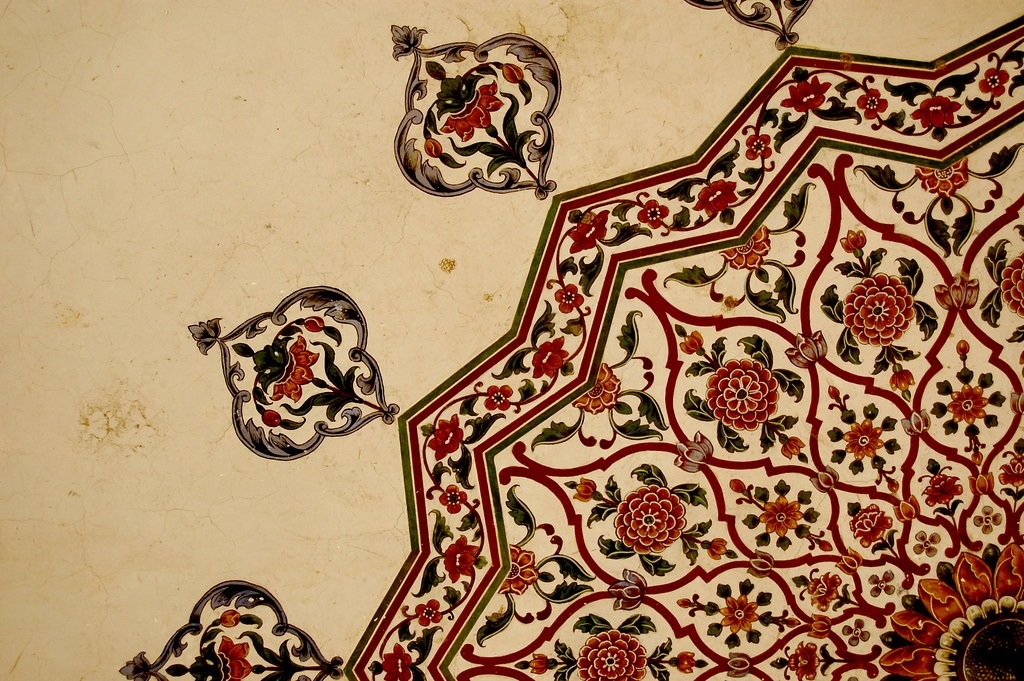
Intricate floral patterns and geometric designs adorn the decorative ceiling of Kamran ki Baradari.
Today, Kamran ki Baradari faces significant conservation challenges. Urban encroachment has altered its original setting, while environmental pollution accelerates the deterioration of its sandstone surfaces. The structure's location within a densely populated area creates ongoing maintenance issues, as modern drainage systems and vehicle traffic impact the building's foundations.
Despite these challenges, the baradari continues to function as a community space. Local residents use the structure for gatherings and celebrations, maintaining a living connection to the monument that helps ensure its preservation. This adaptive use, while sometimes creating conservation concerns, also demonstrates the enduring relevance of Mughal architectural principles.
Recent conservation efforts have focused on stabilizing the structure and documenting its architectural details. Digital surveys have created precise records of the building's current condition, while traditional craftsmen work to repair damaged stonework using historically appropriate techniques and materials.
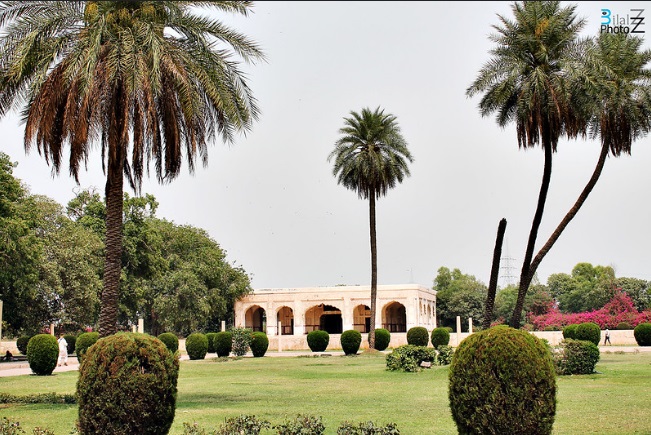
Kamran ki Baradari and its garden
Kamran ki Baradari represents more than historical curiosity, it embodies architectural principles that remain relevant today. The building's emphasis on natural ventilation, its integration with landscape, and its flexible interior spaces offer lessons for contemporary architects grappling with similar challenges. The structure demonstrates how buildings can be both monumental and human-scaled, formal and intimate, permanent and responsive to changing needs.
For visitors, the baradari offers an opportunity to experience Mughal architecture in a more intimate setting than the grand monuments of Delhi or Agra. The building's modest scale allows for careful observation of architectural details and spatial relationships that might be overlooked in larger structures. The interplay of light, shadow, and space creates a contemplative atmosphere that invites extended observation and reflection.
The monument stands as a reminder of Lahore's rich architectural heritage and the sophisticated urban culture that flourished under Mughal rule. In its weathered stones and surviving decorative elements, visitors can trace the evolution of an architectural tradition that synthesized diverse cultural influences into a distinctively Mughal aesthetic language that continues to influence South Asian architecture today.
You may also like: