Written by: Rana Kanwal
Posted on: October 24, 2025 |  | 中文
| 中文

Saba Qamar and Usman Mukhtar in Pamaal
Every once in a while, a television serial comes along that dares to move beyond clichés and explore deeper emotional territories. Pamaal is one such effort a fresh, thought-provoking drama that’s making waves even after just a few episodes. Written by Zanjabeel Asim Shah and directed by Khizer Idrees, Pamaal attempts to portray the silent struggles of women within marriage, self-worth and identity themes often glossed over or exaggerated in mainstream dramas.
The story revolves around Malika, played by the ever-versatile Saba Qamar, who enters marriage full of dreams, only to discover the harsh reality behind her new life. In the latest episodes, the plot has started unfolding more sharply revealing the man Malika chose as her life partner to be aggressive, possessive and emotionally controlling. This shift has deepened the drama’s tone and captured the audience’s attention.
What makes Pamaal Green Entertainment truly distinctive is its narrative technique: Saba Qamar narrates her life story in her own voice, as flashback scenes and present-day visuals run parallel. This storytelling style makes viewers feel as if they are hearing a woman recount her personal journey her regrets, her realizations and her rediscovery of self-worth. It’s intimate, raw and hauntingly beautiful.
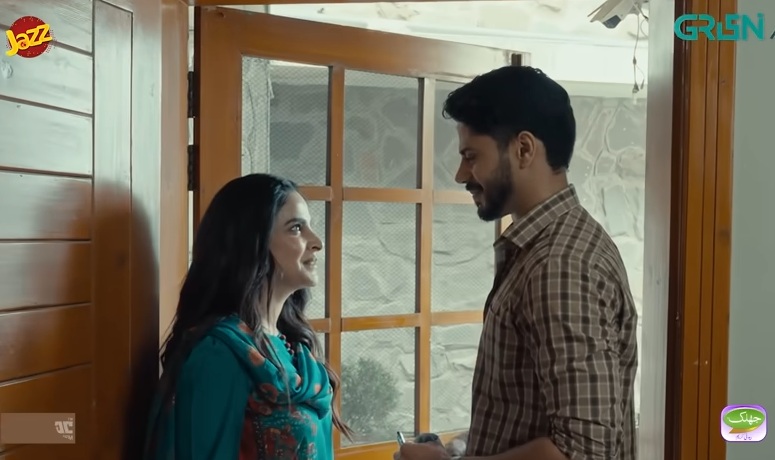
Haris Waheed and Saba Qamar
One of the strongest pillars of Pamaal Green Entertainment is its cast. Saba Qamar, known for her fearless performances, brings unmatched authenticity to Malika’s character. She balances vulnerability and resilience with grace. Her narration almost like reading pages from her diary draws viewers into her emotional world. The monologue-driven style feels as though Saba is reliving her own experiences, giving the performance an autobiographical touch that’s both powerful and relatable.
Opposite her, Usman Mukhtar portrays Raza, a man whose charm quickly gives way to possessiveness. His character’s emotional volatility and controlling behavior create tension and discomfort, which is exactly what the story demands. Usman’s portrayal captures the psychological complexity of men who appear caring but suppress their partners’ individuality.
The supporting cast, including Haris Waheed, Salma Asim and Adnan Jaffar, adds depth to the storytelling. Their well-timed performances help maintain realism and prevent the narrative from feeling one-dimensional.
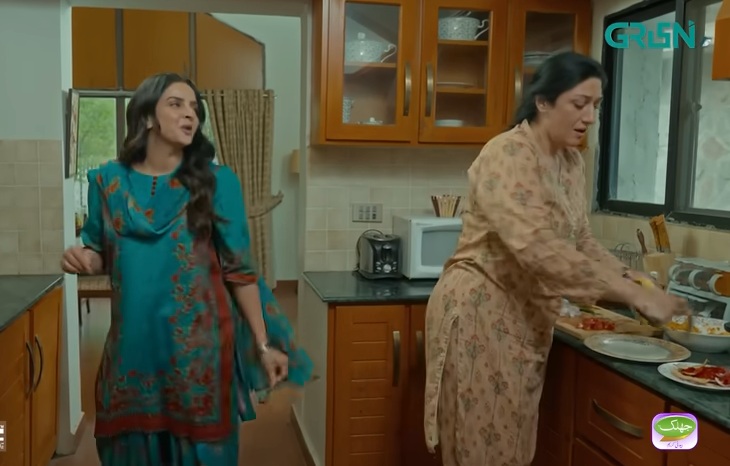
Saba Qamar and Salma Asim
Khizer Idrees’s direction in Pamaal Green Entertainment reflects a clear artistic vision. His camera work captures emotion more than dialogue highlighting silences, glances, and moments of realization. The use of light and shadows mirrors Malika’s emotional state, while the muted tones convey the suffocating calm of a troubled marriage.
The combination of voice-over narration and visual storytelling gives Pamaal a cinematic feel. Each shot feels intentional the director allows the story to breathe, emphasizing emotional authenticity rather than melodrama. This creative approach differentiates Pamaal from conventional Pakistani dramas that rely heavily on confrontation scenes and loud emotions.
Still, the pacing occasionally feels slow, especially when emotional pauses stretch too long. Yet this deliberate slowness aligns with the introspective nature of the story, giving viewers time to absorb Malika’s pain, reflection and awakening.

Usman Mukhtar and Areeba Tirmizi
At its heart, Pamaal Green Entertainment is about emotional strength, societal expectations, and the price of silence. Zanjabeel Asim Shah’s writing shines through its depth and authenticity. She doesn’t paint Malika as a helpless victim but as a woman who evolves through pain.
In the recent episodes, we see how Malika’s husband’s aggressive and possessive behavior becomes the turning point of her journey. The emotional suffocation she experiences feels real, echoing the stories of countless women who lose themselves in marriages that suppress individuality. Her growing awareness, narrated in Saba Qamar’s introspective tone, makes the audience feel her transformation in real time.
The dialogues remain crisp and meaningful, avoiding exaggeration. Each word carries emotional weight, and the story unfolds like a personal confession rather than a scripted tale. This natural flow of emotions allows the drama to connect deeply with viewers.
Pamaal Green Entertainment has stirred strong reactions across audiences. Many viewers praise its realism, relatable characters, and the freshness of its narrative structure. They admire how the drama explores complex emotions without resorting to typical melodrama.
The portrayal of Malika’s struggle has especially resonated with women, who see reflections of their own experiences in her story. The subtle depiction of control and emotional manipulation has sparked discussions on social media about psychological abuse, a topic rarely addressed on television with such sensitivity.

Saba Qamar and Usman Mukhtar
While some viewers find the pacing measured, most appreciate the deliberate storytelling style that lets emotions linger. The drama’s visual language, coupled with Saba Qamar’s narration, has kept audiences emotionally invested. Each episode ends with anticipation, leaving viewers eager to know how Malika will reclaim her strength.
The influence of Pamaal Green Entertainment goes beyond entertainment. It’s reshaping how Pakistani audiences perceive storytelling and character development. Instead of showing women as perpetual sufferers or saints, Pamaal presents them as complex, thinking individuals capable of introspection and change.
For viewers, the show offers a relatable mirror. It invites them to question how relationships are built on power, ego and silence. Malika’s narration - honest and unfiltered, becomes a voice for many who can’t express their struggles.
For the industry, Pamaal proves that Pakistani dramas can be both artistic and commercially viable. Green Entertainment’s decision to back such content shows a commitment to quality storytelling. If Pamaal continues its strong trajectory, it might inspire more producers to invest in meaningful narratives rather than predictable formulas.
From a critical perspective, Pamaal Green Entertainment excels in three major areas performance, direction and narrative innovation. The combination of Saba Qamar’s layered acting, Khizer Idrees’s cinematic vision and Zanjabeel Asim Shah’s realistic writing gives the drama a sophisticated edge.

Faiza Gilani and Adnan Jaffar
However, a few aspects still require refinement. The pacing could be slightly tightened to maintain engagement, and the character transitions of secondary roles might benefit from more depth. If these minor gaps are addressed, Pamaal could easily become one of the most influential Pakistani dramas in recent years.
In a landscape saturated with repetitive love triangles and domestic chaos, Pamaal Green Entertainment stands tall as a drama with purpose. It combines artistic storytelling with emotional truth. The decision to let Saba Qamar narrate Malika’s journey in her own reflective voice gives the series an almost autobiographical tone making viewers feel as though they are witnessing a woman’s personal awakening rather than watching a scripted show.
With its emotionally charged performances, controlled direction, and thought-provoking storyline, Pamaal is more than just an entertainment, it’s a statement. As the story continues to unfold, it promises not only to challenge norms but also to redefine what powerful storytelling looks like on Pakistani television
You may also like:

From the Horn of Africa to Bahria Town: Habesha Café Brings Centuries of Coffee Culture to Rawalpindi
(October 15, 2026)