Written by: Sana Shahid
Posted on: October 07, 2025 |  | 中文
| 中文
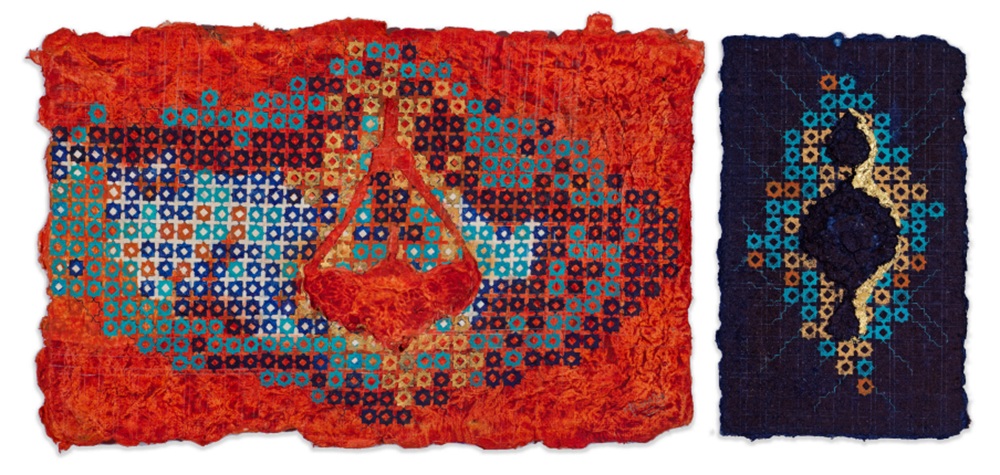
Warast ki Sargoshi I (Whispers of Inheritance) by Minaa Haroon
Minaa Haroon’s Portraits of Adornment feels like a whispered conversation between generations, a dialogue carried through metal, fiber, pigment and gold. Each piece seems to emerge from memory’s intimate folds, where a mother’s jewelry box becomes both archive and altar. The exhibition draws the viewers into that private space where adornment is not vanity, but inheritance; not mere beauty, but a record of emotion, silence and survival.
The Warast ki Sargoshi series translated as Whispers of Inheritance opens this conversation. These works, rendered in gouache, 24k gold leaf, archival ink, and dye pigment on plant fiber and paper, glimmer with a restrained luminosity. The compositions are delicate, as though the artist has captured the echo of stories passed down through touch. The repetition of the series, four pieces of equal size, suggests ritual, the way family heirlooms are handled, cleaned, and then stored again for safekeeping. The artworks are reminiscing in the form of brush strokes, a reverence for the objects that have outlived their owners yet carry their essence. Each “sargoshi,” or whisper, becomes a fragment of storytelling, coded in gold and pigment rather than language.
From whispers, Haroon moves toward celebration in the Zebaish (Adorning) series. These paintings enlarge the idea of jewelry into a meditation on power, femininity, and self-presentation. The same materials, gouache, gold leaf, ink reappear, but the compositions feel more assertive, less like whispers and more like declarations. The textures of plant fiber carry a tactile weight, as though the surface itself is breathing. The title Adorning doesn’t refer simply to the act of decoration; it suggests agency, a reclaiming of adornment as empowerment. Haroon’s brushwork turns jewelry into architecture, lines and shapes into emotional scaffolding. The gold leaf shines not as embellishment but as evidence of endurance, a trace of women who refused to be erased.
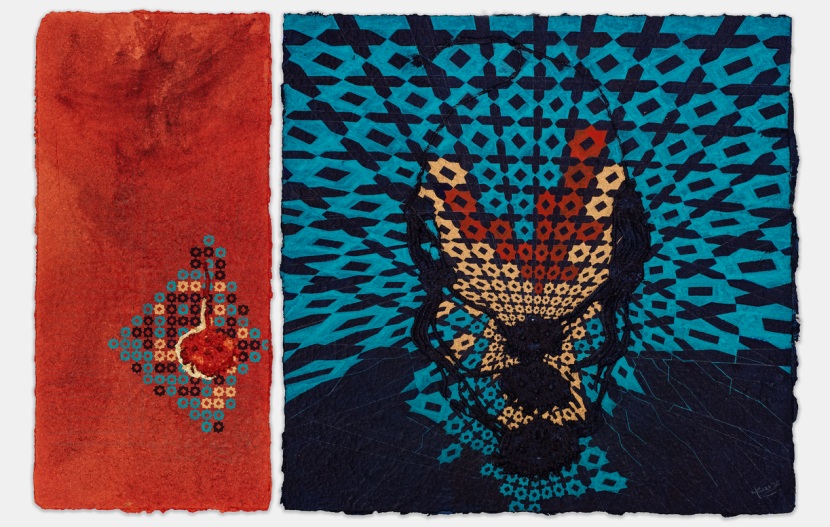
Zebaish VI (Adorning) by Minaa Haroon
In Hujla-e-Aroosi (Bridal Chamber), Haroon moves from the external to the internal, from what is worn to where one is enclosed. The bridal chamber, traditionally a space of both beauty and confinement, becomes her site of excavation. The three versions of Hujla-e-Aroosi seem to vary in size and tone, yet share a haunting intimacy. They appear as dreamlike rooms built of pigment and light, layered with memory. The titles alone carry centuries of expectations, rituals, and silences imposed upon women. But Haroon doesn’t depict these chambers as prisons; rather, they shimmer with quietness. Within these spaces, the gold and paint pigment create thresholds between vulnerability and strength, between inherited roles and the will power.

Hujla-e-Aroosi V (Bridal Chamber) by Minaa Haroon
The Tasht-e-Khawab (World of Dreams) extends this dream logic even further. The scale grows, the imagery feels expansive, as if Haroon has broken open the boundaries of the bridal chamber. Her use of plant fiber and gold leaf here feels unworldly, the adornments have become constellations, floating in an imagined sky of memory. The artist seems to weave personal and collective memory into a single tapestry, where adornment transforms from material object into metaphor. Gold becomes memory’s residue, shining even after the body and its boundaries fade.
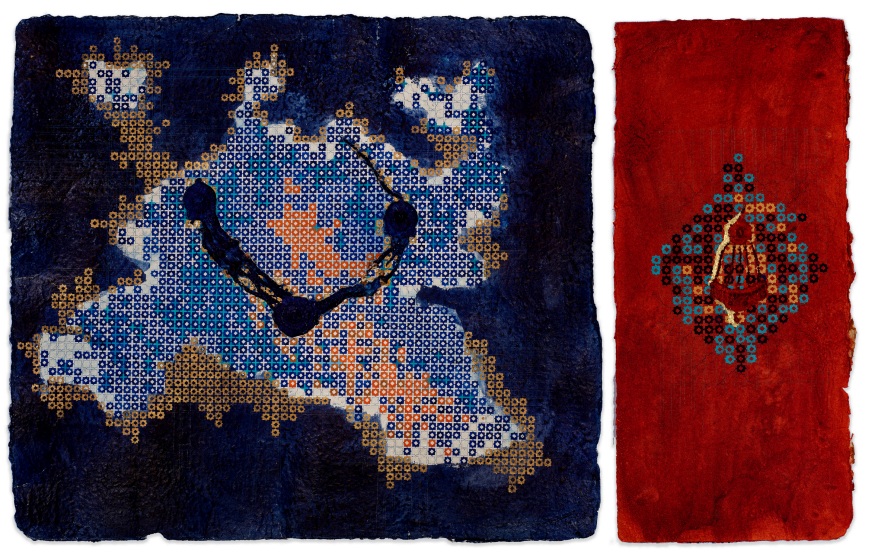
Tasht-e-Khawab V (World of Dreams) by Minaa Haroon
The Kun Ras (Music Lover) series offers a different rhythm altogether. The use of jute plant fiber and direct dye gives these paintings an earthy, tactile quality. Compared to the quiet elegance of her gold-leaf pieces, Kun Ras vibrates with energy as if the sound of tabla or sitar were resonating through the fibers themselves. These works seem to honor another form of adornment not jewelry this time, but the adornment of sound, of rhythm, of joy. They recall South Asian traditions where music, color, and ornamentation converge in celebration.
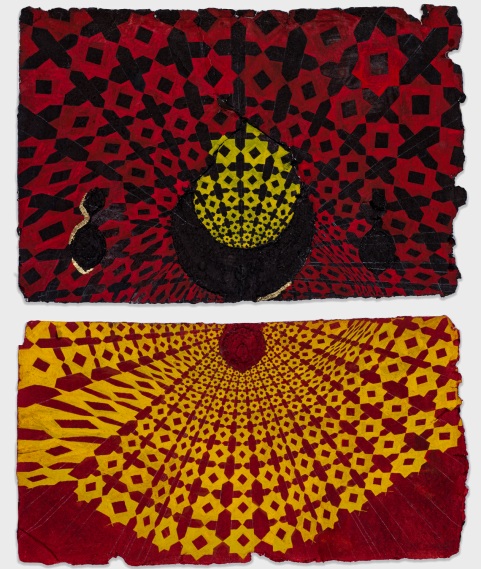
Kun Ras II (Music Lover) by Minaa Haroon
Her earlier Necklace works from 2020, by contrast, feel like sketches of thought, quiet studies where adornment becomes abstraction. Without pigment or gold, these works rely on texture, material, and shadow. The restraint is striking; they appear almost like fossils of jewelry; impressions left behind after the objects themselves have dissolved. These necklaces are less about display and more about absence, about what remains when beauty is gone, when metal oxidizes, when memory alone must carry the weight of connection.

Necklace IV by Minaa Haroon
Across all these series, one feels Haroon’s deep engagement with the idea of inheritance, not as property or possession, but as emotional lineage. The plant fiber throughout her practice grounds the work in organic continuity, as if the paper itself were alive, whispering with the breath of the women whose stories she tells. Her consistent inclusion of 24k gold leaf introduces tension between fragility and permanence. Gold, that most enduring of materials, becomes her language for resilience; yet its brilliance is softened by the tenderness of gouache and ink. Haroon’s artistry lies not only in her technique but in her ability to make stillness speak. Each piece feels like an artifact, yet also like a living being, breathing, remembering, mourning. In reframing jewelry and adornment as cultural text, she turns the personal into political.
Portraits of Adornment is less an exhibition than an act of reclamation. It brings to light the unseen labor of memory, the silent poetry of the domestic, and the emotional intelligence embedded in things we once dismissed as decoration. Through her luminous, layered surfaces, Minaa Haroon reminds us that adornment is not frivolous, rather it is survival, it is storytelling, it is resistance wrapped in gold.
You may also like:

From the Horn of Africa to Bahria Town: Habesha Café Brings Centuries of Coffee Culture to Rawalpindi
(October 15, 2026)