Written by: Anum Zaeem
Posted on: November 18, 2025 |  | 中文
| 中文

The weathered brick walls of Sheikhupura Fort stand as a reminder of Mughal grandeur and Sikh artistry.
About 36 kilometres northwest of Lahore, in the vibrant heart of Punjab, stands Sheikhupura Fort or Qila Sheikhupura, as locals call it.
It was commissioned around 1607 CE by the Mughal Emperor Jahangir, the same ruler who left behind architectural gems like Hiran Minar and the Shalimar Gardens. Jahangir wasn’t simply building another fortress; he was creating a royal retreat in his favourite hunting grounds.
This area, once dense with forests and wildlife, was his escape from court politics and the pressures of the throne. The fort’s elevated position allowed clear views of the plains, and its design balanced defence with luxury, reflecting Jahangir’s signature mix of power and poetry.
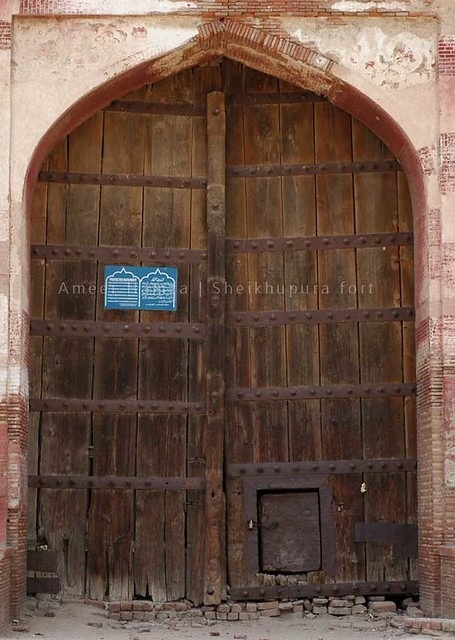
The grand wooden gateway of Qila Sheikhupura, once opened for Mughal emperors and later for Sikh royalty.
The story of Sheikhupura Fort is less a timeline and more a transformation, each era leaving its own fingerprint on the red brick walls.
When Jahangir first ordered its construction, the fort served as a hunting lodge and mini stronghold, guarding the imperial hunting grounds that surrounded the nearby Hiran Minar. Jahangir mentions the area fondly in his memoir Tuzuk-i-Jahangiri, proof that Sheikhupura was part of his personal world of retreat and reflection.
Fast forward two centuries, and the Mughal Empire weakens, and Maharaja Ranjit Singh’s armies march in. By 1808, the fort was under Sikh rule. Ranjit Singh, instead of using it as a military outpost, gifts it to his wife Datar Kaur (Mai Nakkain). She transforms it into her residence and cultural haven, adding elegant havelis inside and filling them with vibrant Sikh frescoes and murals. These artistic touches softened the stern Mughal geometry and gave the fort a gentler, lived-in beauty.
Then came the British, bringing their administrative stamp to the story. The fort briefly served as a district headquarters, then as a shelter for refugees after Partition in 1947. By the time independence arrived, Sheikhupura Fort had seen emperors, queens, soldiers, and settlers, each one shaping its destiny in a different way.
Today, though weather-beaten and weary, the fort still stands tall, a silent storyteller of Punjab’s shifting centuries.
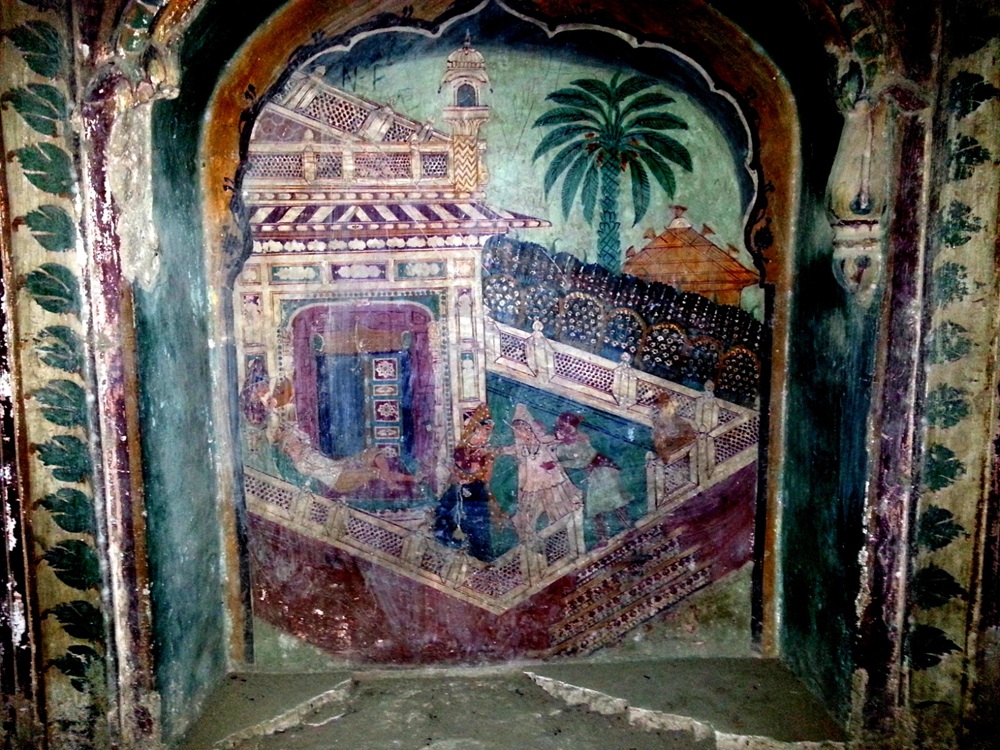
Kangra style fresco in Datar Kaur's haveli depicting a royal palace scene with courtly figures.
Sheikhupura Fort doesn’t impress with sheer ornamentation alone; it captivates through contrast, a marriage of Mughal symmetry, Sikh colour, and colonial practicality.
The fortress itself is almost perfectly square. Each corner is anchored by an octagonal bastion, while smaller semi-circular bastions line the walls, giving it the defensive might typical of Mughal military design.
The main gateway, facing east, still bears traces of carved stone and geometric detailing. Step through it, and you enter a world that shifts in mood: the outer walls whisper of war and vigilance, but the inside speaks of peace and art.
Within the courtyard lie the Sikh-era additions, most notably Datar Kaur’s haveli, adorned with delicate floral frescoes, calligraphy panels, and painted ceilings. Though faded, the colours and patterns still shimmer when sunlight hits the cracked plaster, offering a glimpse of what the fort must have looked like in its prime.
The architecture of Sheikhupura Fort is, in essence, a dialogue between eras: the Mughals gave it form, the Sikhs gave it soul, and the British gave it endurance.

Interior building of the fort showing multiple levels and arched doorways.
A few kilometres away rises the serene Hiran Minar, built by Jahangir to honour his beloved antelope Mansraj. Surrounded by a vast water tank and an octagonal pavilion, Hiran Minar was a symbol of affection and imperial leisure.
Together, Sheikhupura Fort and Hiran Minar formed a royal ecosystem, the fort serving as a residence and command post, and Hiran Minar as the emperor’s memorial and leisure ground.
Visiting both in one trip gives you a full picture of Mughal life beyond Lahore’s grandeur, intimate, emotional, and deeply tied to nature.

Side view of the fort's entrance gate and defensive walls.
Centuries of neglect have taken their toll. Time, weather, and human carelessness have stripped away much of the fort’s finer detail. Walls crumble, frescoes fade and many chambers are unsafe to enter.
But not all is lost. The Punjab Archaeology Department, with international conservation partners, has begun a three-year restoration project to stabilise the structure and revive key sections for tourism.
Even in its current state, Sheikhupura Fort remains hauntingly beautiful. Its massive walls glow red at sunset, and its echoes carry the weight of empires. Photographers love it for its raw, unfiltered texture, a rare fort that still feels authentic rather than restored for show.
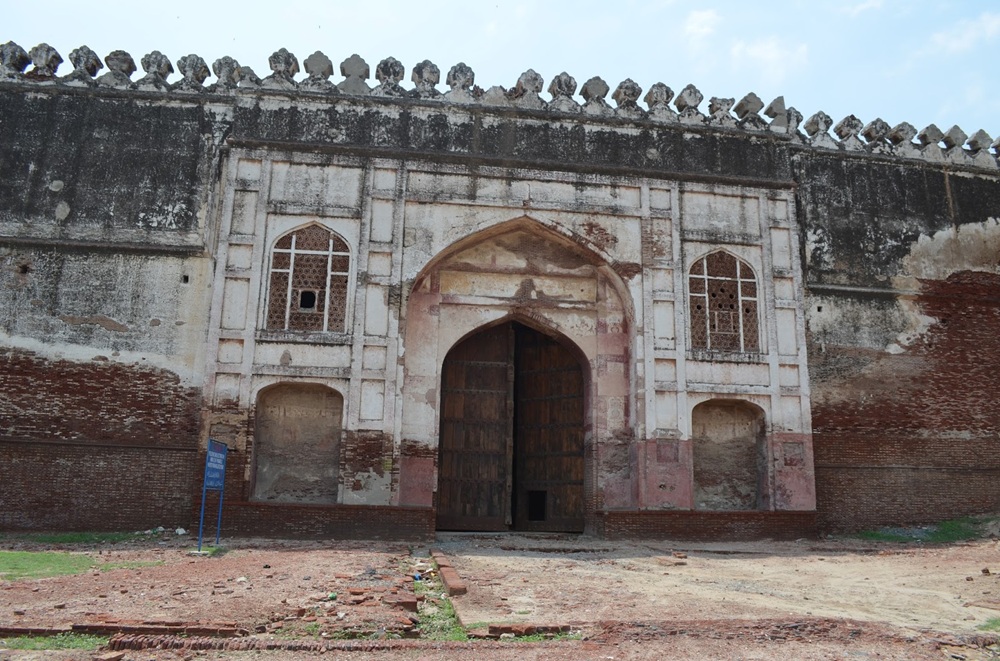
The main entrance of Sheikhupura Fort with its central arched gateway.
Sheikhupura Fort is not just another old structure; it is a living chronicle carved in red brick, where Mughal vision met Sikh artistry and colonial endurance.
If you stand quietly inside its walls, you can almost hear the distant echoes of royal hunts, the laughter from Datar Kaur’s haveli, and the rustle of centuries passing through its corridors.
It’s a reminder that history doesn’t just belong in books; sometimes, it waits in silence behind ancient gates, just an hour’s drive from Lahore.
You may also like: