Written by: Saram Maqbool
Posted on: July 25, 2025 |  | 中文
| 中文
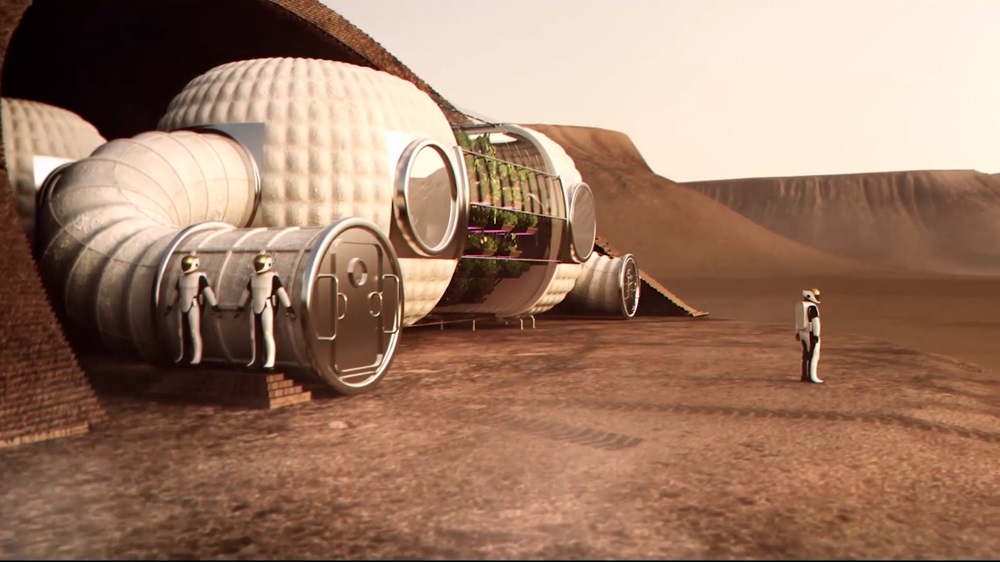
Mars Habitat by Foster + Partners
Architects, for centuries, have tried to create designs that have aimed to reach, or at least in some form mirror, the cosmos. The inherent geometry of the stars above us has intrigued designers in several ways, prompting the Mayans and Egyptians to align their significant structures with astronomical events. Today, the marriage of architecture and space is heading to a whole new level, thanks to the growing interest in exploring Mars as a potential second home for us earthlings.
The concept of establishing human settlements on Mars, once confined to science fiction, is rapidly gaining traction as a genuine architectural and engineering pursuit. Driven by advancements in space exploration and the urgency to find alternatives to Earth’s increasingly strained ecosystems, architects, scientists, and visionaries are now seriously exploring how life could be sustained and structured on the Red Planet. This isn’t quite as simple as aligning structures with the stars, however, as radiation, extreme temperatures, low gravity and dust storms are just a few of the very real challenges designers need to consider. This, of course, is apart from the very real logistical issue of transporting materials across 54.6 million kilometers of space. Despite all that, we are seeing more and more innovative solutions to how architecture on Mars could look like in the future.
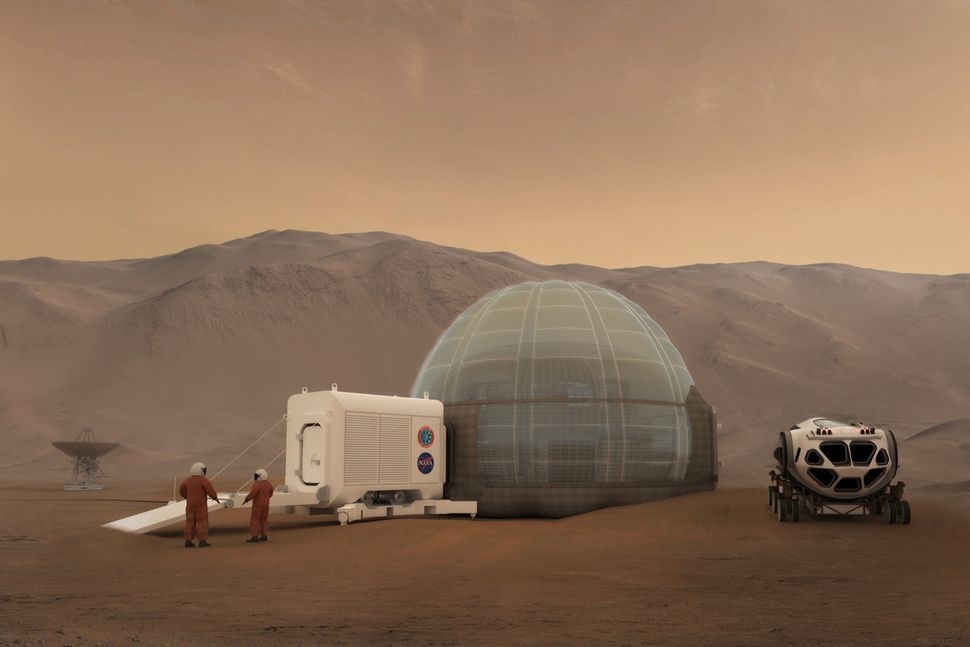
A vehicle rests outside of the Mars Ice Home
One of the most prominent examples of Martian architecture is NASA's 3D-Printed Habitat Challenge, which invited architects and engineers to develop sustainable housing solutions using materials found on Mars. The winning project, MARSHA by AI SpaceFactory, proposed a vertical, egg-shaped habitat that prioritizes internal pressure resistance and minimizes surface exposure to harmful radiation. Unlike traditional horizontal buildings on Earth, MARSHA is designed to be built using automated 3D printing robots and Martian regolith - a layer of loose dust and rock on the surface. Its structure employs basalt fiber extracted from the regolith, mixed with biopolymer resins transported from Earth or manufactured from local Martian microbes. This combination of local and bio-derived resources makes the habitat not only efficient but adaptable to Mars’s isolated environment.
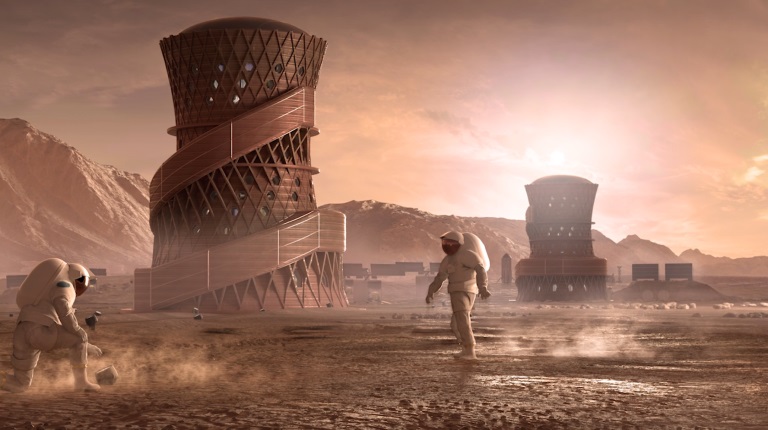
NASA's 3d Printed Habitat Challenge
Other design proposals have explored inflatable modules that can be deployed and expanded upon landing. Foster + Partners collaborated with the European Space Agency to design a modular habitat system incorporating inflatable interiors protected by a shell of sintered regolith. Sintering involves heating regolith to the point where particles fuse without melting, forming solid bricks or panels. This technique could potentially be carried out using solar concentrators, reducing the need to transport building supplies from Earth. The resulting structure is a fusion of lightweight, deployable technology and durable local protection, blending the best of Earth-based and extraterrestrial building methods.
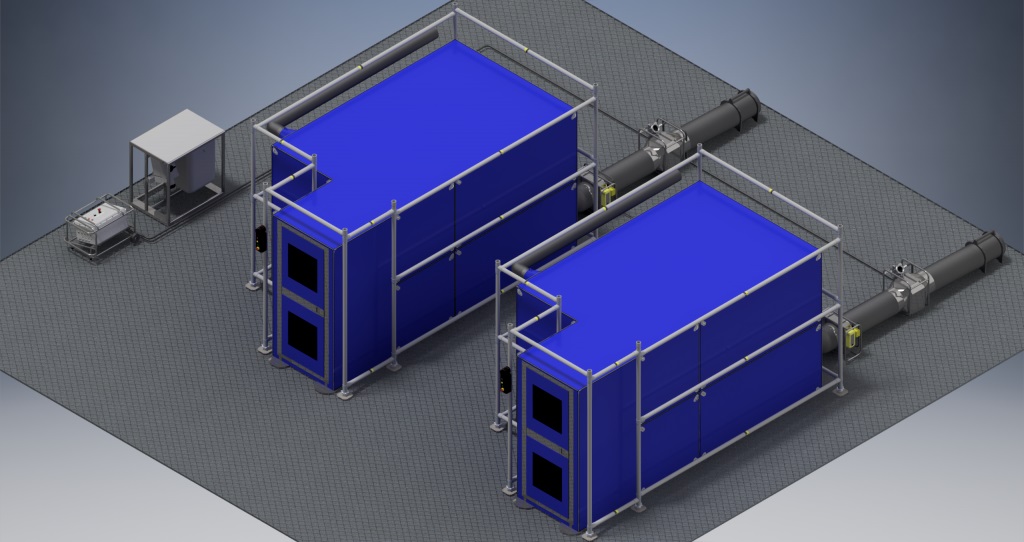
Modular Habitat System design
Designs like Xavier De Kestelier's 3D-printed domes also consider how future Martian cities might expand. These domes utilize a lattice structure filled with Martian soil to provide insulation and shielding. The outer shell protects from radiation while the inner layer supports pressurized human environments. Instead of building from the ground up, these habitats are often semi-subterranean or built into the sides of craters and lava tubes to take advantage of the natural protection the Martian landscape provides. The importance of building underground is further supported by research from the Mars Society and the University of Puerto Rico. Their Mars Ice Home concept proposes structures that harness the abundance of water ice in the Martian subsurface. The habitat consists of a dome inflated with air, covered in a thick layer of ice harvested from the ground. This translucent ice not only provides radiation shielding but also allows diffused natural light to enter, creating an atmosphere closer to Earth’s daylight cycles.
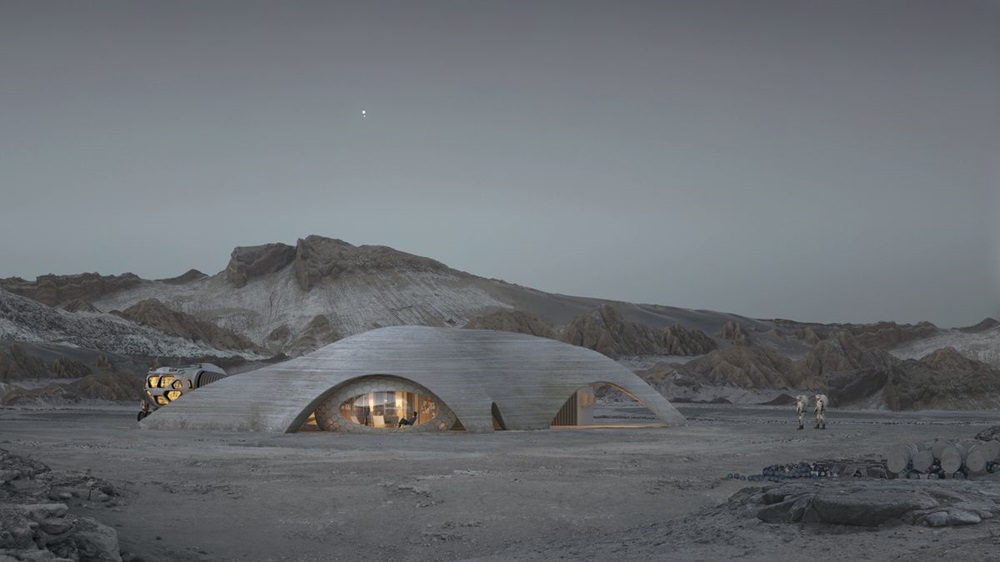
3D Printed Domes by Xavier De Kestelier
The question of how to build on Mars is deeply connected to the methods of construction. Conventional machinery won’t function properly in the harsh Martian climate, and human labor will be limited. Autonomous robotics, therefore, are central to all proposed projects. Robotic rovers could be deployed in advance to clear terrain, dig foundations, and print basic structures layer by layer before humans ever arrive. Energy generation is another foundational challenge that Martian architecture must solve. While solar panels are a clear candidate, their efficiency is affected by frequent dust storms that can block sunlight for days or weeks. Projects like the Mars Dune Alpha, by BIG (Bjarke Ingels Group), consider energy redundancy, combining solar with nuclear mini-reactors such as NASA’s Kilopower units. These compact reactors could ensure a stable power supply for essential life support, heating and even the manufacture of building materials onsite.
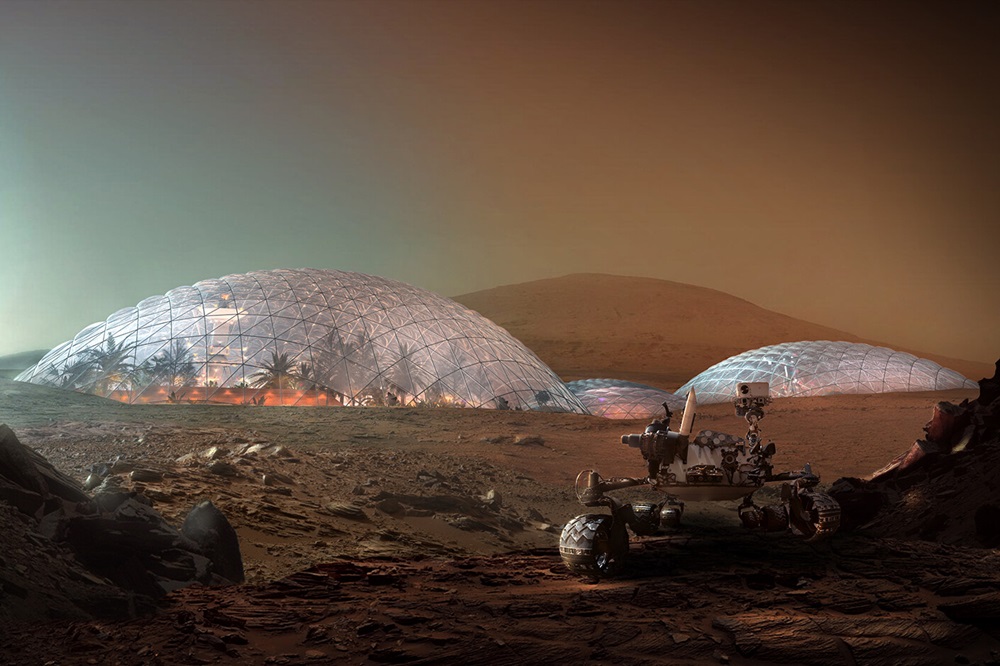
Mars Dune Alpha by BIG
The path to building on Mars is not only a technical challenge but a cultural one. The designs we’re so used to seeing on Earth must be reimagined pretty much completely. Mars has one-third of Earth’s gravity, no breathable atmosphere, and a unique terrain that demands new typologies. Earth’s skyscrapers and sprawling suburbs are irrelevant there, and every part of the built area, from walls to windows, must serve a specific purpose to shelter and protect.
In the end, the architecture of Mars is about more than survival, it is a profound experiment in human adaptation. Every prototype shared thus far tells a story of ingenuity. These structures, born from Earth’s imagination, may one day stand as humanity’s first footprint beyond our cradle. Architecture on Mars will test a new way of living and so it must break free from our Earthly norms. The future Martian architecture reminds us that to build among the stars, we first need to redesign the very concept of what is home.
You may also like: