Written by: Muhammad Hamza
Posted on: October 29, 2025 |  | 中文
| 中文
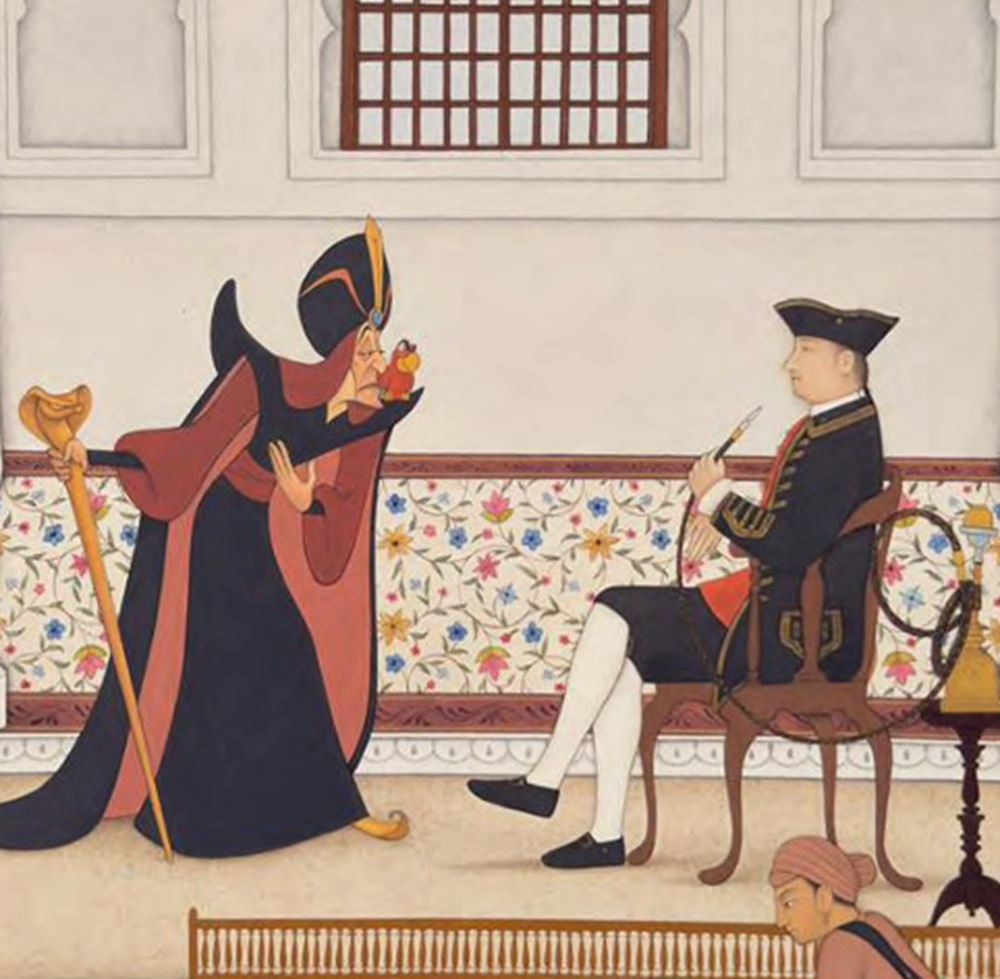
Untitled III
Farhat Ali’s latest exhibition, The Stuff That Dreams Are Made Of, feels like stepping into a dream where ancient tales meet Saturday morning cartoons. Housed at Khaas Gallery in Islamabad, this collection of new works pulls you into a playful yet profound mash up of Pakistani miniature painting traditions and the colorful chaos of animated stories. Ali, a rising star from Sindh, invites us to peel back the shiny surfaces of these familiar forms. What starts as fun quickly reveals deeper emotions, love, loss, war and quiet fears, that echo through both old art and modern kid’s shows.
Ali’s path to this point is as layered as his paintings. Growing up in Badin, he kicked off as a signboard painter, thanks to his mother’s nudge to see the world like an artist. For a decade, he honed his skills with brushes and bold colors on street signs. Then came formal training at the Center of Excellence in Art and Design in Jamshoro, followed by a standout BFA from the National College of Arts in Lahore. Fiction has always fueled him, stories that twist and turn, sparking his love for narrative. Over the years, he’s shown in group shows, solo gigs and big international spots like the Dubai Art Fair and India Art Fair this year. He even made the shortlist for the Sovereign Art Prize. His pieces have popped up in Sotheby’s auctions in New York, twice now. Earlier highlights include solos like How Did I Get Here and What Belongs to You at Sanat Gallery in Karachi, plus Green Signal at Zahoor ul Akhlaq in Lahore. He’s also joined curations such as Inspire under William Titley and Sindh: Reverberating Sound Echo Through Desert at Koel Gallery.
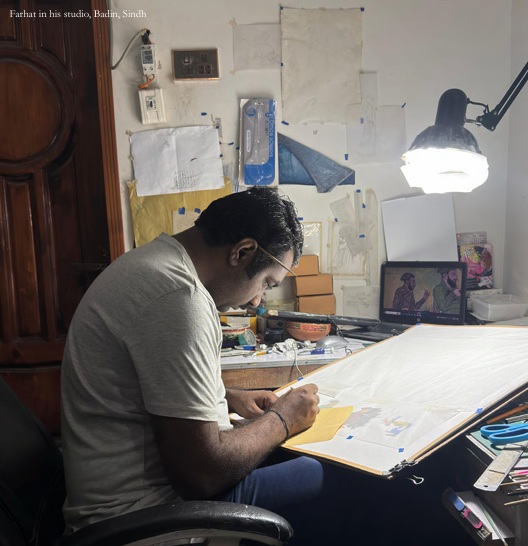
Farhat Ali working in his studio in Badin, Sindh
In his studio shots from Badin, you catch Ali at work, hunched over a drawing board, surrounded by sketches, fabrics, and glowing screens. It’s a cozy chaos: wooden walls, dangling bulbs and half-finished ideas pinned up like secrets. This setup mirrors his art, blending the handmade with the digital, the local with the global. Ali’s statement hits the nail on the head; these works critique how miniature painting has become a hot trend in Pakistan’s art scene. But he flips it by fusing it with pop culture from television cartoons. The flat, bold lines of animated characters inspire him, leading to images that unpack hidden layers. Grief in a goofy chase, passion in a villain’s glare, fear behind a hero’s smile. He wants us to look closer, to spot those buried meanings in miniatures and Mickey Mouse alike.
Take Untitled I. Here, a serene scene unfolds with figures in flowing robes, one drawing a bow amid misty grays and soft pinks. A barrel sits like a silent witness, a flower blooming defiantly nearby. It’s pure miniature elegance, delicate lines, jewel tones, but wait. The archer’s stance echoes cartoon heroism, that split second tension before the arrow flies. Ali’s gouache and shell gold on wasli paper give it a luminous glow, like sunlight filtering through old palace windows. Yet, under the poise, you sense unease, the bowstring pulled taut, ready to snap. It’s love as a weapon, or war dressed in silk.

Untitled I
Then there’s Untitled II, a tender embrace that steals your breath. Snow White, reimagined in ethereal whites and blues, hugs a dwarfish figure in a golden lit frame. Seven dwarfs, peek from ornate borders, their faces a mix of mischief and melancholy. The central pair, her gown flowing like water, his form sturdy yet vulnerable, feels like a fairy tale frozen mid whisper. Ali layers in gold leaf for sparkle, but the closeness hints at isolation. In cartoons, hugs fix everything; here, it’s a grip on fleeting joy, grief bubbling just beneath the happily ever after.
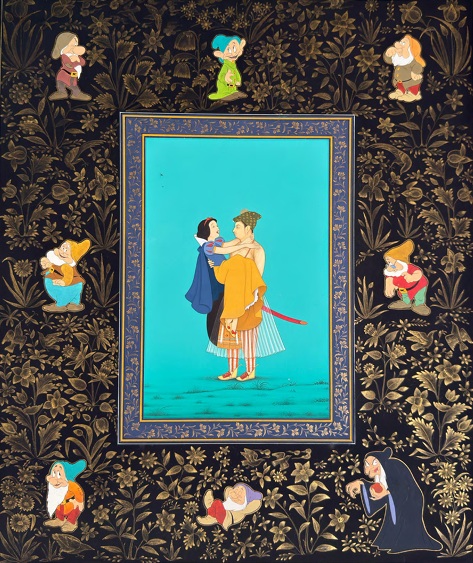
Untitled II
Ali’s magic lies in these collisions. Untitled III dives into Aladdin territory, but twisted through a Mughal lens. A grand archway frames a sultan in robes, chatting with Jafar over hookah smoke. Jasmine lurks in shadows, a tiger prowls the edges, and Abu swings from vines in the margins. The colors pop, deep reds, electric blues, against intricate borders that swirl like desert winds. It’s a palace intrigue, but the genie’s lamp dangles like a forgotten wish. Ali uses shell gold to make the scene shimmer, critiquing how miniatures often glorify power. Cartoons add the whimsy, but the fear lingers, one wrong rub, and the magic turns monstrous.
Not all are star studded. Untitled IV strips it down to a lone wanderer in a vast landscape, staff in hand, trailed by tiny companions. Birds wheel overhead, trees bend in the breeze. The figure’s drape, simple cloth over bare skin, evokes ancient pilgrims, but those followers? Cartoon critters with expressive eyes, carrying burdens that look too heavy for paws. Gouache builds subtle gradients from dawn pinks to twilight blues, inviting you to walk alongside. What dreams chase this traveler? Passion unmet, or wars left behind? Ali’s flat cartoon influence flattens the depth, forcing us to read between the lines, much like life’s own unfinished stories.

Untitled III
The Tom and Jerry vibes ramp up in Untitled V and VI. In one, a chase spills across the canvas, cats in turbans, mice in mischief, tumbling through floral motifs. Another shows Jerry like imps dancing around a bemused Tom in royal attire, tails flicking like sabers. Fabrics weave in for texture, adding a tactile pop to the gouache smoothness. These are pure fun at first glance, slapstick in miniature form. But linger, and the frenzy unfolds, endless pursuits mirroring real chases, loves that slip away, fears that nip at heels. Ali’s critique shines here; miniatures, once courtly and calm, now buzz with pop chaos, exposing how both hide raw human mess.
Untitled VII shifts to quieter drama. A woman in saffron sits under blossoming branches, cradling a lute while a deer rests nearby. Her gaze is distant, fingers poised mid note. The scene’s harmony, emerald greens and cherry whites, feels like a Mughal idyll. Yet, the deer’s alert ears and her shadowed eyes whisper unrest. Is this passion’s pause, or grief’s prelude? Cartoon flatness creeps in with bold outlines, making the serenity feel staged, like a frame from a forgotten episode.
Deeper still, Untitled VIII layers on the surreal. Figures in geometric robes gather around a central void, hands outstretched toward swirling voids. Gold accents catch the light, but the emptiness pulls you in, war’s aftermath, perhaps, or love’s hollow echo. Borders teem with hybrid beasts, half myth, half toon. Ali masterfully blends techniques, letting shell gold elevate the mundane to magical.

Untitled VIII (Detail)
Smaller gems like Untitled IX pack punches in intimacy. A solitary silhouette against a stormy sky, umbrella shielding secrets. Rain in miniature is poetic, delicate strokes, but the figure’s hunch screams cartoon despair, that “why me” slump. Untitled X counters with communal warmth, a circle of elders sharing tales under lanterns, faces lit by inner fire. Yet, shadows hint at unspoken wars, passions faded.
The tiniest, Untitled XI, closes the loop with a child’s wonder, a bird mid-flight, wings spread in gold kissed blue. Simple, yet it captures dreams’ essence, fragile, fleeting, full of hidden flights.
Ali’s show isn’t just pretty pictures; it’s a mirror to how we consume stories. Miniatures, once elite whispers of courts, now sell like hotcakes, stripped of depth. Cartoons, meant for laughs, bury traumas in tropes. By smashing them together, Ali revives the layers, inviting us to laugh, then ache, then question. His wasli grounds it all in tradition, while gouache and golds breathe modern life. Its institutional critique wrapped in whimsy, proving art’s power to unsettle sweetly.

Untitled X
In a world craving quick fixes, The Stuff That Dreams Are Made Of reminds us that dreams aren’t fluff. They’re stitched from grief’s threads, love’s knots and war’s scars. Ali, from signboards to Sotheby’s, proves you can start small and dream big. This exhibition lingers like a half-remembered tale, funny, fierce, forever unfolding. Catch it before the credits roll.
You may also like:
From the Horn of Africa to Bahria Town: Habesha Café Brings Centuries of Coffee Culture to Rawalpindi
(October 15, 2026)