Written by: Muhammad Suhayb
Posted on: October 17, 2025 |  | 中文
| 中文

Usman Peerzada and his wife, Samina Peerzada
It was during a chance encounter at the premiere of a recent Urdu film that veteran actor-director Usman Peerzada was seen chatting with a news reporter. He was there to support his wife, Samina Peerzada, who recently played the role of a ghost-afflicted grandmother in Rafay Rashdi’s award-winning film Deemak.
A friend’s offhand comment: “Usman Peerzada kar hi na lein Urdu film”, only confirmed my suspicion that he knew little about Usman and his remarkable connection with cinema. His words instantly transported me fifty years back, to an era when Usman and his films were the talk of the town. Coming from a non-film background, he had, with his very first feature, emerged as the next big thing in Pakistani cinema.
Usman Peerzada made his screen debut in ad filmmaker Javed Jabbar’s Beyond the Last Mountain, Pakistan’s first film to be made entirely in English, in which Usman played the lead role. A social and political drama, Beyond the Last Mountain portrays the clash between idealism and corruption in a developing society. At the same time, he was also starring in Saazish, the first-ever Pakistan–Sri Lanka co-production, where he portrayed a dual role. Unlike Beyond, he was seen lip-syncing to the voices of Ahmed Rushdi, Masood Rana, A Nayyar and Ghulam Abbas in Saazish (1976).
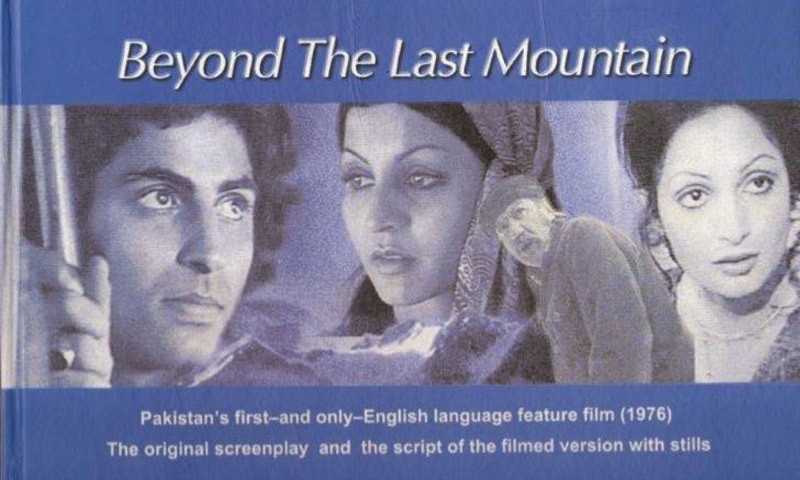
Beyond the Last Mountain
These films created quite a stir, and he was soon cast as a leading man in several Urdu films. However, this was a time when Urdu cinema was in decline, increasingly overshadowed by the growing popularity of Punjabi films. The solo-hero format had become rare, replaced by ensemble casts in a last-ditch effort to hold audiences. Usman often shared the screen with stars like Shahid and Ghulam Mohiuddin, but one of his more memorable roles was in Rangeela’s Aurat Raj, where he played the “normalizer” in a satire well ahead of its time.
As we spoke about the earliest days of his career, Usman admitted he had lost count of the years. Born in May 1951 in Lahore to the legendary Rafi Peer, a pioneering playwright and actor who laid the foundation for theatre in Pakistan, Usman Peerzada had the good fortune of being nurtured in a deeply artistic environment from the very beginning.
"I began my journey in theatre during my time at Government College, Lahore, some sixty years back, it was not yet a university in those days. I was part of a dynamic group that also included actor Salman Shahid and the late writer and intellectual Imran Aslam. Together, we immersed ourselves in the world of theatre, both as performers and collaborators. The plays we staged on campus received an overwhelmingly positive response from the audience, which was incredibly encouraging. That early appreciation instilled in us a sense of purpose and affirmed that we were on the right path."
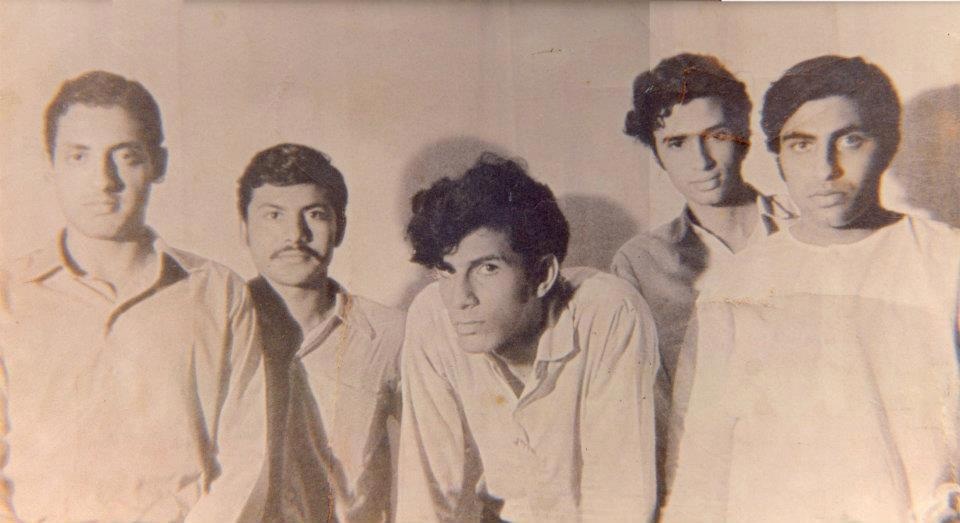
Salman Shahid, Nazir Kamal, Imran Aslam, Sarwat Ali and Usman Peerzada
Usman fondly recalls Dark Room, a play written by poet and playwright Sarmad Sehbai, as one of his earliest theatrical experiences. That production marked the beginning of a series of performances that followed. With Sarmad Sehbai on board, Usman’s theatrical flair finally began receiving the recognition it deserved. At the time, television had just arrived in Lahore and was quickly becoming a major cultural force. Usman, then a college student, hoped his father might use his influence to help him secure a role on television. However, he soon realized his father’s deep commitment to professionalism.
“It would have been easy for him to get me into television,” Usman reflects, “but he believed strongly in merit.”
It was only after persistent efforts, particularly with Moneeza Hashmi, the daughter of legendary poet Faiz Ahmed Faiz, that Usman was finally granted an audition. ‘’It was taken in the early hours of the day and by the evening I was giving my first shot, LIVE on television for a drama. We were cast in a scene set in a restaurant, where a young man brings in a girl but has no money to pay the bill. The late Ali Ejaz sahab played the waiter, while I was selected for the role of the boy. Sarwat Atiq was chosen for the female lead over Roohi Bano. Though Roohi was an exceptionally talented actress, at the time she struggled with voice modulation and didn’t quite meet the requirements of the scene. That said, she went on to grow tremendously as a performer and later established herself as one of the finest in the industry”, Usman Peerzada remembers as it was yesterday.
Usman did not find television as compelling as theatre in the early days, and eventually returned to the stage, his true passion. For someone whose father, Rafi Peer, was a towering figure in Pakistani theatre, performing in both Urdu and English came naturally. Although he gained significant recognition on TV with his double role in Rana Shaikh’s Doosra Aadmi in 1973, it was the theatre that truly held his heart.

Usman Peerzada during a theatre play in 1974
Around that time, the American Centre (USIC) began supporting theatrical productions, and Usman became actively involved. The group toured extensively across Pakistan, performing in various cities. It was during one of these tours that Usman encountered an unexpected opportunity.
"We were doing the Urdu adaptations of some classic plays all over Pakistan. Backstage, in one of the shows in Karachi, I had the chance to meet Shabnam and Javed Jabbar," he recalls. "I initially thought Shabnam, who was related to me through my aunt, had come to greet me. But in fact, it was her husband, Javed Jabbar, who had come with a surprising offer: the lead role in his upcoming film Musafir in Urdu, and its English counterpart, Beyond the Last Mountain." Renowned journalist Marianah Haq, known at the time as Marianna Babar, also accompanied them on the visit, as she was one of the leads in the film.
Beyond the Last Mountain (BTLM) was an experiment that was not successful at the box office, but was applauded in various countries, especially India. Bollywood also had Usman calling, but he was least interested. Born into a remarkably talented and proud ‘Pakistani’ family, Usman Peerzada is part of the enduring legacy of his father, which is being carried forward by his siblings. His brother Saadaan Peerzada continues to uphold the family’s theatrical tradition, while Salmaan and Imran have made their mark in cinema and television as actors and filmmakers. His sister, Tasneem Peerzada, is an accomplished Urdu journalist with a focus on arts and culture. Another brother, the late Faizaan Peerzada, who passed away in 2012, was a celebrated visual artist and puppeteer.
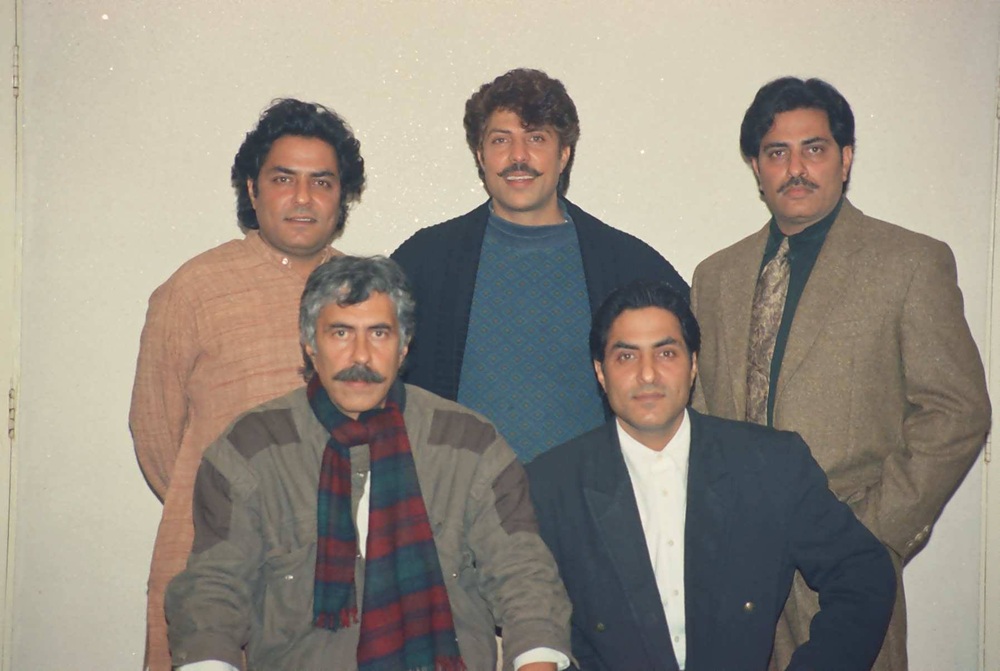
The Peerzada Brothers Faizaan, Imraan, Usmaan, Salmaan and Sadaan Peerzada
In 1975, Usman married Samina Peerzada, who later became a prominent name in the media industry. An acclaimed actor, host, director and producer, she has stood by Usman through every high and low, forming one of the most respected artistic partnerships in Pakistan’s entertainment landscape.
It was between 1976 and 1979, that Usman was a regular in Lollywood and starred against young actresses like Navin Tajik, Babra Sharif, Kavita and Musarrat Shaheen. It was Miss Hong Kong (1979) that made him run away from films.
“The kind of intellectuals and thinkers I grew up admiring were rare in films. The image of filmmakers was far removed from what I had imagined. Miss Hong Kong (1979), directed by Shamim Ara, turned out to be my last film before I stepped away from cinema. I began to feel the same creative restlessness I once felt during the black-and-white television era.”

Usman Peerzada in 1969, new to the entertainment industry.
Television had changed by then. By 1979, with color broadcasts taking over, TV was rapidly replacing cinema, which had come to be dominated by Punjabi films. Around that time, Usman was approached for a TV serial that felt too much like a Punjabi film on television. “I was asked to star in Amjad Islam Amjad’s Waaris, and with Ghazanfar Ali on board, I was about to sign on the dotted line, until Rahat Kazmi and Shahzad Khalil intervened,” he recalled. “The actor and director duo from Karachi wanted me for Teesra Kinara, written by Rahat and directed by Shahzad.”
In Teesra Kinara, based on Ayn Rand’s The Fountainhead, Usman was cast opposite Saba Pervaiz in a supporting role, while Rahat and Sahira Kazmi played the leads. The project appealed to him more than Waaris, despite the latter’s eventual iconic success. Around the same time, Samina Peerzada began her acting career, and by the mid-1990s, the two were appearing together in several television dramas. The power couple would go on to explore every facet of television and film production, helping launch a new generation of stars.
That marked Usman’s rebirth on television. With acclaimed dramas like Karb, Krobi, Sophia and many others to his credit, he remains active even today with projects such as Dayn and Main Manto Nahi Hoon. Approaching nearly six decades in television, Usman never abandoned cinema, throughout the 1980s and 1990s, he continued to appear in a select number of films. Nazdeekiyan (1986), co-starring his real-life wife Samina; the Punjabi hit Gori Diyan Jhanjran (1989); and Qarz (1997), were all his own productions.

Young Usman Peerzada and Samina Peerzada
When asked about his brief appearance in Humayun Saeed’s Love Guru (2025), Usman laughed it off: “Humayun is like family to me. I did the role purely for him. After all, it was Samina who gave him his big break in Inteha (1999), where he played the antagonist.”
That little background may have helped my friend realize that Usman Peerzada was, in fact, a film man long before he became a television icon. His journey stands as a reminder that true talent transcends mediums: evolving, adapting and inspiring across generations. From cinema to television, Usman Peerzada continues to embody the grace, intellect and dedication that keep Pakistan’s artistic spirit alive.
You may also like:
From the Horn of Africa to Bahria Town: Habesha Café Brings Centuries of Coffee Culture to Rawalpindi
(October 15, 2026)