Written by: Amna and Yaver - Posted on: August 21, 2013 |  Comments
Google Translation: اُردو | 中文
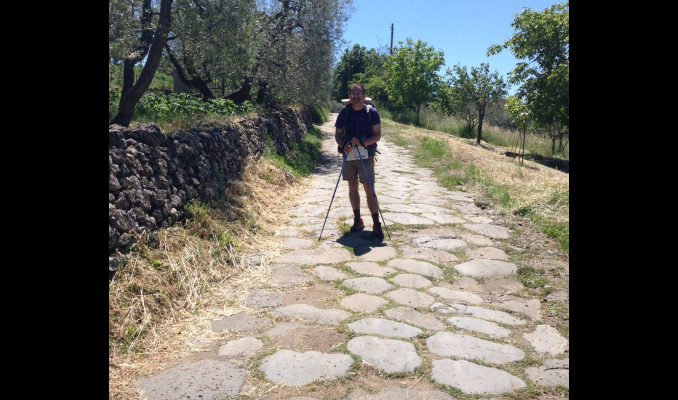
One of the interesting aspects of the walk to Montefiascone was that we got to walk along the original Roman via Cassia. In fact the entire section of Via Francigena that we are walking criss crosses the new via Cassia. Sections of the old road still exist as farm tracks and by-roads, but considering that the old road was built in around 150BC, it is truly a miracle of Roman engineering to see how well preserved these sections are and any sections that are lost are only a function of modern neglect.
 |
The road today is a pavement of tightly interlocked polygonal stones with a standard width of 3.9 m or 13 roman feet. It was built by clearing trees, excavating a metre or more and then building up layers of stone, rubble and sand and topping out with paving blocks cemented together with the pozzolanic cement mortar that the Romans had developed. The paving blocks are of hard dolerite and would need to be shaped to fit together as well smoothed to form the wearing surface.
As we walked along this marvel of engineering, I reflected on what it took to build something like this and the role it played in the success of this great empire. Wrongly, I imagined hundreds of slaves, clearing, excavating, shaping and pulverising stones and working quarries under the management of Roman overseers. In fact, road construction appears to have been one of the primary duties of Roman soldiers. In between battles these men were put to the task of building and maintaining roads. Since these men were paid anyway and often located near frontiers they were used to advance roads into new territories.
The role of these roads in the operation of the empire was fundamental, why else would the empire expend some of its best manpower and what must have been an enormous fortune on them? It is worth recalling that these roads have outlasted our present day ones by at least a factor of 80! Although these roads were built by the empire, maintenance was a local matter and this was one of the most important duties of censors, important civil servants of the day. Tolls were collected to pay for maintenance.
The roads obviously enabled trade, which underpinned the economy of the empire. It is along these roads that goods were brought from faraway places. I always remember reading about the story of transporting frankincense from Yemen. This was worth more than gold by the time it reached Rome; its source kept secret by a series of middle men.
More importantly than trade, these roads played a critical role in holding together this vast empire. passing through a series of staging posts along the way, riders could deliver messages and instructions in unbelievably short periods of time; some estimates are that they covered as much as 150-200 miles a day. A message could travel from Londonium or Palestine to Rome in just 10-15 days. These roads were the internet of their time, and I am sure that this, more than anything else, contributed to the longevity of this great empire. A population of 55m was controlled by a government with a few civil servants in each location and a standing army of only 180,000. I also discovered that Roman soldiers were trained to move to battle at incredible speeds over the roads that they built. They could cover 20 miles in five hours carrying 27kg and still fight a battle. A forced march was 24 miles in the same time, or 8 km/hr – a running pace maintained for 5 hours carrying a heavy load. By comparison, we are carrying between 8 and 10 kg and cover between 3.5 and 5 km/hr.
One last interesting fact about the via Cassia, it is recorded to have served our Scandinavian friends, the Lombards, as the principal route connecting their various duchies in Tuscany some 750 to 900 years after it was built!