Written by: Amna Javed - Posted on: January 23, 2015 |  Comments
Google Translation: اُردو | 中文
There is little doubt that all major cities in Pakistan are in dire need of a Mass Transit System to meet the transport requirements of its citizens. With the ever-increasing population and unprecedented rise in urbanization, the need for an effective Mass Transit System will only increase in the coming years. However, due to limited resources, it is imperative that the system introduced is efficient, sustainable and environment-friendly.
The Islamabad Metro Bus Service, a project initiated in haste, has attracted lots of valid criticism from environmentalists and citizens alike, who claim that the project violates Islamabad’s policy of climate-resilient development. They assert that the project was initiated without the approval of regulatory authorities such as the Pakistan Environmental Protection Agency (Pak-EPA). No alternative traffic management plans have been established until the completion of the project. Moreover, the citizens of Islamabad have been excluded from the decision-making process.
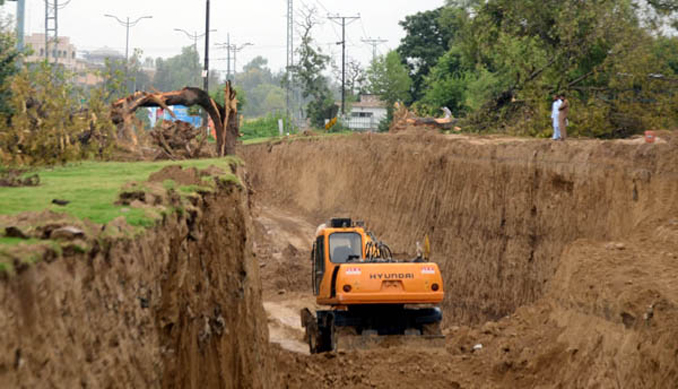
On 2nd January, 2015, a meeting of the Senate Standing Committee on Cabinet Secretariat was held under the chairmanship of Senator Kulsoom Parveen to discuss the performance of the Capital Development Authority’s Environment Directorate. The meeting had representation from Senator Mushahid Hussain Sayed, the Civil Society, as well as environmental organizations such as the Islamabad Green Movement. The legislators raised their concerns regarding CDA’s violation of Islamabad’s master plan by permitting construction activities at dedicated greenbelts and the conversion of open areas into parking lots. Representatives from CDA disclosed that approximately 759 fully grown trees, 80% of which were mulberry trees, were chopped down as they fell in the alignment of the metro bus route.
 |
Green belt along 9th Avenue being uprooted for Metro Bus Route |
The CDA admitted that the ongoing Metro Bus Project did present a ‘short-term negative environmental impact’. The project would result in air, dust and noise pollution in the capital due to the operation of heavy machinery, loss of green cover, solid waste generation during construction, and improper dumping of excavated material.
Earlier, at a court hearing on 30th December, 2014, the CDA informed the Supreme Court that Rs. 181 million had been allocated for the beautification, plantation and repairing of footpaths, which could be damaged due to the Rawalpindi-Islamabad Metro Bus Project. The CDA authorities further revealed that the total environmental cost would amount to Rs. 178.37 million, including Rs. 429,000 in monitoring cost, Rs. 100,000 in environmental training cost and Rs. 177,844,674 in plantation cost.
Concerned residents and environmentalists have expressed strong discontentment by labeling the Environment Impact Assessment Report for Islamabad Metro as dissatisfying and inadequate, as it does not reflect ground realities. Imrana Tanveer, an architect and town planner, stated that the report does not outline any solutions to the irreversible damage caused to the city’s environment.
 |
Improper dumping of hospital waste poses serious health hazards to residents of the twin cities |
Another violation of Islamabad’s master plan took place when a piece of land from a green area in F-5 was unexpectedly rezoned and marked as open space, and was subsequently handed over to a five-star hotel to build a parking lot. The allotment was executed even though the CDA Ordinance bars the authority from renting out green belts for commercial purposes. Sudden changes in the master plan without carrying out a detailed impact assessment are leading to the destruction of Islamabad’s green cover. Questions still remain over what rule was applied to justify the changes to the status of the said land.
The lack of a proper waste disposal system in the capital’s major hospitals poses yet another crucial problem for the administration and citizens. The improper discarding of biomedical waste produced by various health organizations such as dental clinics, primary health centers and diagnostic centers also poses a serious health hazard to the population of the twin cities.
Health professionals have highlighted that out of the total waste generated by health centers, approximately 25% is highly infectious, hazardous and toxic. However, this waste, which includes disposable scalpels, syringes and blades, is disposed of as municipal waste, without practicing any safety precautions. Moreover, radio-therapeutic materials and wastes that contain heavy metal content, such as broken mercury thermometers, are also disposed of as normal garbage.
More than 40 public and private hospitals in Islamabad lack proper incineration facilities for the disposal of medical waste. This poses a great threat to the city’s environment and the health of its citizens; however, little attention is paid to the issue.
 |
CDA's dumping container placed in a residential area of the city |
The waste and by-products from these health centers are capable of causing poisoning and pollution through wastewater or by toxic elements and compounds such as mercury. According to experts, incineration of unsuitable products also releases pollutants into the air that are damaging to the environment.
The Environment Protection Agency (EPA), after conducting a survey, highlighted that all but two hospitals in the twin cities depend on a private firm for the collection and disposal of dangerous medical waste, which averages more than 2,100 kilograms (kg) per day.
The development of infrastructure, including a Mass Transit System and hotels, is of the utmost importance in our cities; however, along with infrastructure development and the provision of basic health facilities, the need to ensure a clean, green and healthy environment for citizens cannot be underestimated. These environmental hazards, if not addressed promptly, will be the cause of much greater harm in the future.