Written by: Muhammad Suhayb
Posted on: April 10, 2026 |  | 中文
| 中文
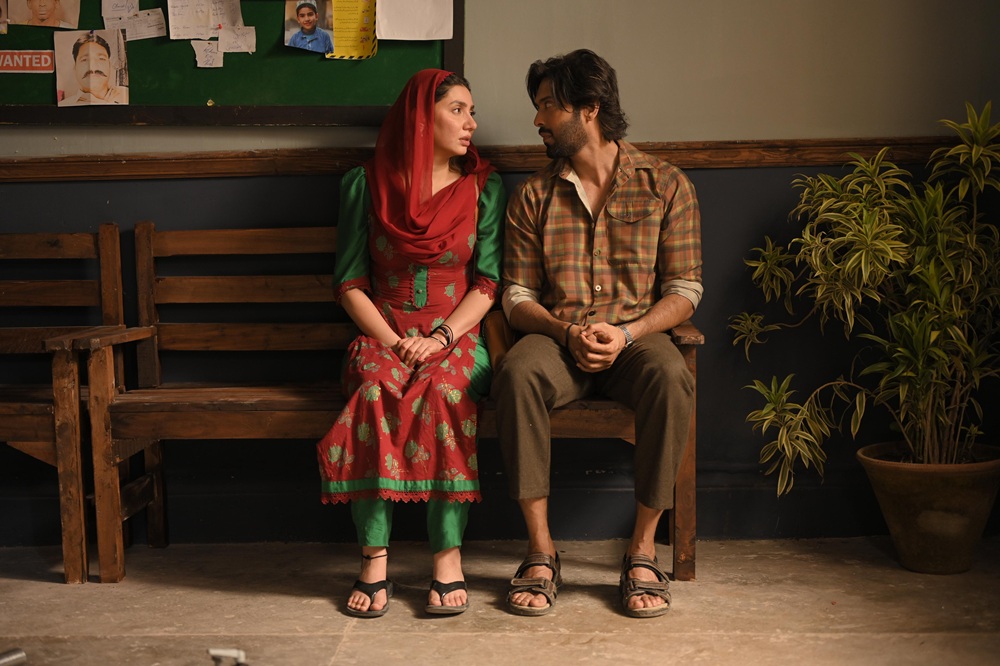
Mahira Khan (Almas) and Fahad Mustafa (Barkat) in Police Station.
‘Aag Lagay Basti Mein’, starring seasoned actors Fahad Mustafa and Mahira Khan, is currently dominating the box office. Despite being a brainless comedy, the very much commercial film is raking in millions at an otherwise barren box office that typically comes alive only during Eid releases.
With a lead pair so frequently seen on television screens, I found it hard to convince myself to step out and pay for a ticket, but if you have a liking for movies from Bollywood actor ‘Govinda’, have no qualms in leaving brains at home and have no issue in watching a television long play in cinema, you are most welcome to go and watch ALBM at your expense.
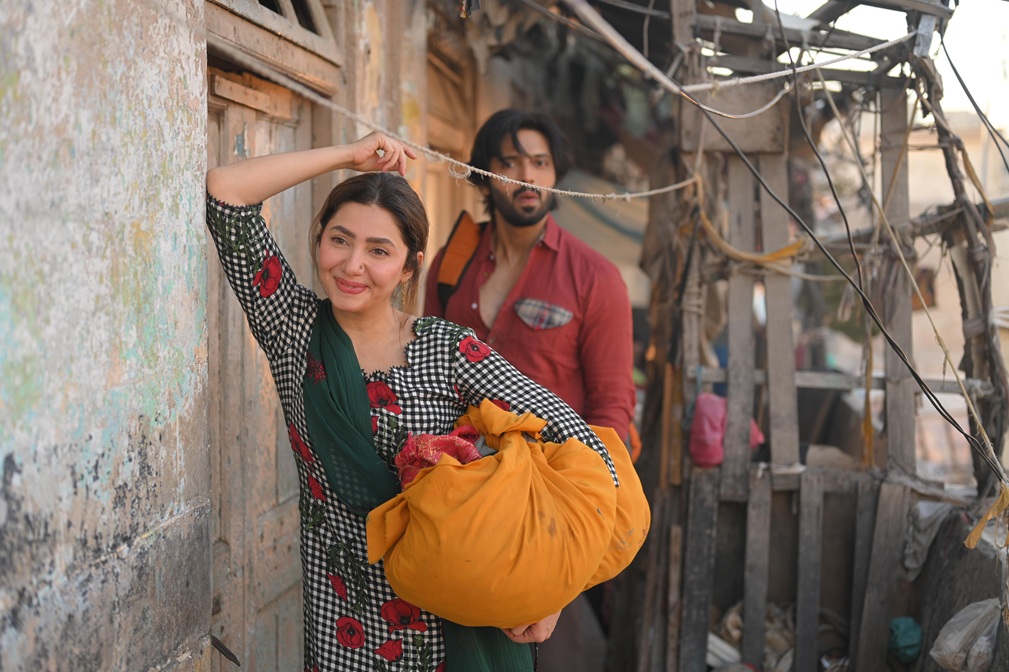
Mahira and Fahad
The film opens with a dacoit family, hinting at the buried goodness in its misfit son, Barkat. Played with conviction by Fahad Mustafa, who also produces the film, the role feels familiar, echoing the kind of characters he has long portrayed on television. Wrongly imprisoned, Barkat’s life takes an unexpected turn when he marries Almas, a master thief operating under the guise of a maasi.
As for Mahira Khan, one of Pakistan’s most glamorous and natural performers, her casting in such a role is puzzling. It demands a kind of exaggerated performance that doesn’t quite align with her strengths, making the choice feel somewhat misplaced.
United by ambition, the two set out in pursuit of wealth, only to find themselves ensnared in a situation that quickly spirals beyond their control. The narrative takes a sharp turn just before the interval with the introduction of a ‘Ghajini-esque’ Marble Seth, played by Javed Sheikh, a man who forgets more than he remembers. It is here that a botched robbery unexpectedly transforms into a successful kidnapping.
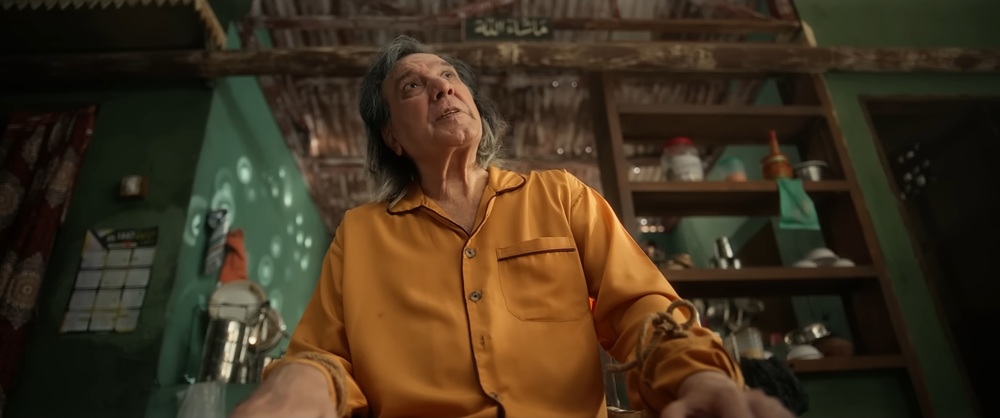
Kidnapped Marble Seth
His son, Changezi, portrayed by Tabish Hashmi, shares a volatile father-son dynamic reminiscent of Ranbir Kapoor and Anil Kapoor’s characters in Animal, driven by a desire to dethrone his father in full ‘gangsta’ style. Unfortunately, despite the promising setup, the emotional build-up fizzles out in the second half.
In the first half, the characters are well thought out and motives are explained well, however whatever promise the premise holds quickly unravels. The second half descends into chaos, devoid of coherence or narrative grip, with social media influencers influencing the story more than the director. What unfolds instead feels like an overstretched episode of Sub Set Hai, the Azfar-Mani-Tipu show that, despite its Karachi-centric humor, maintained a sense of restraint and decency.
Influenced by the cruder strains of mainstream Bollywood comedies, the film becomes an uneasy mix of lowbrow tropes and hyper-local jokes. The reliance on Memon humor, for instance, narrows its appeal, unlikely to resonate with a wider audience. A viewer in Lahore, for example, might just as well walk into the next screen to watch Shaan Shahid’s Bullah instead.
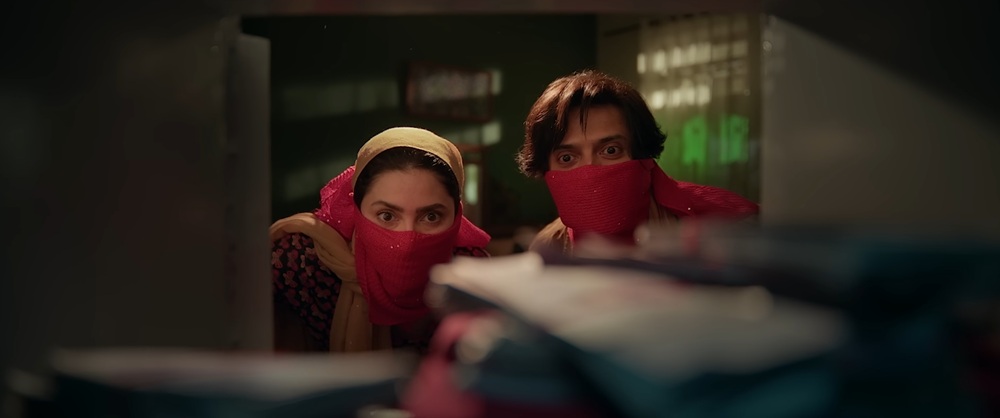
Mahira Khan and Fahad Mustafa in Aag Lagay Basti Mein
It feels as though the production team chose to cut costs on a casting director, assembling a lineup that offers plenty of familiar names but very little in terms of performance. It may have worked as a commercial strategy, but for someone like me who is nearing fifty, it comes across as a clear miss. The surprise cast introduced in the film mostly consists of faces we are already used to seeing on mobile or TV screens. Shehzadi, Marzi Raza ki, “Osama” (who comes across as an M. Rizwan clone), and Abdullah Durrani have entertained audiences on social media before. However, Tabish Hashmi, who hosts a TV show on the format of Kapil Sharma, survives on lewd jokes and double meanings for praise, nothing new.
Javed Sheikh, a veteran film star who is now a regular on television, was last seen as Fahad Mustafa’s father in ARY’s drama Kabhi Main Kabhi Tum. His recent roles in Qulfee (as an odd uncle), Deemak (barely more than a cameo), Love Guru, and Hum Sub have largely been insignificant. Here, he does make an impression despite limited screen time, but it’s a role that could have been written with far more impact.
Featuring cameos by veteran actors Shabbir Jaan, Shamim Hilali, Ashraf Khan and Ayub Khosa, along with brief appearances by Salahuddin Tunio and Ehtishamuddin, the film attempts to present a crime caper, a genre often appealing to audiences looking for a bit of escapist thrill. The climax, like most Nabeel Qureshi/Fizza Ali Meera’s movies is straight out from Gene Hackman-Will Smith’s Enemy of the State. Bilal Atif, an associate for Nabeel Qureshi, copy pastes the last scene, with little logic and lots of bullets. A viewer starved of quality cinema might still find themselves laughing at moments in this film, if only because there’s little else on offer. The use of pop culture references, like Geo TV, ARY Digital, Nida Yasir, and Jeeto Pakistan, may resonate with local audiences, but in the long run, they feel repetitive and ultimately redundant.

Tabish Hashmi as Changezi
There’s a reason even the films of the 1970s resonate more with me than this prolonged string of disjointed jokes. For me, the unwritten rules of Lollywood’s golden era were simple, but sacred.
First: never cast a television face as a film hero. Think about it—did icons like Waheed Murad, Nadeem Baig, Muhammad Ali, or Syed Kamal jump from television screens straight into leading film roles? Stardom was built for the big screen, not borrowed from the small one.
Second: merit in characterization was non-negotiable. If a heroine role was written as a maasi, she looked, spoke, and carried herself like one. Authenticity wasn’t optional, it was expected.
Third: music had purpose. Songs weren’t fillers; they were moments. And even if a film failed, its soundtrack could achieve immortality.
Finally: films were made for all of Pakistan. An Urdu film meant national appeal. If the story was regional, it belonged in a regional language, not diluted for mass consumption.

Fahad going for work in the film
Bilal Atif Khan’s Aag Lagay Basti Mein flips these “don’ts” into a checklist of “yeses.” And yet, in a troubling reflection of where our cinema stands today, this very film is being celebrated as a blockbuster. A success, perhaps, but also a stark reminder of how far the standards have fallen.
You may also like:
From the Horn of Africa to Bahria Town: Habesha Café Brings Centuries of Coffee Culture to Rawalpindi
(October 15, 2026)