Written by: Sirat Gohar Daudpoto
Posted on: April 24, 2026 |  | 中文
| 中文
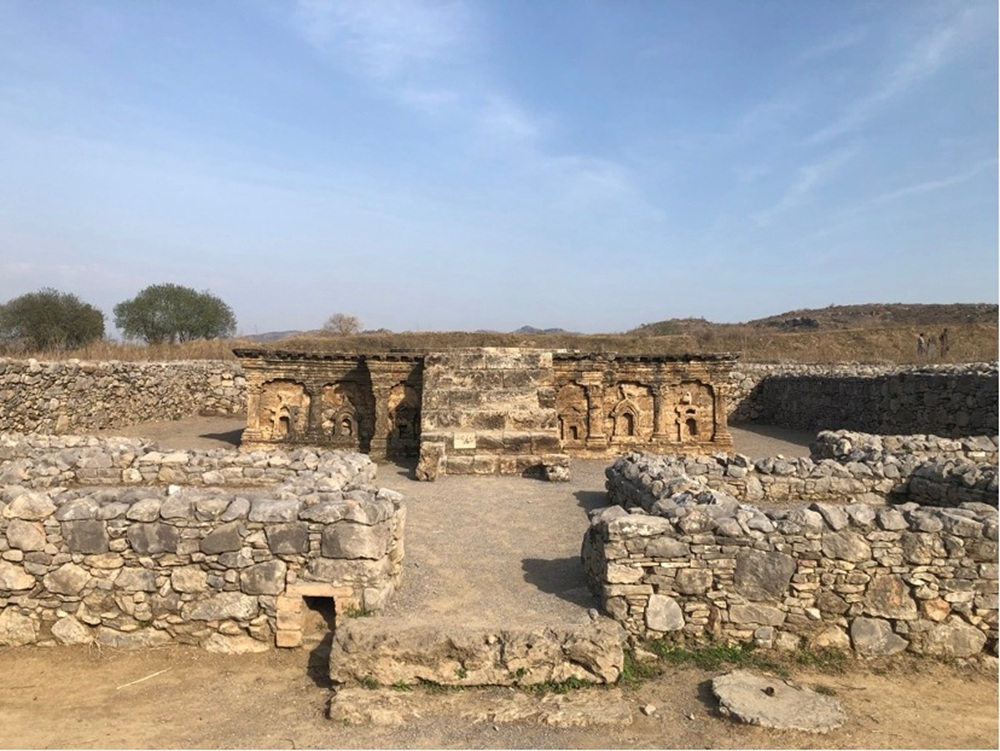
The monument of a Buddhist stupa built in the Parthian era city of Taxila at Sirkap. Photo by the author.
During the Indo-Greek rule in the Indus, the Scythian made intrusions from Persia into the country and occupied some bordering territories. Afterward, they overthrew the Indo-Greek kingdom at the turn of this era and remained in power for nearly five hundred years, between 60 BC and 415 AD. However, in the early first century, Persia’s Parthian empire extended rule over the Indus by invading the Scythian. Although the Scythian lost the country, but they held sway over some parts of the present-day Sindh until their decline in the early fifth century AD. Both of these dynasties descended upon the Indus from Persia. They established their control and settled in a vast territory of the Indus, owing to which, they are called the Indo-Scythian and the Indo-Parthian. During rule of the Indo-Scythian and the Indo-Parthian, almost three centuries past the Achaemenid, once again the diffusion of the Persian culture into the region took place.

Remain of the ancient northern road (Uttarapatha) near Islamabad. Photo by the author.
They were succeeded by the Kushan, who came from Central Asian, in the second half of the first century AD. The Kushans subjugated whole of the Indus valley. These people brought Central Asian ways of life with them and settled in every nook and corner of the country and intermingled with the inhabitants. The Kushan ruled for nearly three centuries; however, in the mid-third century AD the Persian once again led invasion into the Indus under the Sassanian flag and managed to rule side by side the Kushan. This Kushano-Sassanian empire was followed by another group of Central Asian people known as the Kidarites or Kidara Huns. They are named after their first great king Kidara, who is believed to have spread his dominion over the northwestern parts of the Indus valley by conquering the Kushano-Sassanian kingdom in the mid-fourth century AD. During this period, the native Indian Gupta empire also annexed some of the Indus territory, which remained under their control till mid-fifth century AD.
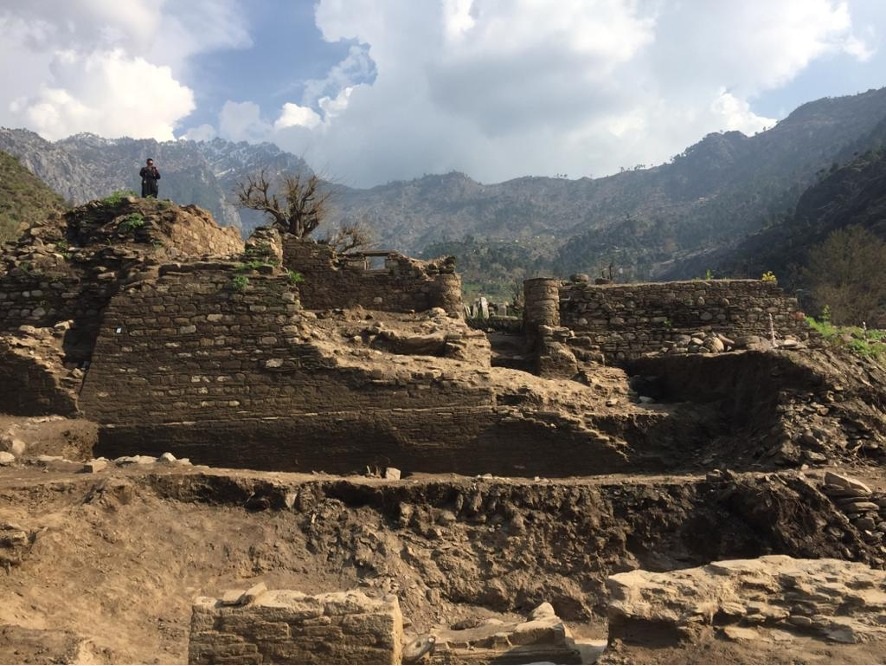
The Hindu Shahi building located in Amlukdara, Swat. Photo by the author.
The Gupta rule in the Indus valley ended after the invasion of another Central Asian nomadic people known as the Hephthalites or White Huns. The Hephthalite captured almost whole of the country, except the lower Indus valley (including present-day Sindh province and parts of Balochistan province). The southern region of the Indus was under the dominion of Sindh’s Rai and Chach dynasties from the late fifth to the early eight century AD. However, the Hephthalite strongly controlled the northern region for nearly two hundred years until about 670 AD.
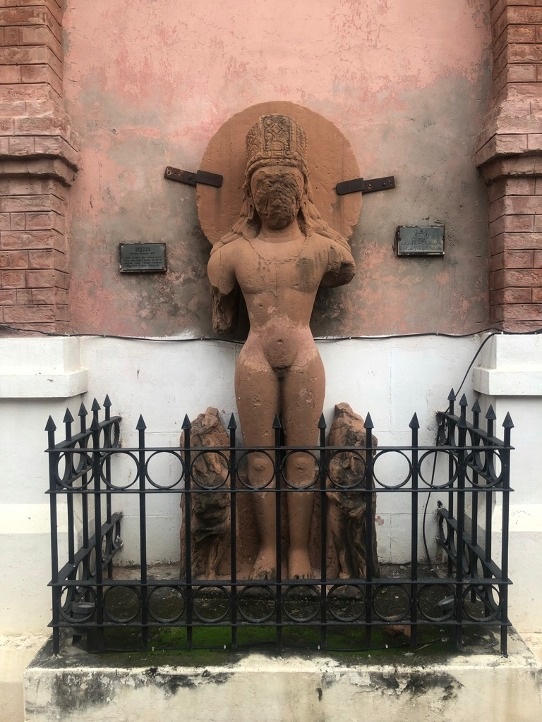
The eighth or ninth-century statue of a Brahmanical deity Vishnu discovered near the Chopala village in Gujrat, Punjab.
They were removed from power by the Turk Shahi dynasty, which also, after ruling a little more than fifty years, was replaced by the Odi/Hindu Shahi dynasty in circa 822 AD. The Hindu Shahi were staunch followers of Brahmanism. They revived Brahmanical traditions by building Shivaite and Vishnuite temples all across their dominion, and the ruins of these temples still stand conspicuous in the landscape. On the other hand, in 712 AD the Arabs led invasion into the lower Indus valley and subjugated the country by defeating the ruling Chach dynasty. The Arab ruled for more than three hundred years and their control expanded from the sea up to present-day Multan. With that, the Arab culture diffused into the Indus society, and the most important of all the Arab transmissions was the introduction of Islam and the Arabic writing system, which made great impact on the Indus society.
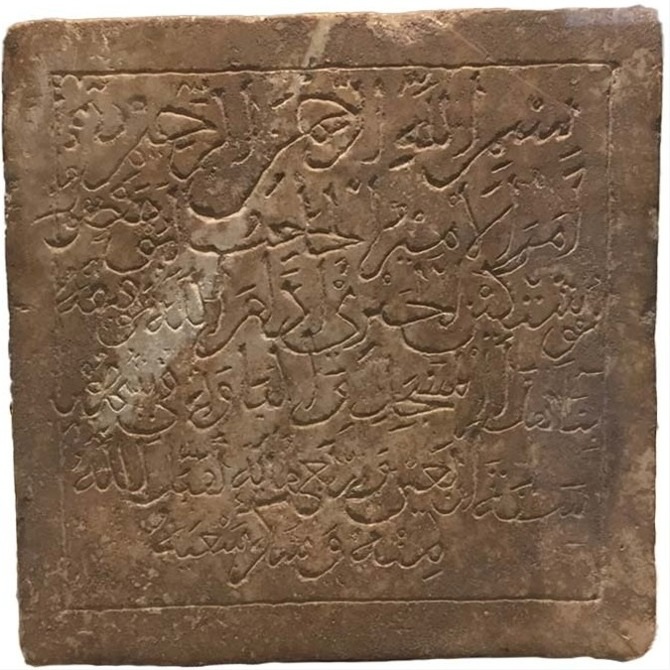
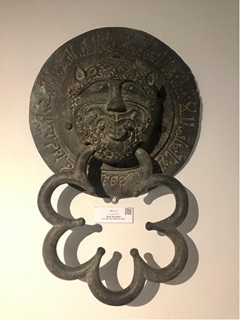
An Arabic inscription found at Udegram in Swat records the foundation of the eleventh century Ghaznavid Mosque, now exhibited in Islamabad Museum.
The archaeology of the last three hundred years of the first millennium AD shows that the Indus country was divided among the Arab and the Hindu Shahi during this period. The Arab held sway over the lower valleys and the Hindu Shahi were established in the upper valleys. So, the society was dominantly Brahmanical and Muslim, although there was an immense population of the peoples of other faiths, like Jainism, Zoroastrianism, Buddhism. However, the Ghaznavid conquest in the eleventh century AD brought whole of the Indus valley under the Muslim control. During the Arab and the Ghaznavid period, Islamization in the country began at large and that proved to be the springboard for the Muslim governance. As in the subsequent period, which is the last phase of Pakistan’s ancient history, the Muslim rule under the Soomra, Ghurid, Delhi Sultanate and Samma dynasties was established. With them, finally, a very long ancient period of Pakistan ended when the Europeans first entered into the Indus country in the fifteenth/sixteenth century AD. Europeans’ arrival marks the beginning of the modern period of the history of the Indo-Pakistani subcontinent.
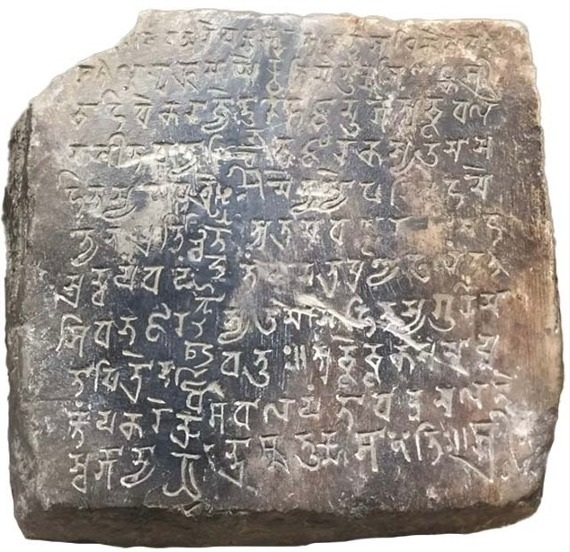
A fifth to seventh-century Brahmi inscription discovered in Gandhara, now displayed in Islamabad Museum. Photo by the author.
You may also like: