Written by: Muhammad Hamza
Posted on: November 06, 2025 |  | 中文
| 中文
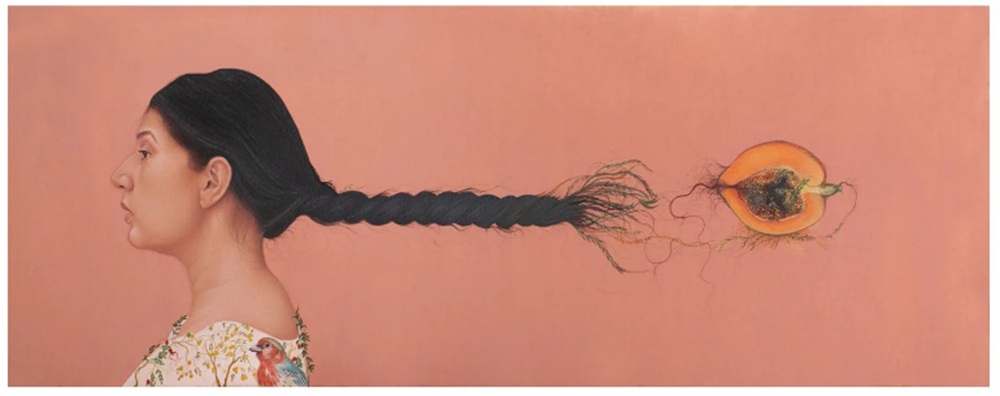
Saffron by Attiya Usman
Gallery 6 in Islamabad has long been a haven for emerging expressionists in Pakistani art, and its latest showcase of 12 outstanding paintings pulses with the raw energy of young creators grappling with identity, displacement, and the quiet miracles of everyday life. Curated to highlight fresh perspectives from recent graduates and mid-career artists, this collection feels like a conversation across generations, intimate, urgent and unapologetically human. Without the clutter of commercial details, these works stand on their conceptual legs, inviting viewers to wander through themes of shelter, growth, manipulation, and transcendence. Each piece unfolds like a personal manifesto, blending traditional techniques with bold experimentation to question where we find home, how we bend reality and what it means to simply breathe in a chaotic world.
Opening the exhibition is Shahid Hassan Boni’s Refugee, a poignant meditation on sanctuary amid uncertainty. At its core, the concept revolves around containment and quiet direction. A concrete structure, rendered in muted acrylics and textured with mud and wooden twigs, forms a box-like enclosure, part prison, part protective shell. Inside, a delicate cluster of greenery pushes through, its tender leaves and blossoms a symbol of resilience against the barren walls. A small barred window on one side hints at the gaze outward, the longing for connection beyond isolation. The mud, sourced perhaps from local earth, grounds the work in tactile reality, while the twigs evoke makeshift barriers or hopeful scaffolds. It is a concept that ends in hope, not despair. The plant’s growth suggests that even in exile, life insists on blooming. This piece sets a tone of introspection, reminding us that refuge is both a burden and a birthplace.
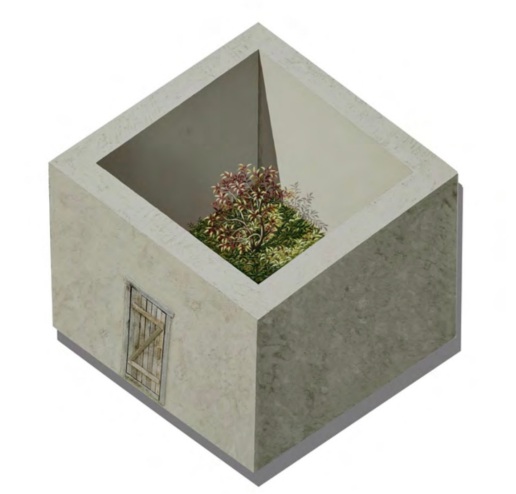
Refugee by Shahid Hassan Boni
Transitioning from enclosure to expanse, Rajeshwari Lohana’s Breath of the Earth exhales a cosmic sigh of planetary vitality. Lohana, hailing from the University of Art, Design and Heritage in Jamshoro, layers acrylics and pastels to evoke the earth’s layered skin, cracked, breathing, alive. The concept here is one of elemental dialogue: swirling forms in deep umbers, siennas, and fleeting greens suggest tectonic shifts where rock meets sky in a hazy embrace. Veins of gold and turquoise dissolve through. It is as if the canvas inhales the weight of soil and exhales mist, capturing the earth’s quiet exhale after a storm. The abstraction avoids literalism, instead inviting sensory immersion; viewers might feel the cool dampness of moss or the crunch of dry clay. Ending on a note of renewal, the work proposes that our breath is intertwined with the planet’s, a call to listen to the ground’s unspoken stories. In a gallery full of figures, this piece stands as a grounding force, a reminder that human narratives are but threads in nature’s vast tapestry.
Ghaas Ahmad’s Manipulated disrupts this harmony with a visceral exploration of form and façade. Using oil on a sturdy base, Ahmad crafts a fragmented portrait that feels like a puzzle of self-deception. The concept centers on distortion: a face emerges from jagged patches of yellow, green, and pink, eyes half-formed, mouth stretched into an ambiguous curve. Striped bands and geometric intrusions overlay the features, as if societal grids are literally reshaping the subject. The colors bleed and clash, evoking emotional turmoil, yet there is a playful edge in the bold pinks and greens, suggesting manipulation can be reclaimed as creation. The work culminates in ambiguity. Is the figure victim or architect? By ending without resolution, Ahmad challenges us to confront our own edited selves, turning the canvas into a mirror of fractured authenticity.

Manipulated by Ghias Ahmad
Hifza Khan’s Elsewhere offers a lush escape, transporting us to an ideal realm where nature whispers secrets of belonging. Rendered in gouache on delicate washi paper, the circular composition frames a verdant paradise: pomegranate-laden trees arch over a serene blue river, birds in jewel tones such as parrots, kingfishers, and cockatoos perch amid ferns and orchids. The fruits hang heavy, symbols of fertility and temptation, while the birds’ vibrant plumage adds a chorus of life. The round format evokes a mandala or locket, enclosing a private reverie. Conceptually, it is about yearning for “elsewhere,” a mental refuge from the urban grind, ending in harmonious balance, as if the viewer could step through the frame. Khan’s delicate lines breathe life into the foliage, making the scene pulse with quiet joy, a balm after Ahmad’s distortions.

Elsewhere by Hifza Khan
Jasmin Ditta’s Scene on Hair bursts into festive whimsy, reimagining celebration through a lens of retrospective sense. Oil on canvas brings a flock of birds, like pheasants, finches and canaries, donning party hats and streamers, gathered in a triangular formation against a soft blue sky. The birds, bejeweled with goofy accessories, parade like guests at an unseen feast, their feathers a riot of patterns and hues. It is a nod to human folly, dressing up to mask the ordinary, yet ends in infectious delight, the confetti trails suggesting endless possibility. The triangular shape funnels the eye upward toward liberation, turning a simple gathering into a metaphor for fleeting unity. In this playful interlude, Ditta reminds us that joy often hides in the ridiculous, a feathered counterpoint to heavier themes.
Attiya Usman’s Saffron weaves surrealism into cultural intimacy, transforming the body into a vessel of heritage. Opaque watercolor on acid-free paper depicts a woman in profile, her long braid cascading like roots into a ripe mango below. The hair, dyed with saffron threads from her embroidered blouse, symbolizes threads of identity linking personal to ancestral. The mango, split open with seeds exposed, evokes fertility and decay, a nod to South Asian motifs of abundance. The warm peach tones ground the dreamlike flow, ending in a poignant union. The woman’s upward gaze suggests enlightenment through embodiment. It is a concept that blooms from the everyday (a braid, a fruit) into profound commentary on women’s stories woven into the fabric of tradition.
Farah Khan’s Hum Kalami (Conversation) elevates portraiture to a meta-reflection on creation. Opaque watercolors on washi capture a serene woman in white, her dark hair framing thoughtful eyes, with a tiny sparrow painting perched above like a framed memory. Khan layers the concept with duality: the subject as both muse and maker, the bird as symbol of fleeting inspiration. The wooden frame within the frame blurs boundaries, questioning where art begins. Neutral tones allow the gaze to pierce, ending in quiet empowerment. The “we” of the title implies collective storytelling. This piece whispers of the artist’s hand, turning observation into a shared quill.

Hum Kalami by Farah Khan
Laiba Abid’s Mai Kon (Who Am I?) delves into domestic affairs, portraying a man supine on a table in a red-floored room flanked by golden doors. Oil on canvas renders the scene with stark realism: arched windows and stairs lead nowhere, the figure’s inverted face a mask of vulnerability. Abid conceives home as a labyrinth of thresholds, open yet impenetrable. The warm crimson floor bleeds unease, while the doors promise escape or entrapment. Ending in suspended limbo, it probes masculinity’s hidden fractures, the body a bridge between interior worlds.

Mai Kon by Laiba Abid
Buland Iqbal’s Untitled captures poised isolation in a sunlit courtyard. Oil brings a woman in a floral blouse and jeans to life on a chair, her expression a mix of resolve and reverie amid brick arches and potted plants. Iqbal explores quiet rebellion: the modern attire against a rustic backdrop symbolizes negotiation between tradition and self. Shadows play across her face, ending in subtle strength, a portrait of becoming, unadorned yet profound. Nabia Gillani’s The Meridian ascends to cosmic aspiration, with a woman scaling a paper ladder under starry voids, red threads anchoring floating sheets. Oil on canvas fuses fragility and ambition: the figure reaches for light amid cardboard clouds, conceiving progress as subtle construction. Gillani ends in transcendent poise, the stars a map of untethered dreams.
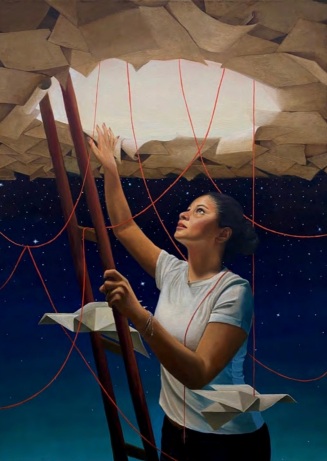
The Meridian by Nabiha Gillani
Swarim Abid Hasan’s Glitch in the Grid fractures digital-age alienation. Mixed media overlays a contemplative figure and cat with blue-gold grids, evoking system errors in human connection. Hasan builds to chaotic harmony, the glitch a portal to authentic messiness.
Finally, Aafia Ali Shah’s The Waiting Room simmers with anticipatory tension: a green-tinged interior strewn with vessels, red ribbons trailing like blood or hope. Acrylic and oil blend still life with dimensional unease, a study in direction and light that, with only a few tints, ends in unresolved poise. It mirrors life’s pauses and gentle hesitations.
Together, these 12 works form a mosaic of becoming, refuge sought, earth breathed, selves manipulated, elsewhere dreamed. Each painting is a seed for deeper reflection. In their gentle conceptual endings, we find not closure but an invitation to grow.
You may also like: