Written by: Muhammad Hamza
Posted on: October 15, 2025 |  | 中文
| 中文
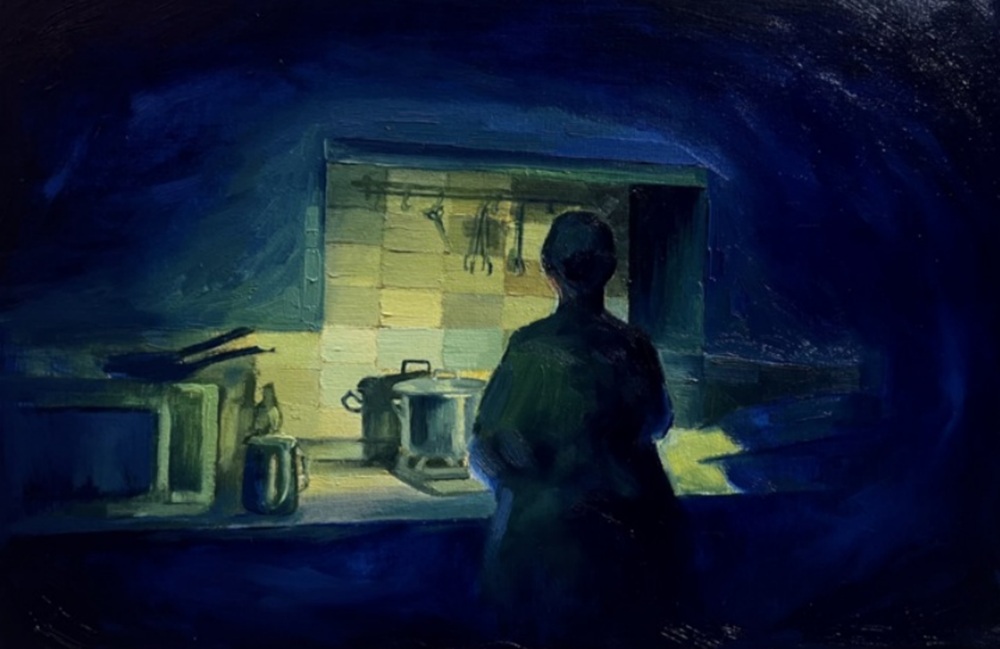
Torch Light by Fatimah Mirza
In this episode of art review this week, Kaleido Kontemporary in Lahore hosted six emerging artists that showcased the diversity of silence and emotion that go hand in hand. There’s a vast mix of materials that have been used; these artists have mastered the ability to present the entirety of subtle gestures and moments that are often overlooked.
Curated by Syed Zainab Gilani, herself a practicing artist, she knows the importance of such a group that captivated the audience in their pure, true format of expression through paintings that speak in silence and make their own unique presence around each other as if they’re talking.
In the hushed glow of Fatimah Mirza’s Fragments of Silence, ordinary domestic corners emerge as portals to quiet introspection, where light carves poetry from the mundane.
In Too Many Wires, the mood shifts to subtle clutter: a bedside table tangled in cords and headphones, dominated by a lampshade’s radiant halo against navy walls. This smaller-scale intimacy critiques modern entanglement, wires as veins of distraction, yet the glow affirms resilience, a subtle breeze amid chaos. Mirza’s shift to paper lends a raw immediacy, the medium’s absorbency mirroring emotional intelligence.
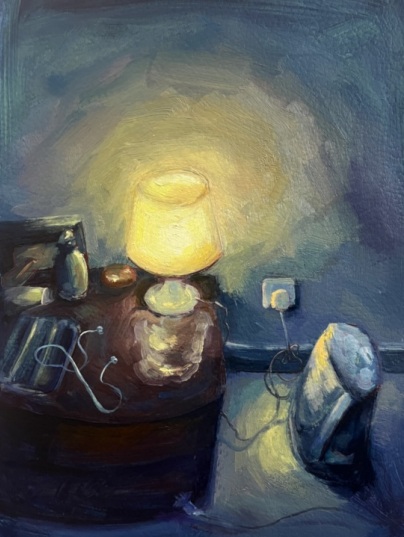
Too Many Wires by Fatimah Mirza
So, Golden I & II capture a dimly lit alcove suspended in amber hush. Suspended lamps dangle like forgotten pendulums, casting elongated shadows over a cluttered table bearing an open book and a solitary lamp whose bulb flickers with warm defiance against encroaching dusk. Mirza’s brushwork, loose yet deliberate, builds layers of ochre and sienna, evoking the patina of aged wood and the subtle breath of dust glimmering in sunlight. Here, silence isn’t absence but a tangible presence.
Peering into a corner nook, a purple armchair cradles an orange cushion, its form softened by the spill of a desk lamp against maroon curtains. The composition’s asymmetry, a half-open window framing the unseen outdoors, suggests thresholds between isolation and connection, with verdant floor hints nodding to nature’s intrusion on human retreat.
Mirza’s palette, restrained to earth tones pierced by golden highlights, masterfully renders atmosphere over detail, turning the basic into the profound.
Wahab’s signature style marries hyper-realistic figuration with surreal undercurrents, where light fractures like memory’s shards. In Scour, two figures flank a crimson mirror, their gazes averted yet entangled in a vortex of reflection.
The bearded man in blue, poised in a quiet vigil, and his bespectacled counterpart evoke a dialogue unspoken, perhaps lovers, siblings or fractured selves, trapped in domestic reverie. Gouache’s delicate intimacy shines thoroughly, where elongated forms huddle in shadowed rapport, colors bleeding like half-forgotten dreams.
Perch anchors the series with poignant vulnerability: a reclining figure, eyes sealed in slumber, extends a foot toward an unseen precipice, smartphone aglow like a talisman. Here, Wahab dissects modern alienation, where technology perches on the edge of disconnection, silencing the clamor of urban Lahore to amplify inner monologues. Wahab’s fragments reassemble the human condition, urging us to linger in our own silences.
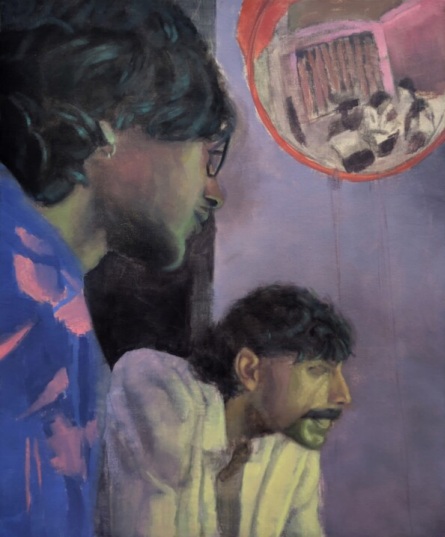
Scour by Abdul Wahab
Nasir’s practice dissects paint’s tactile alchemy, how it clings, pools and fractures against surfaces, birthing illusions of depth and beauty.
Gesture to Nothing unfurls a solitary hand, splayed in limbo, fingers curling toward an unseen void. The composition’s teal mists evoke a suspended breath, paint’s fluidity mimicking the hesitation of touch, where form dissolves into atmospheric longing.
Held in (the not yet) captures two shadowed figures in intimate proximity: a bearded silhouette cradles another’s gaze amid emerald auras, their faces half-veiled in luminescence. Here, light behaves not as illuminator but conspirator, refracting through layered glazes to suggest unspoken yearnings, the “not yet” a liminal space of anticipation.
Nasir’s fragments silence the noise, inviting tactile communion. Textures ripple like memory’s afterimage, light’s interplay forging emotional architectures from mere pigment. In an era of digital glare, his works reclaim painting’s primal pulse, a resonant call to witness the unspoken, priced accessibly for collectors attuned to quiet revolutions.
As Lahore’s light flickers, Nasir’s canvases endure, fragments reassembling into profound, glowing wholes.
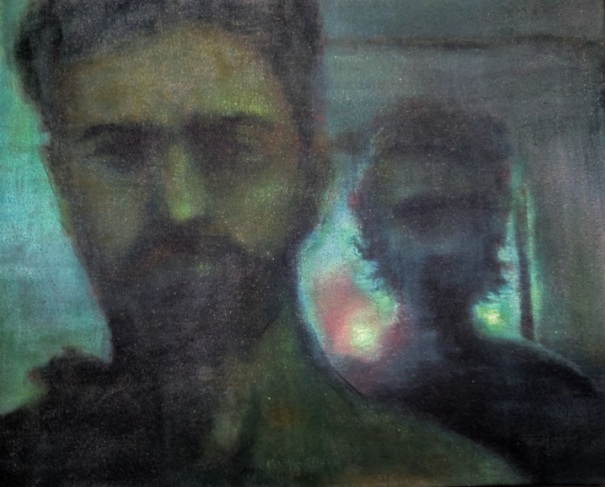
Held in (the not yet) by Hassan Nasir
Kamran Ali Dall’s diptych delves deeper into endurance’s raw underbelly.
Beyond Hope frames three elongated figures behind iron bars, backs turned to a searing yellow void. Their postures, hunched and intertwined, convey a collective sense, the bars’ stark geometry slicing through ochre flesh tones, symbolizing confinement’s indelible mark. Light pierces from without, illuminating not freedom but the illusion thereof, casting elongated shadows that merge into a frieze of quiet defiance.
Sinless Defeat counters with intimate surrender: two nude forms entwine on a shadowed ledge, limbs overlapping in ochre and sienna embrace, faces obscured in mutual solace. The composition’s warmth belies its title, paint’s thick impasto evoking skin’s yielding texture, a defeat rendered sinless through shared fragility, bodies as bastions against oblivion’s chill.
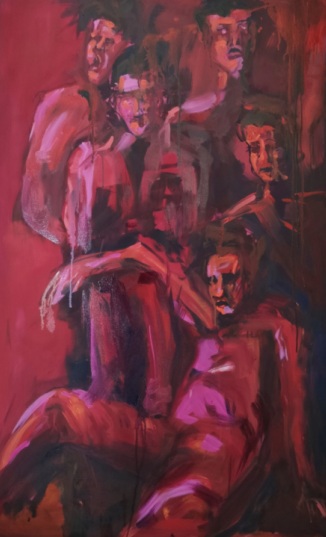
Sinless Defeated by Kamran Ali
Sara Mansoor’s series unravels human multitudes in feverishly chaotic abstraction. Series, II (me), I erupts in fiery ochre figures, limbs in ecstatic tangle, faces dissolving into a blur of sienna and rust. The crowd surges like memory’s onslaught, forms overlapping in rhythmic chaos, conveying emotion’s inescapable swell, identity fragmented yet fiercely communal.
Another from the series masses bodies in crimson haze, torsos fused in primal huddle, evoking the passage of time as a devouring wave. Mansoor’s brushwork, bold and unyielding, layers texture to mimic flesh’s pulse, turning individual contours into a symphony of shared endurance, where silence births cacophonous humanity.
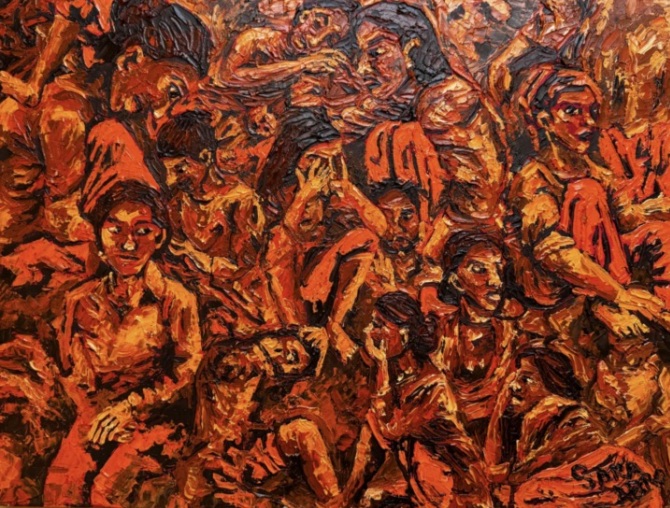
Series, II (me), 1 by Sara Mansoor
Tazeen Fatima’s vignettes probe the feminine-masculine dialectic with meditative grace.
Samarasa isolates golden hands in repose, palms upturned amid violet dusk, fingers interlaced in harmonious rhythm, equality’s fragile equilibrium rendered in luminous oil, light caressing contours to dissolve gender’s rigid lines.
Nazar juxtaposes a collaged portrait, a man exhaling smoke, against a barren expanse, the figure’s gaze piercing through ink-wash haze, evoking internal schism.
In Salar, a robed woman cradles a wilted rose, her form swathed in ivory folds, eyes distant in contemplative poise; the flower’s crimson thorn a subtle emblem of vulnerability’s bloom.
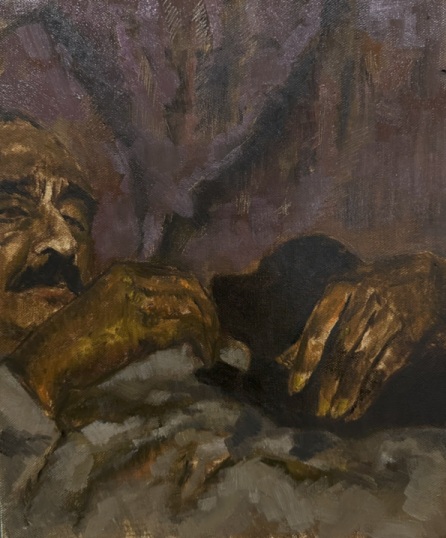
Samarasa by Tazeen Fatima
In Kaleido’s intimate confines, the works linger like afterimages, compelling viewers to confront their own unspoken shards. These artists have shown themselves through an intimate experience of color and brushwork that speaks volumes about their lives and longings, lingering through our collective consciousness as memories and nostalgic moments.
You may also like: