Written by: Nimra Khan
Posted on: September 17, 2025 |  | 中文
| 中文

Sindh Floods by Arif Mahmood
In the wake of the most recent torrential Monsoon rains and subsequent urban flooding, a recent group show at AAN Gandhara Art-Space, curated by Amra Ali, simply titled “Sailaab”, fittingly explores the ecology of water. In recent years, countries like Pakistan have been witnessing direct impacts of shifting climate patterns in the form of natural disasters. Ali delves into ongoing practices which investigate this through the flooding in rural Sindh as well as the metropolis of Karachi, exploring the concepts of personal and collective loss, displacement and transition across socio-political, cultural, ecological and emotional levels.
The works gel together in a way that it becomes difficult to separate one artist from another as they all come together to create a cohesive narrative with diverse trajectories. Arif Mahmood’s photographic works look at collective loss and displacement in the Sindh floods, 2010. It explores transition, transformation and resilience through a stylistic documentation to create evocative imagery. An institutional commentary simultaneously runs through the works on the dying process of analog photography through the use of expired paper and contact sheets included as “sketchbook pages” for a photographer.
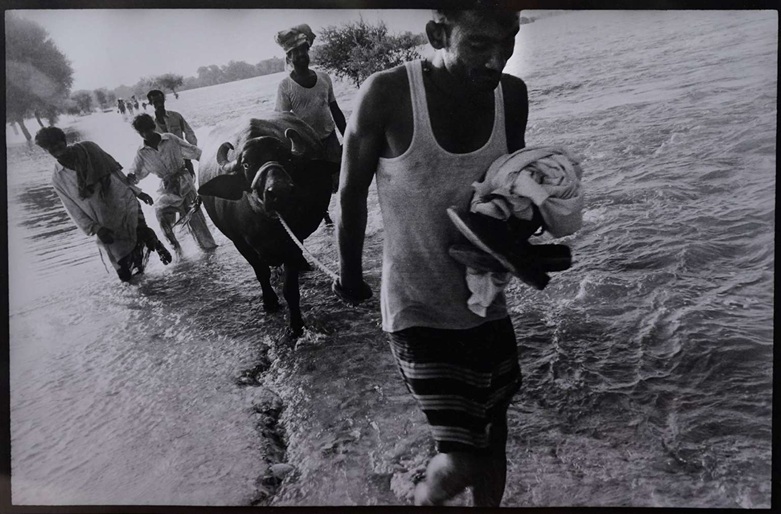
Sindh Floods by Arif Mahmood
Saad Aslam Ali also uses photographs but as symbols for personal and collective loss and transformation. These found archival photographs explore the damage to personal property in the Karachi floods, damaged, yet enduring in a new form. These images don’t depict the floods, but personal memories and precious moments forever altered yet resilient in their tragic beauty. The artist in a way paints with water, creating artworks out of disruption and detriment, speaking of displacement and trauma.
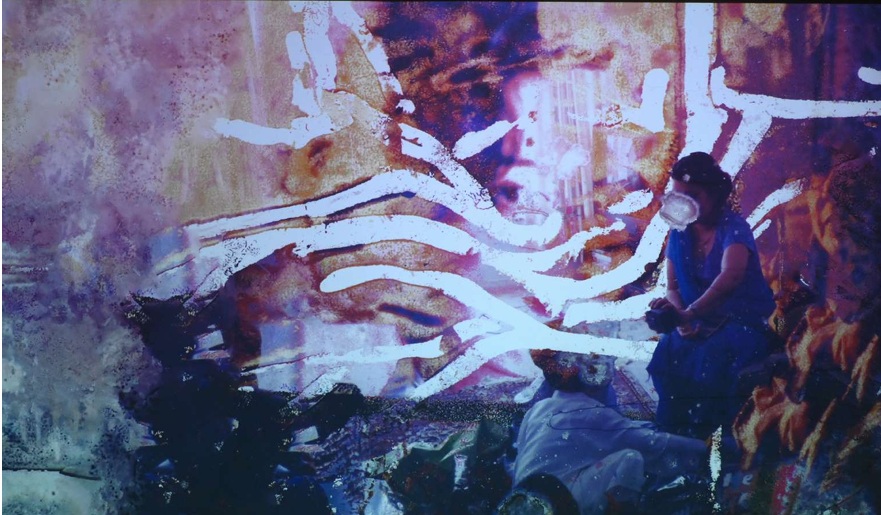
We Were Here by Saad Aslam Ali
Malika Abbas looks at a more personal sense of loss and disruption and the emotional layers of unforeseen events, as well as the physical one that is carved out of what remains. Her imagery is thus less direct and more metaphorical in nature, obliquely evoking a sense of the chaos and devastation in the subtleties of everyday life, and an intelligent play of light. Through the images and texts, we see water as a formidable force that charts its own course, transformatory in nature as it moves and molds all that it touches, creating an eerie sense of helplessness and foreboding.
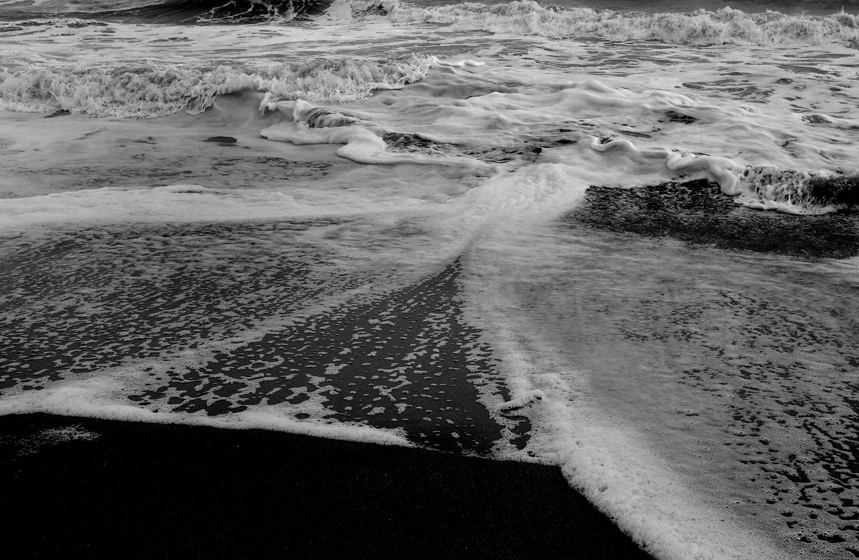
Where it Once Flowed by Malika Abbas
Similarly, Sohail Zuberi’s work is also a personal narration of the Karachi floods, studying the disaster through a very anecdotal lens. During the urban flooding of 2022, the artist’s own home was waterlogged, leaving him stranded in water without electricity for 4 days. Zuberi’s ongoing practice negotiates the tumultuous relationship of Karachi with its shoreline and addresses ecological concerns and the effects of uncontrolled urban expansion and consumerist culture on the environment. Through this engagement with the coastline, the artist collects and repurposes debris that litters the seashore where the city meets the open sea, documenting this interaction through photographs, objects and experiences. Here, he comments on a different kind of relationship through personal experience, yet emerging from and connoting the same concepts, which he highlights by installing his photographs of the floors to be viewed through found bhaari (sinkers). It is a silent critique of the unplanned growth of the megapolis of Karachi and its infrastructure crumbling beneath its exploding population.
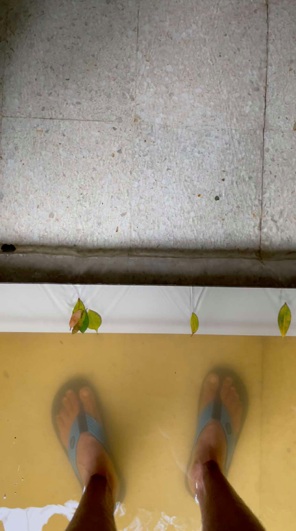
Threshold by Sohail Zuberi
Namra Khalid, through her ongoing project ‘Karachi Cartography’, looks at the physical aspects of flooding in Karachi, with an investigative and proactive approach that seeks to develop solutions through archiving and documentation. It seeks to create a deeper understanding of why the city floods through archival maps, hoping to chart an evolutionary trajectory of the city and uncover vulnerabilities. Through a layering of maps and the lens of human experiences we are reminded of the influence of the sea in shaping the boundaries of the city, and the effects of the city’s growth on its waterways, a study that may reveal a course for the future.
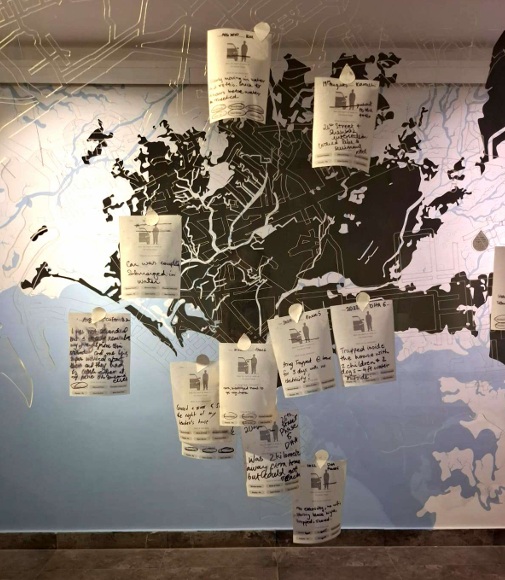
Namra Khalid's work
Rasheed Araeen’s engagement is also with the physicality of water bodies explored through his formal investigations to voice ecological concerns. Ali charts Araeens history of performances and interactive minimalist sculptures, as well as his personal experiences in his ancestral village as well as the disappearing waterbodies in the metropolis of Karachi. The red disks, or Chakras on display here act as symbols of a convergence of all these experiences. Released into various waterways around the world, these disks floated alongside garbage, in polluted waters, and eventually found their way into the open sea. Water always in movement, much like ideas, and here these discs turn the water into art through its intervention, and in turn the water disrupts and influences the outcome through its unpredictable movements, out of the artist’s control.
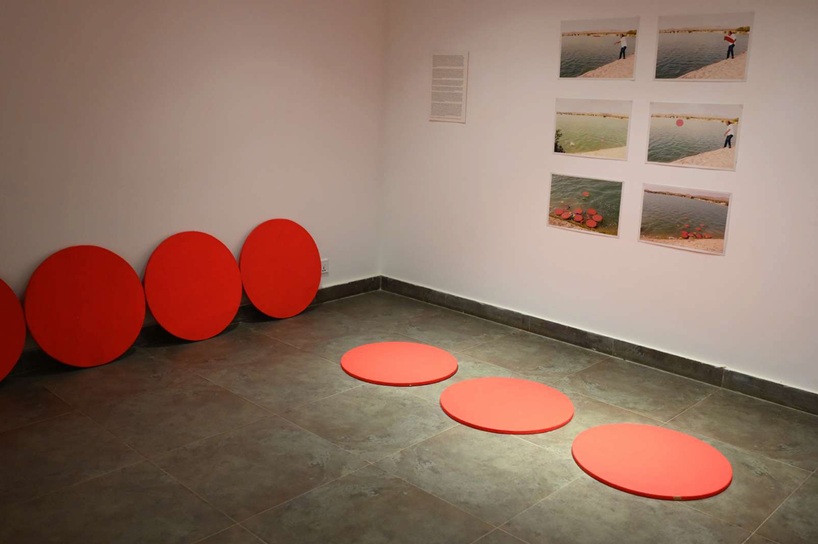
Chakras by Rasheed Araeen
Through processes of archiving and documentation, water as a natural force is investigated laying bare the helplessness of the human race in its wake, as it makes its own way. So, the question we left with is, as we come to terms with our losses and start anew, is the water encroaching into our spaces or are we the ones getting in its way, attempting to corrupt and alter its path, encroaching on its territory, pushing it back and depleting its reserves?
You may also like: