Written by: Maysam Khan
Posted on: May 07, 2026 |  | 中文
| 中文
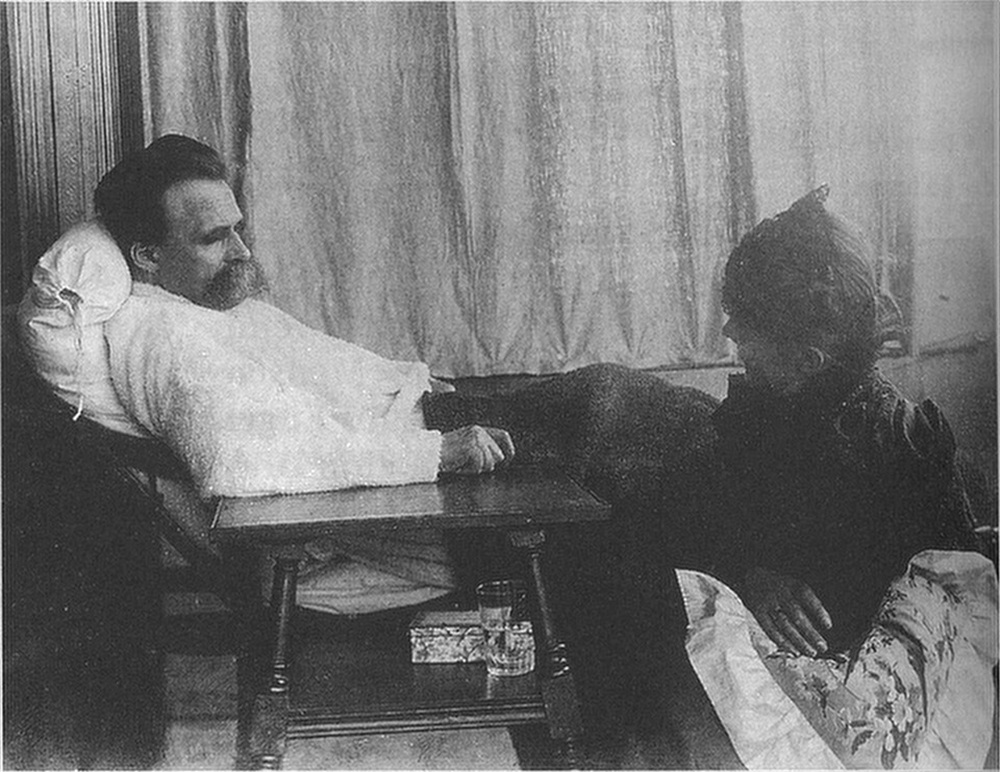
Friedrich Nietzsche in the care of his sister, 1899.
Friedrich Nietzsche was a German philosopher of the nineteenth century known for his provocative writings on truth, values, and human nature. In Beyond Good and Evil, he makes a striking claim: “good” and “evil” are not universal truths. Instead, he argues that these moral categories are human constructions shaped by societies and religions, often used as instruments of control. Against this, he calls for individuals to move beyond inherited moral systems and create their own values.
This is a powerful idea because it urges independent thinking. However, it also raises an important question: if everyone creates their own values, what happens to universal values of kindness, peace, and safety that benefit everyone. While Nietzsche’s vision of value-creation is intellectually liberating, it becomes unstable without some shared ethical limits. Freedom of valuation needs to be balanced with responsibility toward others.
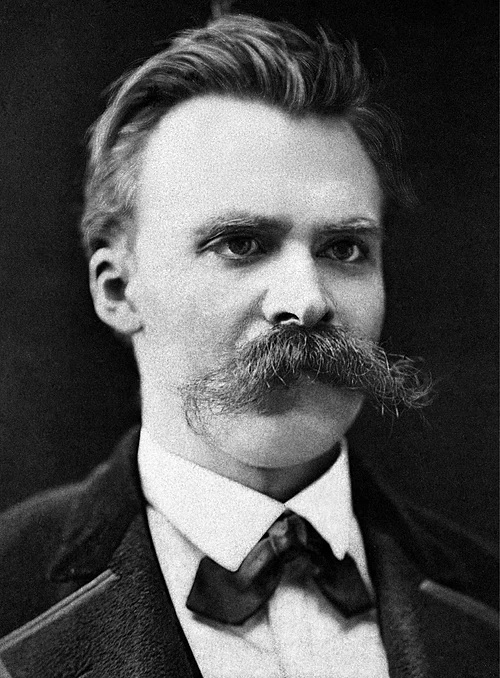
Friedrich Nietzsche, 1875
Nietzsche’s critique begins with the claim that morality is not natural or objective but historically produced. He suggests that moral systems were shaped by relations of power. Priests, rulers, and religious institutions, in his view, developed moral codes to discipline and manage those beneath them. Morality, therefore, is not neutral but deeply political in origin.
To explain this, Nietzsche distinguishes between “master morality” and “slave morality.” Master morality reflects the values of strong and confident individuals who affirm qualities such as strength, courage, pride and achievement. These values are not imposed but created through self-assertion. Slave morality, by contrast, emerges from weaker groups who emphasize humility, obedience and compassion, partly as a protective response to powerlessness. Over time, Nietzsche argues, slave morality becomes dominant through religion and cultural conditioning.
It is against this background that Nietzsche introduces the idea of the “will to power.” This is not simply a desire for domination but a broader inner drive toward growth, self-overcoming and self-expression. For Nietzsche, human flourishing lies in acknowledging this drive rather than suppressing it under inherited moral systems. Individuals, he suggests, should actively create values that reflect their own strength and life-affirming energy.
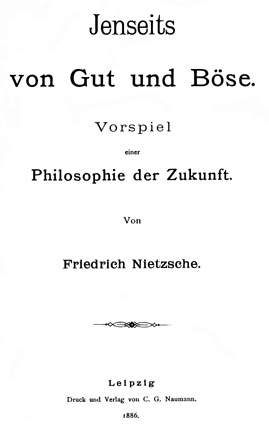
Title page of the first edition of Beyond Good and Evil by Friedrich Nietzsche.
This perspective is compelling because it challenges passive conformity and encourages self-authorship. However, Nietzsche leaves a crucial gap: he does not clearly specify how value-creation can be ethically constrained. Without such limits, the idea risks being interpreted as permission for purely self-interested behavior, where power becomes the only measure of justification.
This ambiguity has had serious consequences in interpretation. Nietzsche’s philosophy was later misappropriated, most infamously by the Nazis, who used distorted readings of his ideas to justify hierarchy and violence. Although this was not Nietzsche’s intention, it highlights a structural vulnerability in his argument: when moral limits are rejected without replacement, interpretation becomes open-ended in dangerous ways.
A stable society, however, cannot function on entirely individual moral systems. It requires a minimal set of shared ethical commitments, such as not harming others, respecting rights, honesty and responsibility. These are not necessarily absolute in a metaphysical sense, but they are practical conditions for coexistence. Without them, even well-intentioned self-created values can conflict destructively.

The residence of Nietzsche's last three years along with archive in Weimar, Germany, which holds many of Nietzsche's papers.
The stronger reading of Nietzsche, therefore, is not that all values should be discarded, but that inherited values should be critically examined and re-affirmed or revised consciously. In this sense, self-creation does not mean moral isolation. It can include reflection, dialogue and accountability to others, rather than pure individualism.
Nietzsche’s own writing style contributes to these tensions. He writes in aphorisms rather than systematic arguments, often leaving ideas deliberately open-ended. This stylistic choice produces philosophical force but also interpretive instability. His critique of universal truth, for instance, sits uneasily alongside claims that appear universal in scope, such as the will to power itself.

Nietzsche, 1861
A more workable approach is to combine Nietzsche’s emphasis on self-overcoming with basic ethical boundaries that make social life possible. Strength and autonomy do not have to exclude responsibility. One can reject unexamined tradition while still committing to principles like fairness and non-violence. In this sense, value-creation becomes disciplined rather than arbitrary.
In conclusion, Nietzsche’s philosophy offers a powerful challenge to inherited morality by insisting that individuals take responsibility for creating meaning and values. This can lead to greater authenticity and intellectual freedom. Yet without some shared ethical limits, this freedom risks collapsing into relativism or misuse. The most defensible position is therefore a balanced one: Nietzsche’s call for self-overcoming is valuable, but it must operate within a framework of responsibility toward others.
You may also like: