Written by: Prof. Dr. Mamoona Khan
Posted on: April 14, 2026 |  | 中文
| 中文
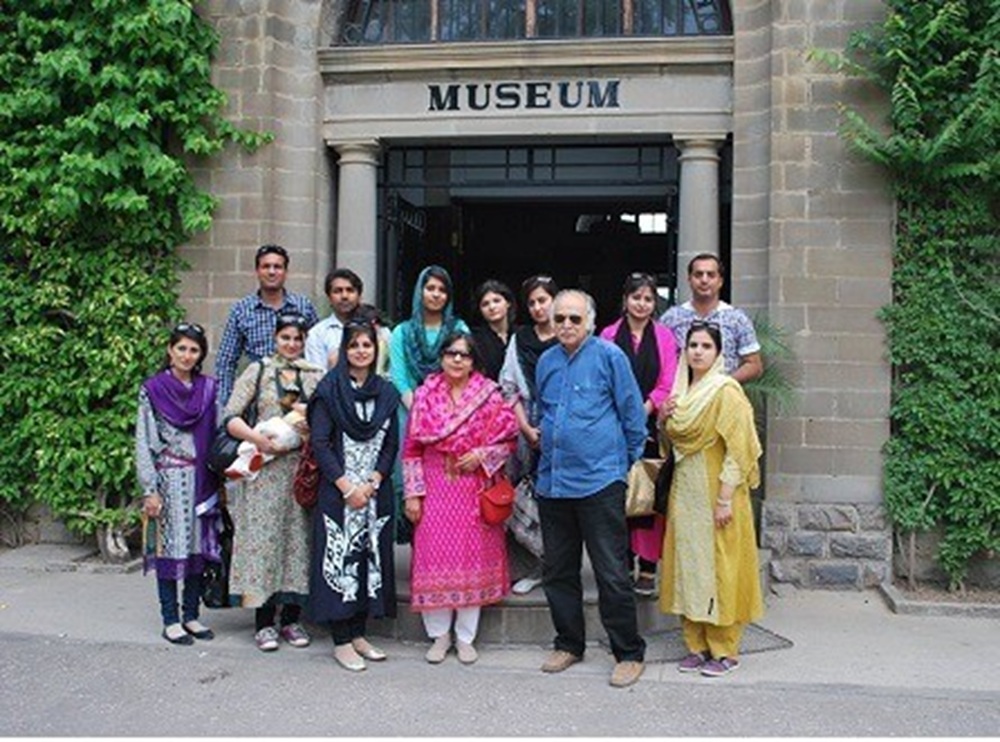
Dr. Shaukat Mehmood at Taxila Museum with students.
Perseverance is the linchpin that turns trials to blessings, obstacles to opportunities, boosting resilience that fosters success in the endeavors of life. Thousands of examples are recorded in history about those who persevered against odds, time proved their worth. Analogous is the tale of Prof. Dr. Shaukat Mahmood, who sincerely kept on with the tasks assigned to him by destiny, especially imparting of knowledge, and is still brimming over with energy to transmit it further. A role model to follow. This article will focus his post doctorate contributions and honors that nature bestows to the chosen ones.
He humbly recalls July 1981 when he rejoined the UET after completion of his Doctorate but soon after in September, received an offer from the King Abdul Aziz university, Jaddah, facing usual resistance from the local colleagues on deputation leave and the foreigners when he fortunately reached Jaddah. The administration was in the hands of Egyptians who deceitfully asserted Dr Sahab to join as lecturer, though he was invited as an Associate Professor. Tactfully handling the situation by saying that he would make a complaint to the king before leaving Jaddah that threatened the coward and he was allowed to join on the required post. No pleasant recollections about that stay, as reverential status was within the university only, while outside was a different situation. Women were kept within homes, could not move independently, and Aqama (residence permit) was always required while moving anywhere, but recollected some revered moments too.
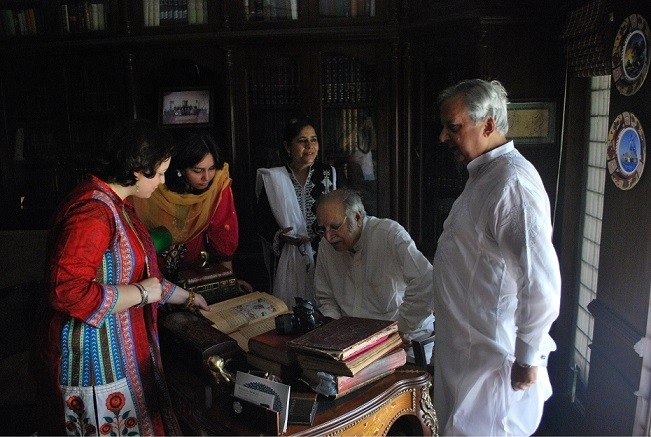
Dr. Shaukat Mehmood studying rare treaties in collection of Hur Gardezi Saheb, Multan.
On an ecstatic night, an hour before the Fajr prayer, telephone bell rang, which was only landline at that time, and one of his students asked him to join promptly at Kaʽāba, as its inside doors were to be opened after Salat-i Fajr. He at once shared the great opportunity with his friend because he was allowed to accompany one person, and both reached the sacred destination at thirty-five minutes’ drive. Actually, father of the student, a civil engineer, had asked him to invite his favorite teacher, that he did. He narrates the incident reverentially that after Salat-i Fajr they stayed at Maqām-i Ibrahim, on eastern side was the door of Kaʽāba, almost one meter high from the ground. A staircase was brought in and two air conditioners were fixed to cool down the sacred interior, the door opened, interior washed with Āb-i Zam Zam (water of the sacred spring of Zam Zam), princes of the royal family and esteemed guests entered the venerated space. Inside had two stories, not apparent from outside and the staircase was on north-eastern side, while upper storey was so low-lying that one couldn’t stand erect. It was not a regular cube from inside and its floor was of irregular stones that retained water after washing. They said Nawāfil in all four directions, clothes got wet but it was a euphoric state. When they came out everyone embraced and applauded them. So much so that after reaching home, friends venerated the clothes that he was wearing, especially the women folk took pieces of his dress as a sacred icon. The experience is still so vivid in his memories. He further added to our information that Kaʽāba actually, was not a cube, Ḥatīm was part of the interior, not the separate outer quarter. Originally, it was an oblonged oval from inside but during renovation it was shaped so. A present-day video shows that the 2nd storey, viewed by Dr Sahab in the 1980s no longer exists now.
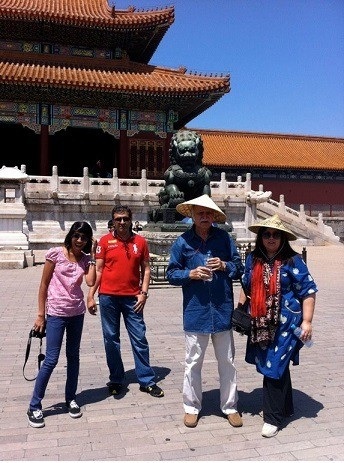
With daughter and grandchildren in China
Three years of deputation leave ended, he had earned esteem and the Dean insisted to protract his stay but the UET authorities earnestly wanted him back. He recalls another experience when the Dean of Jadda University asked him to make an Istakhāra, for his prolonged stay in the Jadda University or to join UET, Pakistan. He was asked to recite specific Āyāhs of the Holy Qurʼān after ʽīshāʼ prayer seeking guidance from Allāh. The anxious Dean arrived early morning, inquiring whether he dreamt anything. He said yes, envisioned sitting in a boat with the family and going somewhere. He at once said, “signal is direct, you must go back.” This is how Allah guided because the students of Pakistan needed him.
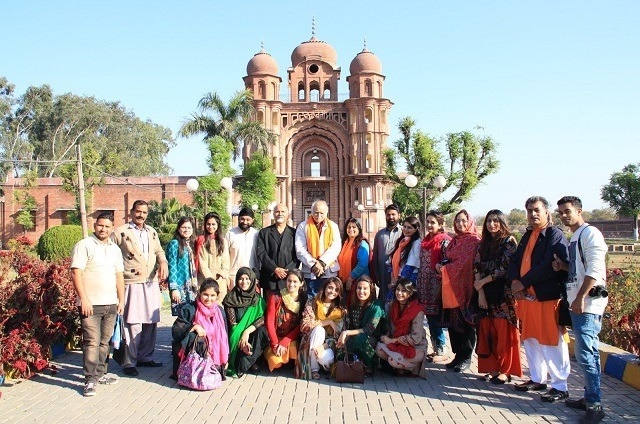
At Gurudwara Rohri Saheb, Gujranwala
Tārīkhi Virsa, a PTV program destined laurels of fame where he analyzed the historical edifices of Pakistan as an expert. People recognized him on airports, air hostesses within planes, plebeians within streets, or in bazaars, like in Multan, a passerby recognized him and said in Punjabi,
“Tū tay sāday shahar nūṇ runaqāṇ la dītīyāṇ.”
(tr.) You celebrated the splendor of our city
A month before his retirement, a shopkeeper in Multan having hidden talent of palmistry entertained them with Fālūda, prophesied while reading his palm about promotion and monetary benefits. He laughed and said, “What promotion, I am getting retired next month,” but amazing fate awaited him.
In 1998-99 in an international conference, Turkey, he developed friendship with a Malaysian professor, the Dean of Architecture and Landscape Design. They remained in contact through exchange of letters. He visited Lahore in 2000 to view Mughal architecture, Dr Sahab hosted him to the Shalamar Garden, where people enthusiastically welcomed them because of Virsa. Here, he was offered professorship at IIU Malaysia, with a respectable salary package, and Shopkeeper’s prophesy actualized.
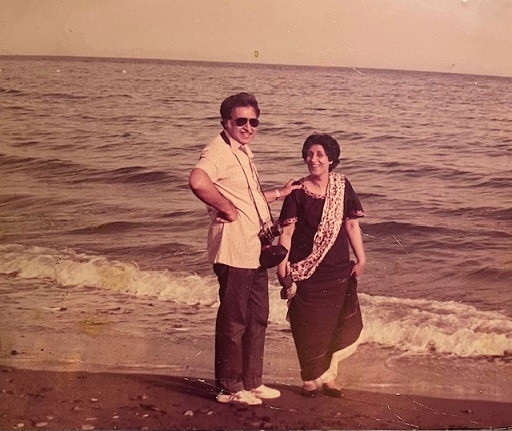
At Mediterranean Sea, Cyprus, with wife
Six years Malaysia stay was memorable, he highly appreciates the amicable nature of Malaysians, were equally revered Masjid, Hindu’s, Chinese-Buddhist temples interplay interfaith harmony. The first diadem, granted in 2001, was The Pride of Performance Award, celebrated even in Malaysia. Rector of the university arranged a splendid function in his honor. Then another accolade, al-Bukhari Chair was awarded to him, exclusively meant for the locals of Malaysia. Mr. Bukhari the owner of merchant ships, extending patronage for Muslim Art and Architecture, established Islamic Art Museum, and a department of Islamic Art in the university and then announced al-Bukhari Chair. Finding no equivalent, while merited foreigners were highly respected, it was awarded to Dr Sahab. He was member of the advisory committee of the museum as well. Then upright return to the homeland.
HEC Chairman Dr Atta-ur-Rahman while visiting Malaysia in 2006, offered Dr Sahab the position of foreign faculty in Pakistan with an equivalent to Malaysian salary package. He joined the Research Center, University College of Art and Design, Punjab University, Lahore. From 2006-2020, worked tirelessly, mentoring a number of M.Phil. and Ph.Ds. there. Then in 2021, while coming to the Old Campus PU, his mobile bell rang and a Federal Secretary asked for his CV. Having no idea that his name was being considered for Sitra-i Imtiaz, the largest civil award in Pakistan, the diadem of perseverance. It reminded him the moments when his right was grabbed many times by the incompetents. In 1994, he applied for the Principal NCA but anticipating circumstances did not appear for interview. He was called by the Secretary Education to immediately reach Islamabad, air-ticket was arranged by them because all the incompetents were rejected and he was selected on merit but approach of a higher authority changed the game and a rejected inept joined as principal. The entire story was published in the newspapers also. Analogous is the story when he applied for the Principal of Aitchison College. But nature chose better places for him. Barbara Schimtz, an American scholar working as a colleague in the Research Centre PUCAD, while she was leaving after completing her tenure, said, “Professor Shaukat, when you leave the Research Centre will be doomed.”
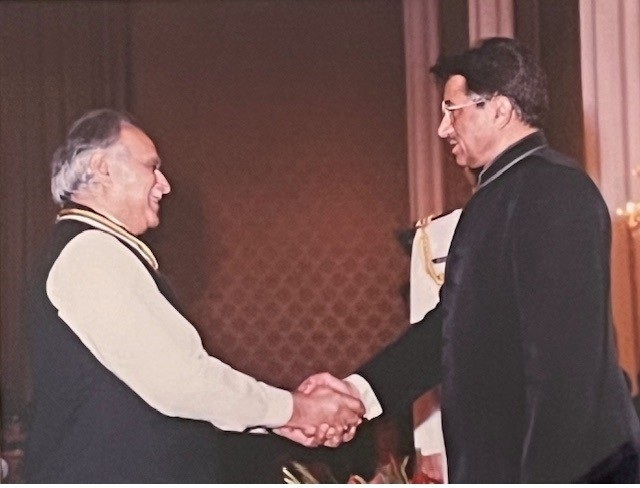
Dr. Shaukat Mehmood receiving President's Medal for Pride of Performance from Gen. Musharraf in March 2001.
You may also like: