Written by: Hurmat Majid
Posted on: April 21, 2026 |  | 中文
| 中文
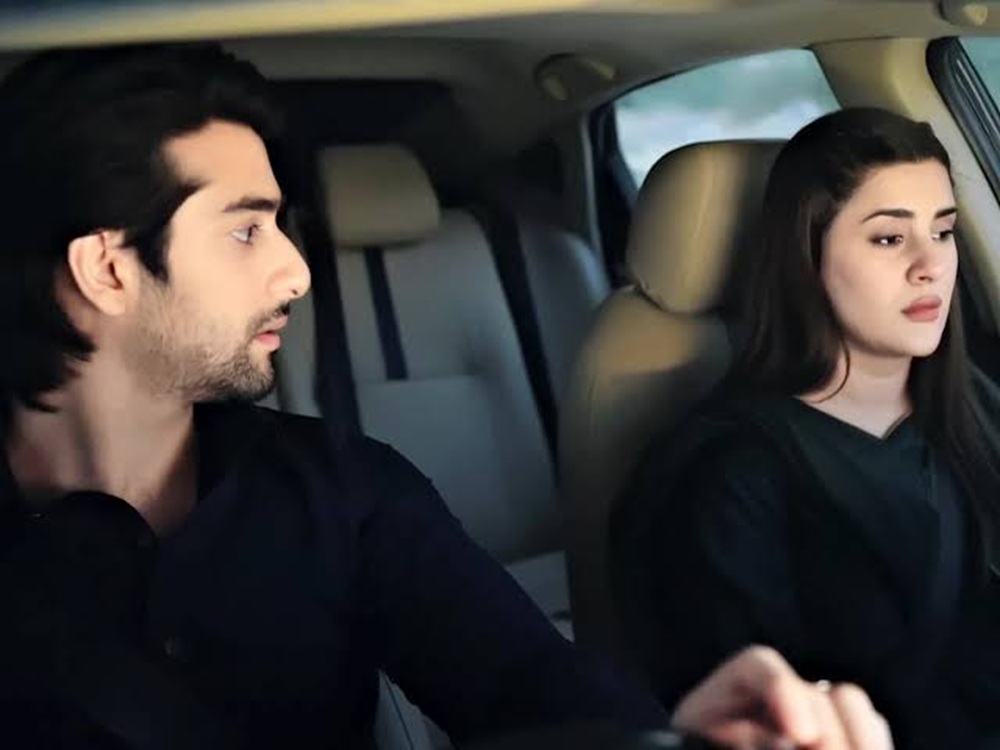
Shuja Asad and Kubra Khan in Doctor Bahu
Doctor Bahu arrives at a time when Pakistani television often leans heavily on high-voltage conflict and instant gratification. In contrast, this drama chooses restraint, patience, and emotional layering. It is, unapologetically, a slow burn. And that is precisely where its strength lies.
From its very first episode, Doctor Bahu establishes a tone that is deliberate and immersive. The narrative does not rush to manufacture drama. Instead, it allows characters to breathe, relationships to take shape, and tensions to simmer beneath the surface. In an industry that frequently prioritizes immediacy over depth, this measured pacing feels not only refreshing but necessary. The story understands that meaningful emotional investment cannot be forced. It must be earned over time.
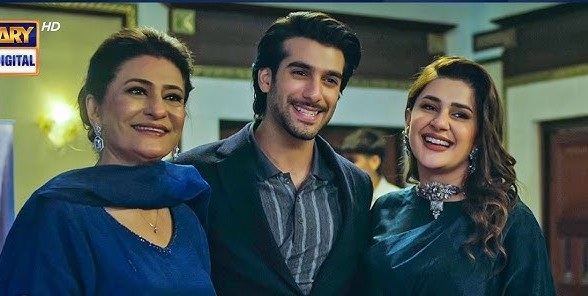
Saba Hameed, Shuja Asad and Kubra Khan
At the heart of the drama is Sania, played with remarkable nuance by Kubra Khan. Her portrayal is controlled, introspective, and quietly powerful. Sania is not written as a loud or overtly rebellious protagonist. Instead, she is thoughtful, observant, and grounded. Kubra Khan captures this internality with precision, allowing the audience to read between silences, glances, and restrained reactions. It is a performance that grows on you, much like the drama itself.
Opposite her, Shuja Asad delivers a compelling portrayal of Salman. His character exists in a space of emotional ambiguity, shaped by familial expectations and personal hesitations. What makes his performance stand out is its realism. There is no attempt to sensationalize his role. Instead, he embodies a man conditioned by his environment, often passive, occasionally conflicted, and entirely believable. The chemistry between the two leads is subtle, almost hesitant, which aligns perfectly with the narrative’s intention. This is not a sweeping romance placed front and center. It is a relationship that is taking its time to develop, unfolding gradually through shared spaces and unspoken tensions.
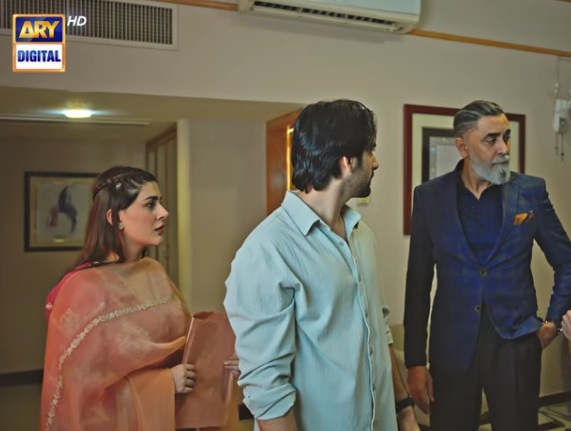
Kubra Khan, Shuja Asad and Shahzad Nawaz
The romance, in fact, is not the focal point of Doctor Bahu, and that is a conscious creative choice. It exists in the margins, quietly evolving rather than dominating the narrative. This approach allows the drama to explore broader themes without reducing itself to a conventional love story. It also ensures that when emotional shifts do occur between Sania and Salman, they feel organic and earned rather than contrived.
A significant part of the drama’s strength lies in its direction. Mehreen Jabbar’s signature is evident in every frame. There is a distinct visual language at play here, one that prioritizes realism and subtlety over spectacle. The camera work is thoughtful, often lingering just long enough to capture emotional undercurrents without overstating them. Lighting is used with intention, enhancing mood without drawing attention to itself. Interiors feel lived-in rather than staged, and transitions between scenes are smooth and purposeful. It is clear that every technical element has been carefully calibrated to support the storytelling.
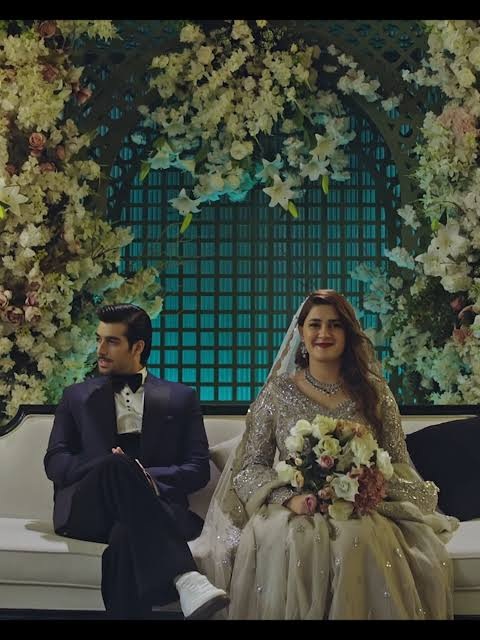
Shuja Asad and Kubra Khan
The world of the drama feels cohesive because of this meticulous direction. The Shahnawaz household, in particular, is depicted with striking authenticity. The dynamics within this family are layered and believable. Authority, hierarchy, and unspoken rules govern interactions, creating an environment that feels both familiar and unsettling. The writing and performances work in tandem to bring this space to life, making it one of the most compelling aspects of the show.
Shahzad Nawaz anchors this household with a commanding presence. His portrayal of the patriarch is measured yet authoritative, capturing the essence of control that does not need to be loudly asserted. Alongside him, Saba Hameed adds depth to the domestic landscape, embodying a character shaped by years of navigating this very system. Together, they create a dynamic that feels grounded in reality rather than exaggerated for dramatic effect.
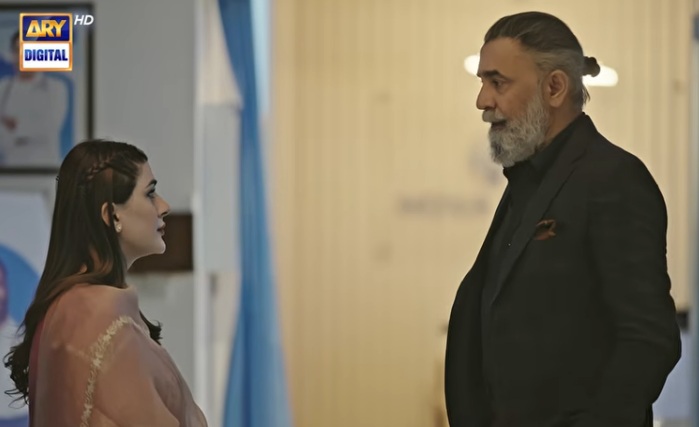
Kubra Khan and Shahzad Nawaz
Amidst this intensity, the drama offers a refreshing counterbalance through Sania’s phuppo, played by Bakhtawar Mazhar. Her character is, quite simply, a breath of fresh air. In a genre where such roles often fall into predictable patterns, Bakhtawar Mazhar brings a sense of warmth, wit, and vitality that feels genuinely new. Her comic timing is impeccable, delivered with an ease that never feels forced. More importantly, she infuses the character with positivity and emotional intelligence, offering moments of levity without undermining the narrative’s seriousness. It is a refreshing take on a role that is often stereotyped, and it stands out for all the right reasons.
Another welcome presence is Marina Khan, whose appearances on screen are always a reminder of her enduring charm and skill. There is a certain comfort in watching her perform, a familiarity that enhances the viewing experience. She brings credibility and grace to her role, adding another layer of strength to an already solid ensemble.
Of course, it is impossible to ignore the presence of Mohammad Ahmed as Sania’s father. His casting carries with it an almost meta-textual expectation. Audiences familiar with his body of work cannot help but anticipate a particular narrative trajectory. There is an unspoken understanding that characters he portrays often meet a tragic fate, and that anticipation quietly lingers in the background. It adds an additional layer of emotional tension, even in moments that are otherwise ordinary.
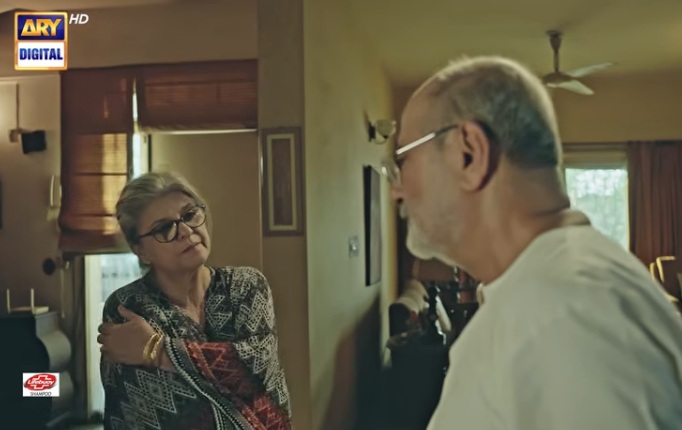
Marina Khan and Syed Mohammed Ahmed
What makes Doctor Bahu particularly compelling is its refusal to rely on exaggerated conflict. Instead, it builds its narrative through everyday interactions, small gestures, and gradual revelations. This approach may test the patience of viewers accustomed to faster pacing, but it ultimately results in a richer, more immersive experience. The drama respects its audience enough to trust that they will stay with it, that they will appreciate the slow unfolding of its story.
The performances across the board are consistently strong. Each actor understands the tone of the drama and calibrates their performance accordingly. There are no jarring notes, no unnecessary theatrics. Everything feels aligned with the overarching vision, which is a testament to both the direction and the cast’s commitment.
In many ways, Doctor Bahu feels like a return to a more thoughtful style of storytelling. It prioritizes character over plot twists, atmosphere over spectacle, and authenticity over exaggeration. It is a drama that invites you to observe rather than react, to engage with its world at a measured pace.

Kubra Khan and Hajra Yamin
Yes, it is a slow burn. But it is a slow burn done right. It understands that not every story needs to begin with a bang. Sometimes, the most impactful narratives are the ones that take their time, that allow emotions to build gradually, and that trust their audience to appreciate the journey.
In a crowded television landscape, Doctor Bahu stands out not by being louder, but by being quieter, more deliberate, and more assured in its storytelling. It is a drama that knows exactly what it wants to be, and more importantly, it succeeds in being just that.
You may also like: