Written by: Shehrbano Saiyid - Posted on: September 12, 2012 |  Comments | 中国 (Chinese)
Google Translation: اُردو | 中文
Passu Expedition: Part III
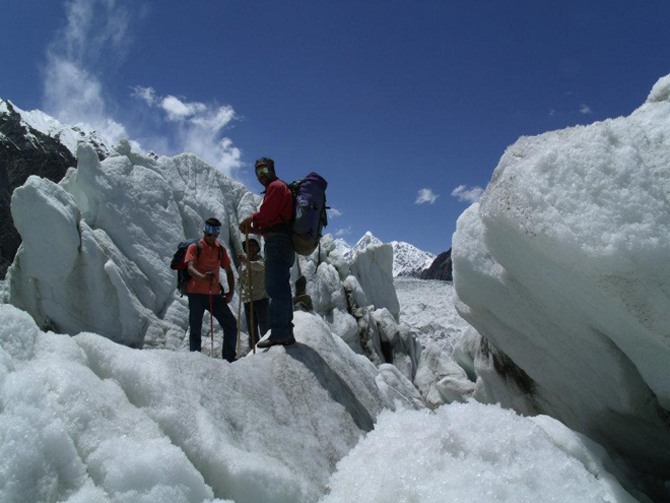
The third day was a rest day, and the team had to organize all the supplies needed for the climb. The summit would require three camps on the mountain. The high camp, which was set up on the glacier about three hours from base camp, lay across an icefall - a field of open and hidden crevasses, where any climber could fall into the unknown depths of the glacier. It was dangerous and the team would need to rope up before they started tackling the route. For non-Alpine style climbing, the expedition needed to go for a few acclimatization climbs to set up the campsites, and come back down before they would go for the final summit. Alpine style is light and fast, where the team goes straight up the mountain in one go, and can be very dangerous above 7000m. On the rest day the team had to make separate loads of supplies that needed to be dumped at each of the camps, to set the route for the final ascent. Two of the porters had stayed back to help organize the equipment, and take the loads up to high camp. The expedition leaders, Karim Hyatt and Wajahat Malik, had arranged for only one high altitude porter, and were planning to take a number of trips back and forth between each camp, in order to move all the supplies up.
This is where the problems started. Hyatt, the official guide from Altit, Hunza and Malik, an Islamabad based adventure documentary filmmaker, had no idea how much weight had to be carried, how many trips they would need to make, and how many people would be required to carry all the supplies? What if they miscalculated and were stuck in bad weather on the way down from the summit, without enough food to last the time spent in zero visibility due to cloud cover? My questions were not appreciated - I was, after all, the only woman and was questioning men who were more experienced and trained. The two porters, who had stayed back to take the loads up to high camp, were stopped from leaving base camp, because Malik said we needed to spend the day acclimatizing. Next day the porters went back without having served the purpose for which they had been brought. The team comprised of Ilyas, an Altit based mountain guide who worked for Hyatt, and Ahsan, an IT expert from Lahore. The group of five took three days moving all the supplies to High Camp. The team went for a route finding trip towards Camp 1 to dump more supplies, and when they came back they told me the route ahead is something I couldn’t do, and would have to return to base camp, although I had not shown any strain or stress so far. At this point I decided it was too risky going for the summit with a group of people whose judgment I had could not trust, and returned to the base camp with Hyatt and Khan.
On the way back I was roped in the middle, with Khan in the lead and Hyatt behind me. It had snowed the previous night, and all the crevasses were hidden. Khan had to prod his way making a safe route and we had to follow directly behind and stay in line with his steps, because that was the only route that we knew to be crevasse free and safe to walk on. Hyatt told me to walk a few feet to the right on the fresh, uninvestigated snow in order to test how I would walk in high altitude conditions. When I refused, they refused to keep moving. I decided it was okay to follow his instructions, and if anything happened, the rope would keep me safe. After walking a few feet, my right leg fell through the snow, and when I tried to lift myself with my left leg that went in as well, until each leg kept going deeper in till I was stuck and called out for help. Hyatt and Khan started laughing and said this is what the conditions were going to be like on the mountain, and the others might be too tired to help me, and I had to get to my feet myself. They didn’t figure that I had just fallen into a crevasse! After struggling for a while and digging in the snow with my ice axe to release my trapped legs, Hyatt finally came up and helped me out. After seeing the gaping black hole I had just been pulled out of, Hyatt acknowledged the fact that I couldn’t have climbed out of that alone.
Base camp seemed like a blessing after that. I stayed there for three days with the cook and his assistant, waiting for the daily updates on the progress of the expedition. The team at High Camp waited for the weather to clear after the snowfall, and left for Camp 1 in the middle of the night, when the snow had hardened with the cold. When they approached the ascent to the mountain, they found that what they thought was one ridge were actually two ridges, one in front of the other, and they would have to ascend roughly 500m, descend the other side, and then go up again. They decided it would take too much time and effort, and turned back. The expedition was a miserable failure. The remaining team returned to base camp before lunch the same day, which gave them enough time to rest, before heading back to civilization the next morning.
The team walked home in high spirits, while I felt I had lost my dream of walking amongst the clouds I saw before me. But the mountains were going no-where, and I knew I would return that summer for a women’s expedition, to attempt a mountain no one had climbed before. The women of Shimshall, a valley in Upper Hunza, had successfully climbed two unclimbed summits and now they were planning a third summit expedition. This would be another achievement for women’s mountaineering in Pakistan, and would show the men in the country as to how it’s done.
Click to view picture gallery