Written by: Sana Shahid
Posted on: September 01, 2025 |  | 中文
| 中文
Hope from the Ashes by Safwan Bashir
The exhibition Between Concrete & Coral opens like a tide pulling two very different currents into one shore. Here, Safwan Bashir and Samra Cheema present paintings that navigate the fragile seam between urban hardness and oceanic resilience, between permanence imagined and fragility endured. Both artists come to the canvas with their own vocabularies, yet together they compose a dialogue that is as unsettled as it is necessary.

Musician by Samra Cheema
Safwan Bashir’s paintings are heavy with material memory. His surfaces feel almost geological, built from sedimented strokes, pigments layered until they resemble eroded walls. In one canvas, rust-reds bleed into concrete greys, evoking seawater stains on abandoned structures. In another, deep aquamarines fracture into blotchy textures, as if coral were breaking through cement. Bashir’s mark-making is muscular but patient: lines that begin like architectural scaffolding soon buckle, twist, and soften into organic growths. He is less interested in depicting either reef or ruin than in painting their collision.
His “The Last Green Breath” series showcases rapid urbanization in the form of skyscrapers being placed in the midst of mountains, rosy fields, and lust pastures. This highlights the current state of the world, where we have disconnected from nature and rely on materialism and ecological neglect. The use of color in these artworks is quite striking, with some relying on bold tones like blues and neon pinks while others take a more subtle approach to show the beauty and resilience of nature as its waits to be inevitably replaced with steel and concrete.
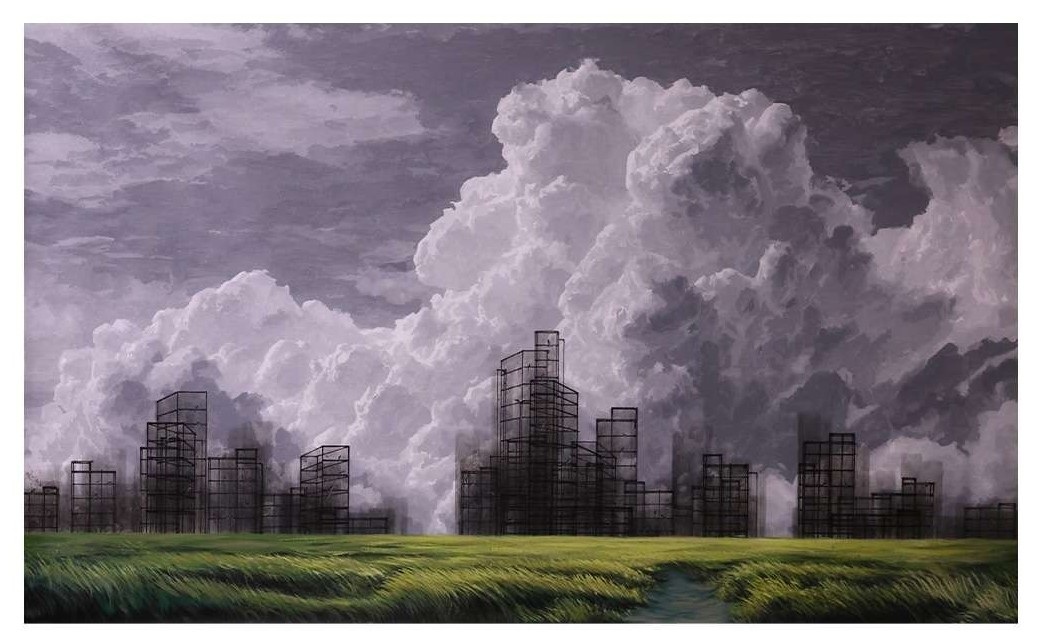
The Last Green Breath - III by Safwan Bashir
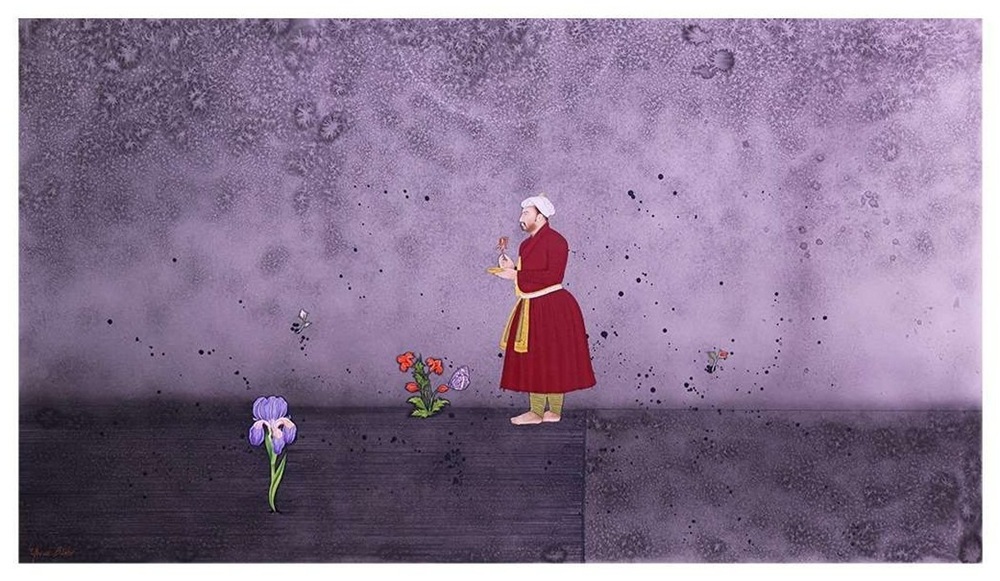
On the other hand, his “The Lost Landscape” series focuses on underground, hidden worlds full of detail. Bashir has painted traditional Mughal figures as they navigate this hidden world in search of something that is lost above-ground. These figures, painted in bright colors evoking ancient miniature paintings, stand in reflection, as the rest of the canvases are dominated by the crevices and cracks of the earth, with streams of blue water cutting through the browns of the surrounding rocks. The result is a series of paintings that make the viewer think: what exactly are the figures trying to look for, and what has happened to the world above to have caused it?

The Lost Landscape by Safwan Bashir
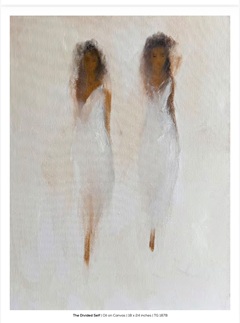
If Bashir’s works push the viewer toward the edges of ruin, Samra Cheema’s paintings linger at the threshold where landscape becomes memory. Her canvases are quieter, yet equally forceful, offering visions of shorelines transformed by expansion. She does not dramatize loss in bright color; instead, she employs a subtler palette, sands, silvers, pale blues bright reds and yellows, that echoes devastation in a quieter register. The effect is unsettling: you realize you are looking at the vanishing point of an ecosystem, and the silence of that disappearance is more devastating than any storm.
Cheema’s figures, when they appear seem to be caught mid-gesture, almost dissolving into surf. Her artist statement speaks of fragility, of bearing witness to what is erased before it is fully seen. This translates beautifully into her practice as the brushwork dissolves forms before the eye can settle. Her canvases are not confrontational but invitational, asking the viewer to linger in the discomfort of watching something slip away. There is, however, an undertone of resilience in her work. In several paintings, muted architectural forms give way to soft organic lines, as though the land itself is resisting, bending but not breaking. Even the act of painting the careful layering of pigment, the insistence on surface feels like a gesture of preservation, a way of holding onto what might otherwise dissolve.

Untitled by Samra Cheema
Her use of color and texture separates the abstract figures she creates from the backdrop of underwater worlds that seem to be fading into memory. It’s commendable how, despite using very bold strokes, she manages to make her forms stand out, even giving them facial expressions. In “Untitled”, the figure seems to be lost in thought with eyes closed, whereas a sense of longing can be seen in “Talk to me”, in which a figure sits next to a bright yellow telephone, awaiting a phone call. All her artworks in the series follow the same formula – a kaleidoscope of colors and textures in the foreground with a muted, dull, and faded background – and it works together to create pieces that force the viewers to think about their role in sustaining ecological balance.

Talk to Me by Samra Cheema
Placed together, Bashir and Cheema’s works form a remarkable duet. Bashir’s canvases speak in the voice of materials - the weight of rust, the silence of decay while Cheema’s whisper in the language of memory and witness. Despite the differences, the use of color and texture takes center-stage in both artists’ works, making “Between Concrete & Coral” a striking visual experience, one where each work makes you think about the state of the world we’re living in and how to play our part in sustaining it.
You may also like: