Written by: Muhammad Hamza
Posted on: December 18, 2025 |  | 中文
| 中文
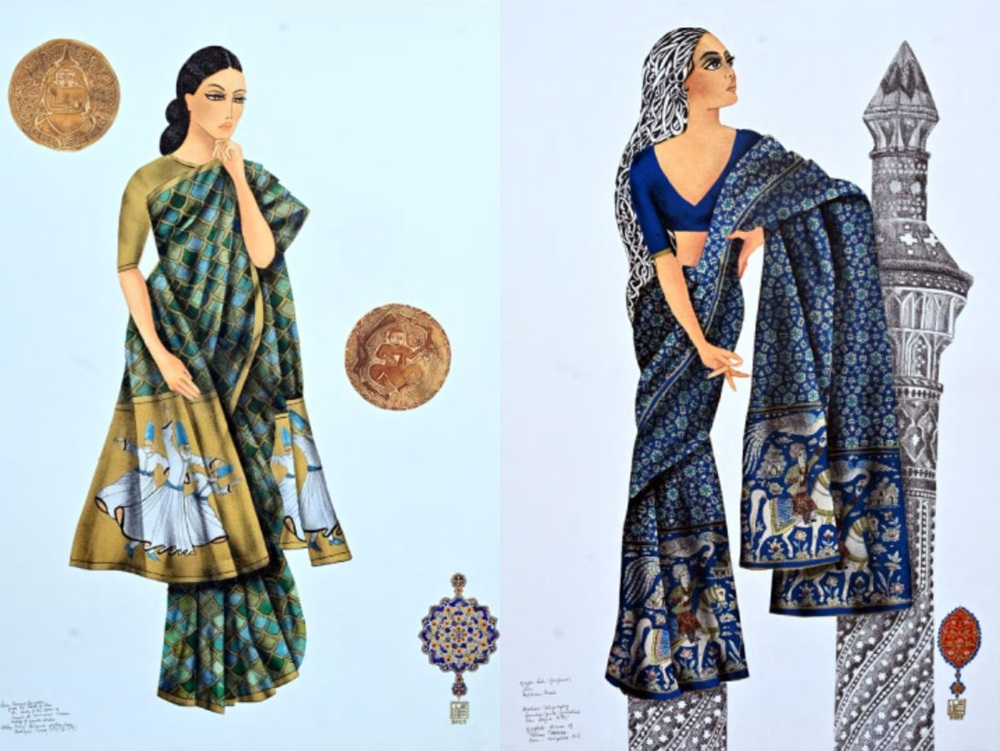
Wandering Ascetic and A Seljuk Pilgrimage
In this week’s exhibition “Unveiling Persia” at Tanzara Gallery brings to life the beauty of ancient Persian designs in a fresh way. Shakil Saigol takes the detailed tile patterns from mosques, palaces, and old ruins in Iran and turns them into flowing sarees worn by graceful women. These are not real sarees but paintings on paper using gouache and graphite. The works feel calm and elegant, mixing hard stone patterns with soft cloth. The colors are mostly deep blues, rich golds, and touches of red or green, creating a sense of peace and wonder. Saigol’s idea is simple yet powerful: he moves the stiff beauty of ceramic tiles into something that can move and touch the skin, making old art feel alive today.
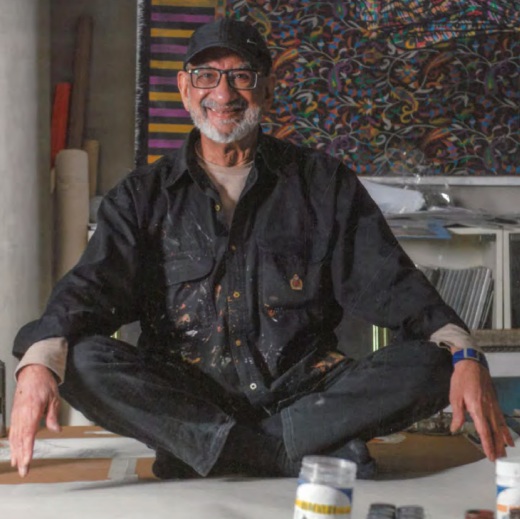
Shakil Saigol
The show is a quiet tribute to Persia’s long history of fine craft. Saigol was inspired by his trip to Iran, where he saw well-kept monuments and complex tile work that seemed to defy gravity. In his paintings, one tile becomes part of a larger repeating pattern, just like in real Islamic designs. The women in the sarees stand tall and confident, often next to drawn sketches of minarets or domes. This mix of color and line draws the eye in, making you look closer at the tiny details.
Safavid Ascent. Here, a woman in a blue saree covered in flower and leaf patterns stands with one foot raised, as if climbing. The fabric has swirling vines, tulips, and small red dots that look like classic Persian garden designs. Behind her, gray graphite drawings of tall domes and pillars rise up, giving a feeling of height and history. The saree flows softly around her body, contrasting with the hard lines of the architecture. It feels like she is rising into the grand past of the Safavid era, when Persian art was at its peak. The blue tones give a cool, serene mood, inviting you to dream of shaded palaces and quiet gardens.
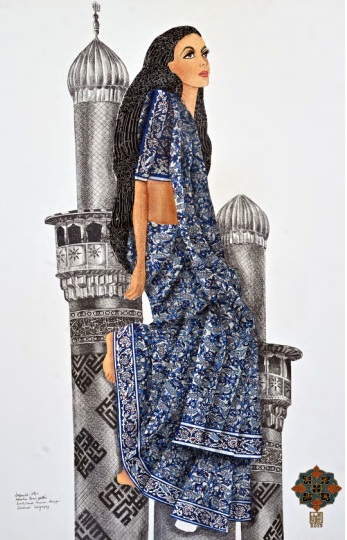
Safavid Ascent
In An Equal Music, the focus is on harmony and rhythm. The woman poses with one arm raised, her saree draped in deep blue with star-like shapes and geometric repeats. At the bottom edge, small figures play instruments or dance, painted in warm colors against the cool background. This border reminds us of old Persian miniatures where musicians gather in royal courts. The graphite towers on the sides frame her like silent guardians. The title suggests balance – the “music” of patterns repeating evenly, like notes in a song. The detail in the saree makes it look almost real; you can imagine the fabric moving gently.
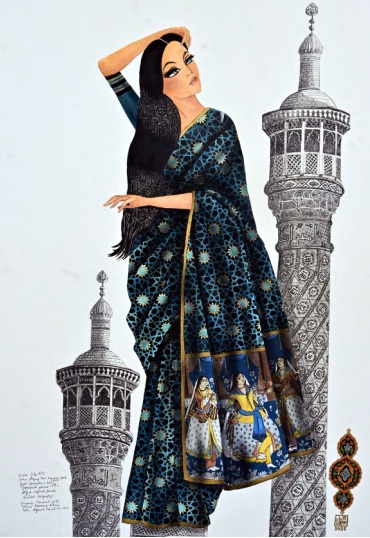
An Equal Music
A Seljuk Pilgrimage takes us on a journey. The woman holds her saree pallu carefully, looking to the side with calm eyes. Her outfit is rich blue with hunting scenes on the lower part – horses, birds, and riders in action. These come from Seljuk-era tiles that often showed brave hunts or travels. A tall pointed tower drawn in graphite stands beside her, like a landmark on a long road. The patterns are full of energy, with animals leaping and clouds swirling. Yet the woman’s pose is steady, suggesting a spiritual trip rather than a rushed one. The gold borders shine softly, adding a touch of luxury to the adventure.
Whirling Ecstasy brings movement and joy. A seated woman in a dark green saree with gold lines looks peaceful, while small sketches of whirling dervishes spin around her. These dancers, with arms open and skirts flying, come from Sufi traditions linked to Persian poetry and mysticism. The saree’s pattern has bold stripes and flame-like shapes in gold on black, creating a sense of spin even in still fabric. The ecstasy in the title comes through in the flowing lines – it’s as if the patterns are dancing too. This piece feels spiritual, connecting Persian culture’s love for poetry and dance with quiet inner happiness.
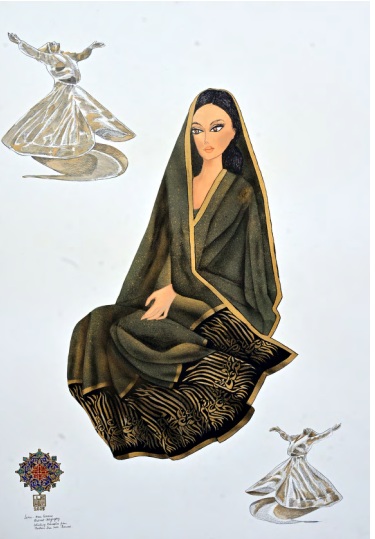
Whirling Ecstasy
Wandering Ascetic shows intricate turquoise and gold tiles turned into saree folds. The woman stands gracefully, her long hair blending into the patterns. The design uses repeating stars and crosses, common in Persian mosques, but now they wrap around a body. Small colorful tile motifs dot the edges, like jewels. The graphite background has delicate dome sketches, making the colored saree pop forward. This piece shows how Saigol makes hard tiles feel soft and wearable.
In Reverence to Ahura Mazda has a rich blue saree with hunting riders and leaping animals along the hem. The woman gazes thoughtfully, framed by tall minarets. The scenes on the fabric tell stories of courage and nature, straight from ancient tiles. The contrast between the lively border and her quiet pose creates balance.
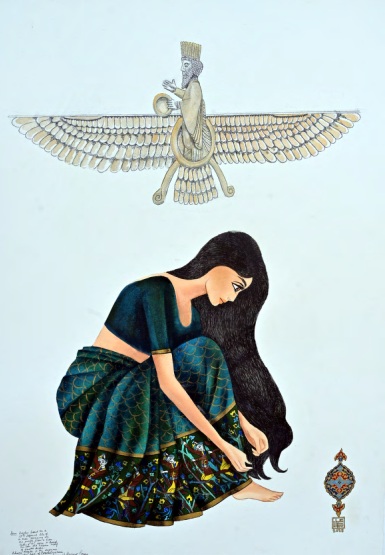
In Reverence to the Ahura Mazda
In the charbagh with layered blues and subtle red accents shows a saree full of garden motifs – flowers, birds, and vines. The woman poses elegantly, with architectural elements drawn lightly around her. It feels like stepping into a Persian paradise garden, where everything is ordered yet full of life.
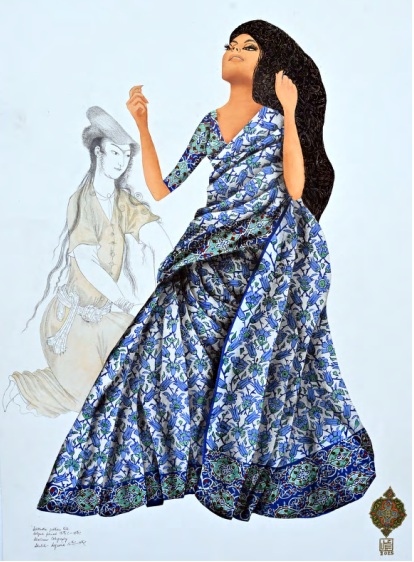
In the Charbagh
Overall, “Unveiling Persia” succeeds because it makes ancient patterns feel close and personal. Saigol does not copy the tiles exactly; he adapts them to fabric, giving them new life and movement. The women are strong and serene, like guardians of this beauty. The paintings are detailed but not overwhelming, easy to enjoy for their color and calm. By putting Persian designs on sarees, Saigol connects two rich traditions: the geometric perfection of Iran and the flowing grace of South Asian dress. The result is a show that feels timeless, reminding us how art can travel across borders and centuries. It is a gentle, beautiful homage that leaves you with a sense of wonder and peace.
You may also like: