Written by: Tanveer Ali
Posted on: March 16, 2026 |  | 中文
| 中文
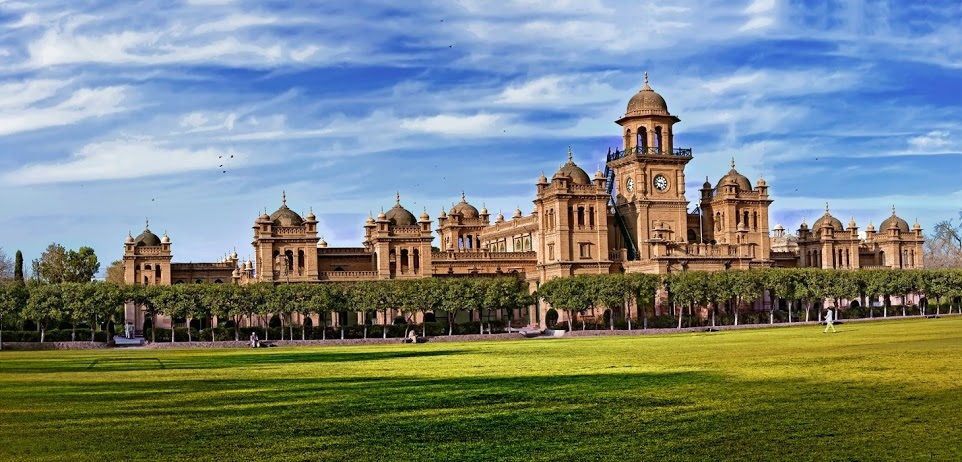
Islamia College Peshawar
For over a century, a magnificent institution in the heart of the frontier region has been shaping minds, inspiring leaders, and nurturing the dreams of generations. Islamia College Peshawar, established in 1913 as Dar ul Uloom Islamia Sarhad, has been a beacon of higher learning, standing as a symbol of knowledge, heritage and progress.
Spread across 300 acres, ICP is one of Pakistan’s oldest premier public institutions of higher education. Renowned for its academic excellence, enduring legacy, and commitment to learning, it has played a pivotal role in the Pakistan Movement and produced alumni who contributed significantly to the nation’s development and progress.
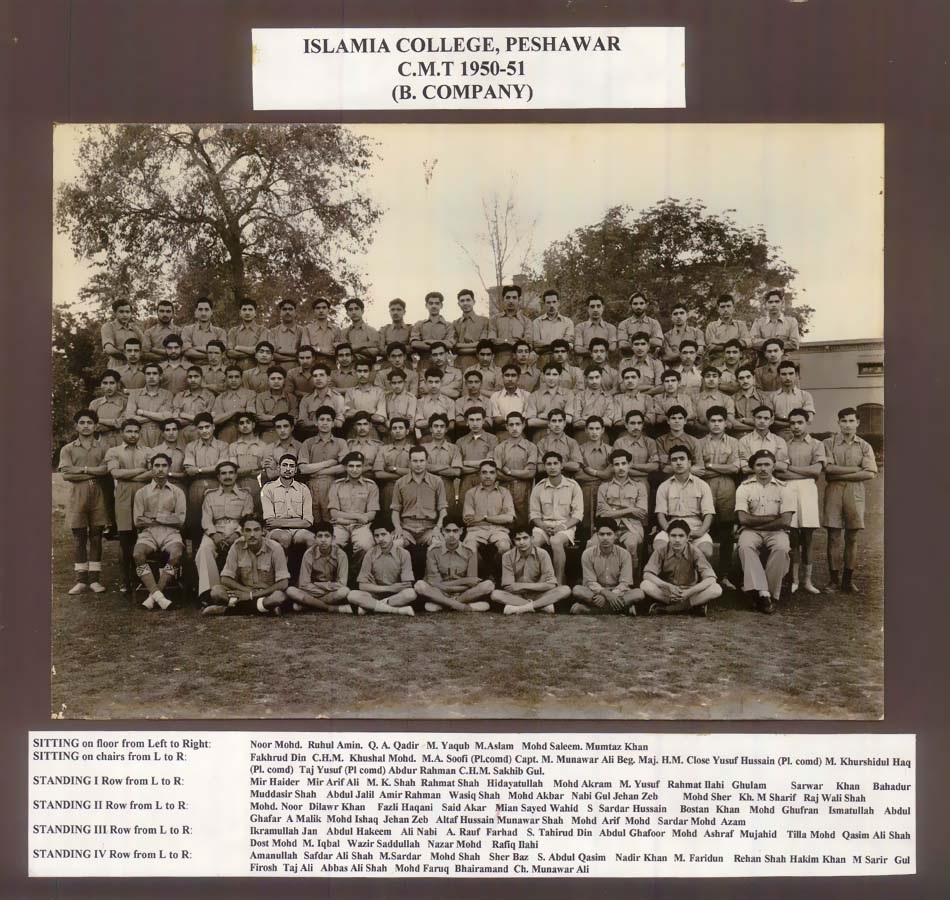
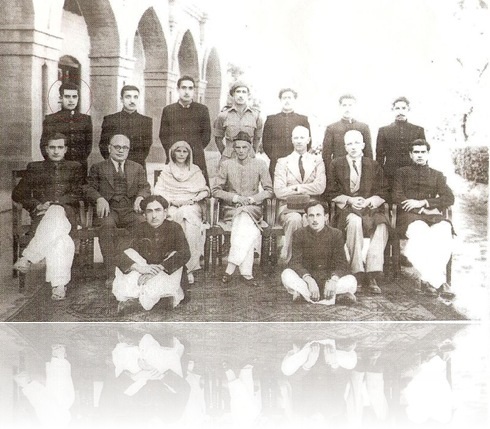
Islamia College students, 1950
The lush green campus features Mughal-inspired architecture with domes, high-ceiling rooms, open windows, and long corridors reflecting the art, architecture and intellectual history of Muslims in the subcontinent. The cricket, football, hockey, badminton and tennis grounds are surrounded by lawns adorned with flowers and plants, while a stream flowing through the campus adds to its charm. The college houses a well-equipped computer lab, an extensive modern library, and several auditoriums catering to the academic and extracurricular needs of students. ICP was upgraded to a university in March 2008 and now offers programs in Natural Sciences, Technologies and Engineering Sciences, Arts and Languages, Religious and Law Studies, and Basic and Social Sciences.
Peshawar University, the University of Agriculture Peshawar, UET Peshawar, Khyber Medical College, and several other institutes in the region owe their origin to the intellectual foundation laid by ICP.
ICP was founded by Sir Sahibzada Abdul Qayyum Khan with the support of the then Chief Commissioner of N.W.F.P, Sir George Olaf Roos-Keppel. Recognizing the educational needs of the province by 1909, they envisioned a college that could transform the region. A visit to MAO College in 1911 inspired them to establish a similar institution in the Frontier. Students from the region also expressed their need for such a college, making ICP a culmination of the Aligarh Movement, a renaissance for Muslims in British India. The college ignited the minds of Muslim intellectuals and emphasized higher education as a solution to the challenges faced by the community.
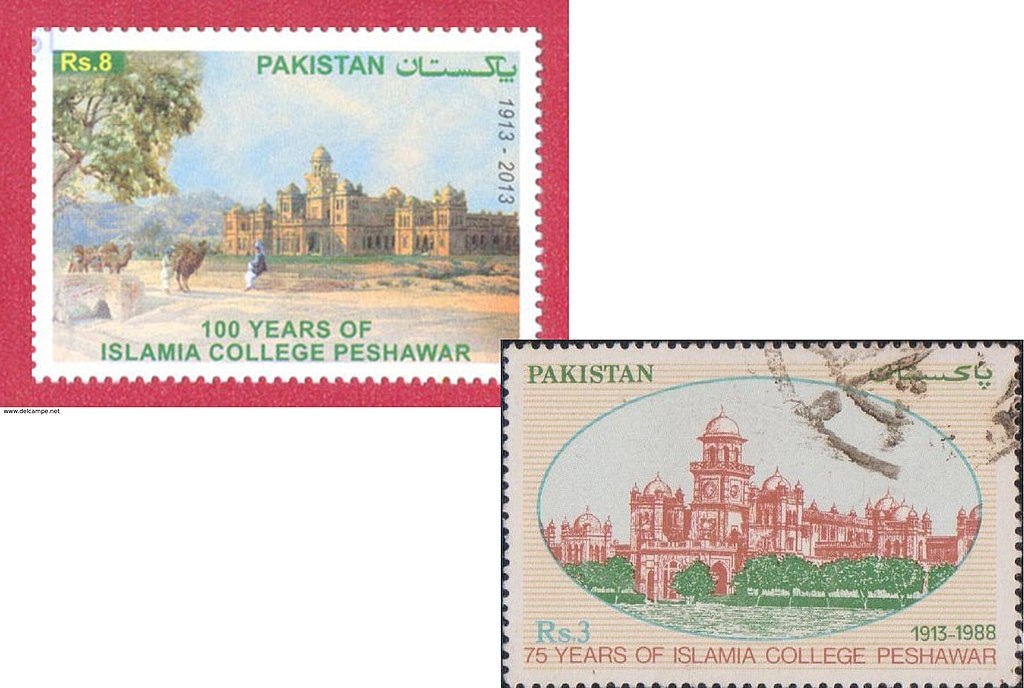
Postal Stamps depicting Islamia College
With the assistance of Sir Keppel and other notable figures, Sir S.A. Qayyum began raising funds, which poured in swiftly. Haji Sahib of Turangzai, a revered religious figure, laid the foundation stone in 1913, and the college began with just 26 students. Mr. L. Tipping served as the first Principal, with Allama Inayat Ullah Mashraqi as Vice Principal. Two years later, Allama Mashraqi became Principal, transforming ICP into a beacon of knowledge and wisdom for the Frontier.
ICP soon became a center for social and political movements in British India. The college was at the forefront of the Pakistan Movement, with students acting as ambassadors of its cause, spreading its message across the Frontier and contributing financially to its advancement. In recognition, Quaid-e-Azam Muhammad Ali Jinnah visited ICP three times: in 1936, 1945, and finally as Governor-General on April 12, 1948.
Acknowledging the contributions of ICP students, Quaid-e-Azam bequeathed one-third of his estate to the college. In his will dated May 30, 1939, he wrote:
“All my residuary estate including the corpus that may fall after the lapse of life interests or otherwise to be divided into three parts and I bequeath one part to Aligarh University, one part to Islamia College Peshawar, and one part to Sindh Madrassa of Karachi.”
Quaid-e-Azam and Fatima Jinnah at Islamia College Peshawar, 12 April 1948.
During his final visit, he addressed the students, where he said:
“I am indeed very happy to be present here today and to have this privilege of addressing the students of this great Darul Uloom, who are the future builders of Pakistan”
Here, he expressed his desire to establish a quality university in Peshawar, a vision later realized by Pakistan’s first Prime Minister, Mr. Liaqat Ali Khan, with the inauguration of Peshawar University in 1950.
Quaid-e-Azam’s visits were instrumental in securing support for Pakistan in the then North West Frontier Province (N.W.F.P), which voted overwhelmingly in favor of joining Pakistan in the July 1947 referendum with 99.02 percent approval. To honor ICP’s contributions, the college is featured on the reverse of Pakistan’s thousand-rupee note.
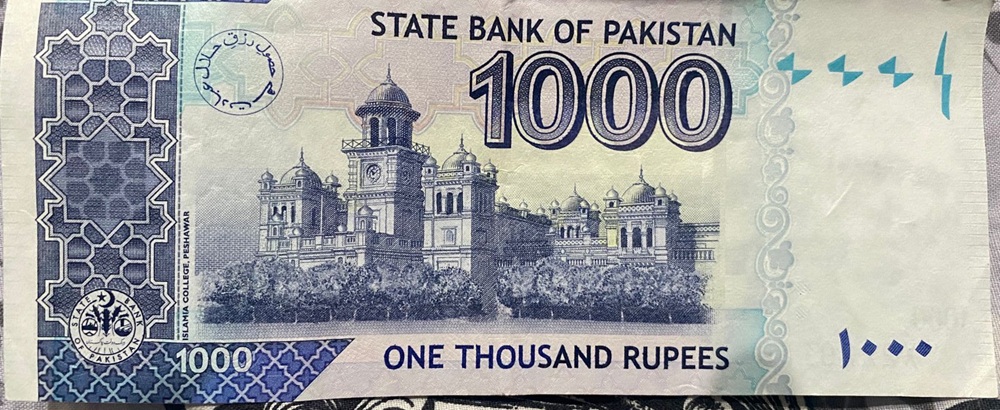
Islamia College on 1000 PKR note
Over the years, ICP has produced exemplary citizens contributing to all spheres of life. Sahibzada M. Khursheed, the college’s first student, became the first Muslim Governor of N.W.F.P after independence. Other notable alumni include former President Ghulam Ishaq Khan, former Chief Minister Hayat M. Khan Sherpao, former Interior Minister Aslam Khattak, and former Governor Ali Ahmed Jan Orakzai. ICP alumni have also excelled in sports, with Olympian Qazi Mohib and cricketer Zakir Khan representing Pakistan internationally.
ICP celebrated its centenary in December 2015 with great enthusiasm. The then Prime Minister, Mr. Mian Muhammad Nawaz Sharif, praised the college’s role in Pakistan’s creation and its continued contribution to national development. A commemorative coin was issued by the State Bank of Pakistan, and postal stamps depicting ICP were released. The author had the honor of being part of the 100th batch, a distinction to cherish.
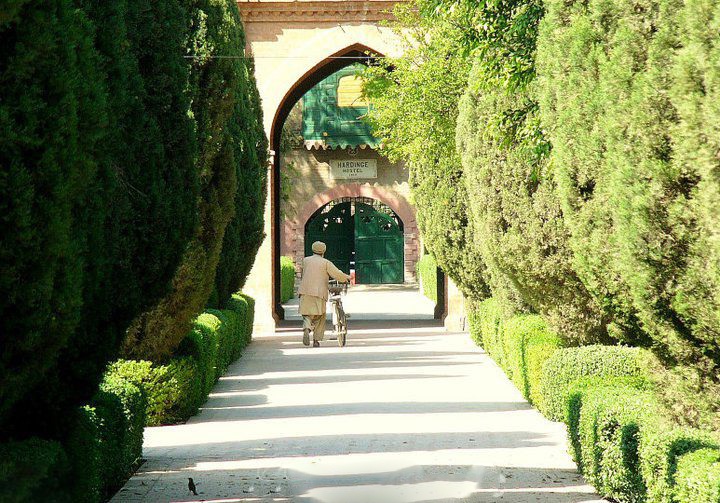
The corridors of the College
Since 1927, ICP’s magazine, Khyber, has chronicled the college’s journey from its early days to the present, offering a window into its glorious history.
True to its anthem, penned by Prof. Dr. Abdus Salam Khalis, "Da Islamia College, Da Da Ilam Khazana" meaning "This is Islamia College, this is a treasure of knowledge", ICP continues its mission of disseminating knowledge. It remains a torchbearer of learning, progress and change, fulfilling one of Pakistan’s most pressing needs.
You may also like: