Written by: Anum Zaeem
Posted on: July 02, 2025 |  | 中文
| 中文
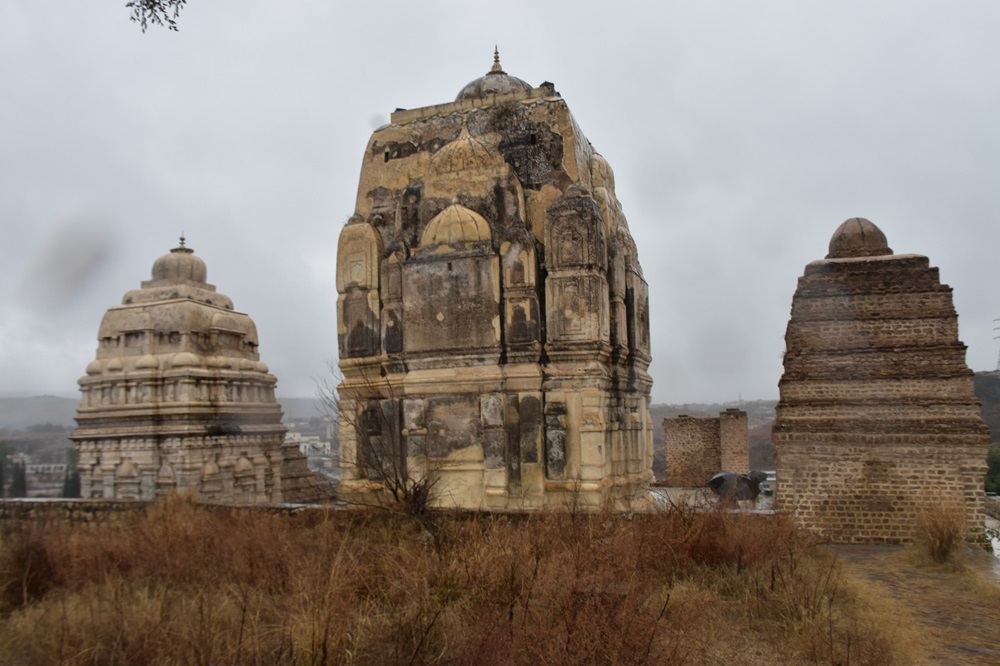
Three of Katas Raj's seven temples of the Satgraha complex, Shiva Temple (center), flanked by the Hanuman Temple (left) and one of the subsidiary shrines (right).
As the sun rises and the morning mist lifts from the Salt Range mountains, the first golden rays of sunlight dance across the surface of a sacred pond. The water shimmers and reflects the ancient stone temples that have been there for centuries. This is Katas Raj, a place where myth and history combine, where divine tears are said to have fallen, and where I found myself staring in wonder at one of Pakistan's most breathtaking heritage sites.
The drive from Islamabad takes you through the landscape of Punjab province, but nothing prepares you for the moment Katas Raj reveals itself. As I rounded the final bend in the road near Choa Saidanshah in Chakwal District, the temple complex seemed to materialize like a mirage, stone structures clustered around that mesmerizing blue-green pond that forms the heart of this sacred place.
The pond there is said to have been formed by Shiva’s tears. According to Hindu mythology, when Shiva's beloved wife Sati died, his grief was so overwhelming that he wandered the earth inconsolable. Where his tears fell, sacred pools formed, one here at Katas, and another at Pushkar in India. Even the name "Katas Raj" comes from "Kataksha," Sanskrit for "tearful eyes." Hindu pilgrims still come to bathe in these sacred waters, believing the water washes away their sins.
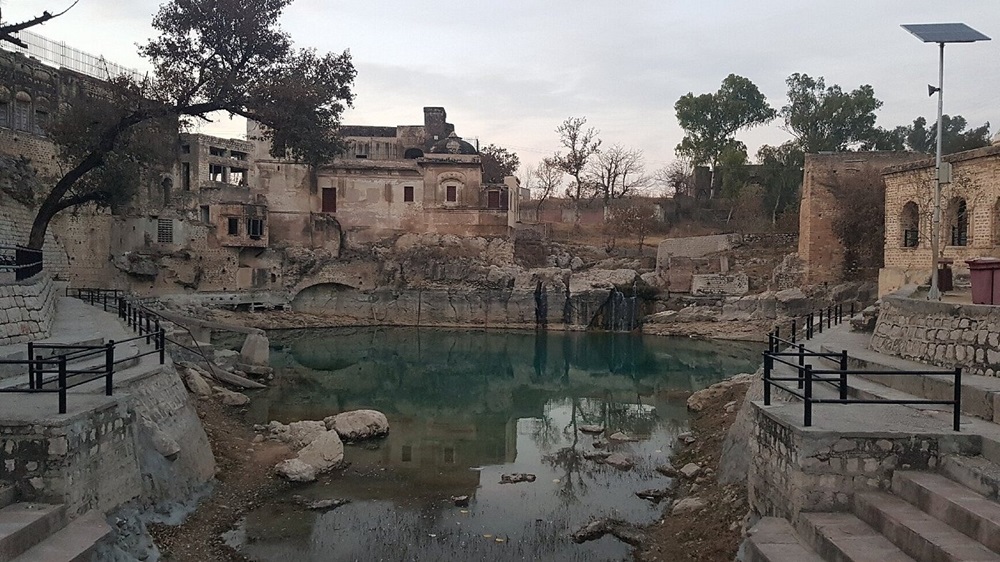
The sacred pond formed by Shiva's tears sits at the heart of the complex, its turquoise waters reflecting the ancient structures built around it.
The religious significance of Katas Raj extends far beyond its natural beauty. According to Hindu tradition, the site plays an important role in the Mahābhārata, where it is believed the five Pandava brothers spent a significant portion of their exile. Legend says that it was here that the brothers engaged in a famous riddle contest with the Yakshas, as described in the Yaksha Prashna.
Another tradition associates the site directly with Lord Krishna, who is said to have established the foundation of the temple and installed a hand-made lingam here. Some devotees even believe that the Katas Raj complex is dedicated to Lord Shiva, with various temples honoring other deities including Ram and Hanuman.
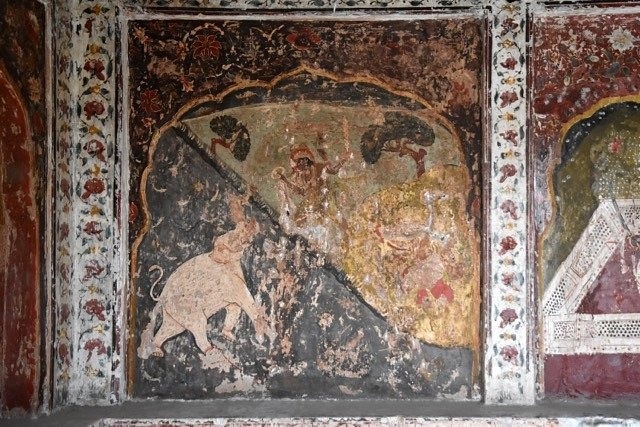
Ancient wall mural depicting an elephant with human figures, symbolizing Lord Ganesha's wisdom and royal power in Hindu tradition at Katas Raj Temple.
The Katas Raj complex represents an architectural timeline, with buildings and ruins stretching in an unbroken line from the Buddhist era through to British rule, preserving at least 1,500 years of history in one sacred space. The site houses the Satgraha or "seven temples," which form the most prominent part of the complex, along with remains of a Buddhist stupa, medieval temples, and havelis (traditional mansions) scattered around the holy pond.
The elevation of the sub-shrines creates a series of cornices with small rows of pillars, crowned by ribbed domes. The Ramachandra Temple stands prominently on the eastern side of the Hari Singh Haveli, while the Hanuman Temple occupies the western extremity of a high rectangular enclosure. The Shiva Temple, built on a square platform, features a recessed round arch entrance with faint cusps.
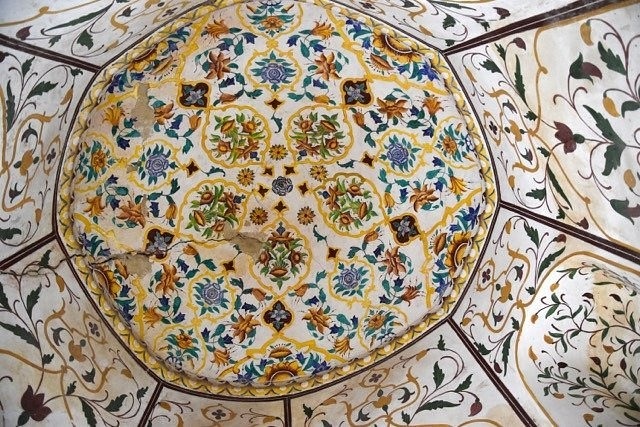
Floral dome ceiling painting showcasing detailed Islamic-influenced decorative patterns in vibrant colors.
What makes Katas Raj particularly remarkable is its role as a crossroads for different religions and cultures throughout history. Archaeological evidence suggests the site was first mentioned in the travelogues of the Chinese monk Faxian. Later, the 7th-century Chinese traveler Xuanzang described a Buddhist stupa here that reportedly towered 200 feet in height and was surrounded by ten springs.
The complex flourished under the Hindu Shahi kings between 615-950 CE, who established it as one of their most significant temple sites. The founder of the Sikh faith, Guru Nanak, is believed to have visited Katas Raj, as the site became a popular destination for ascetics. The powerful Sikh emperor Ranjit Singh also conducted regular pilgrimages here, visiting for the Vaisakhi festival in 1806, in December 1818, and again in 1824.
The partition of British India in 1947 marked a turning point for Katas Raj. The local Hindu community migrated to India, and while Indian pilgrims continued to visit for the Maha Shivaratri festival, their access was prohibited following the Indo-Pakistani War of 1965 until 1984. The temple complex fell into disrepair over these decades, suffering from neglect and environmental challenges.
A significant change came in 2005 when India's former deputy prime minister L.K. Advani visited the temple. His concern over its deteriorated condition prompted the Pakistani government to undertake renovation work. Since then, restoration efforts have continued, with further improvements announced in 2017, including the installation of shikharas (spires) on the temples and a water filtration system for pilgrims.
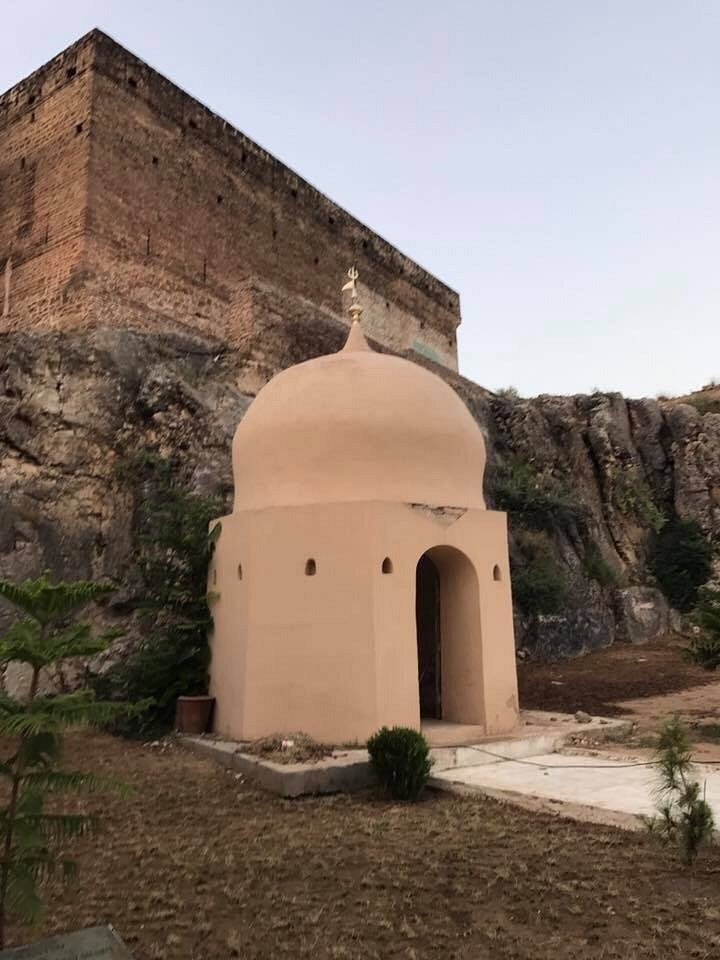
A recently restored white domed shrine contrasting against the ancient fortress wall and rugged cliffs behind it.
In recent years, environmental concerns have threatened the sacred pond. Water levels decreased significantly due to nearby cement factories drawing groundwater and the plantation of water-hungry eucalyptus trees that lowered the area's water table. This issue reached Pakistan's Supreme Court, which ordered the factories to find alternative water sources to preserve this important heritage site.
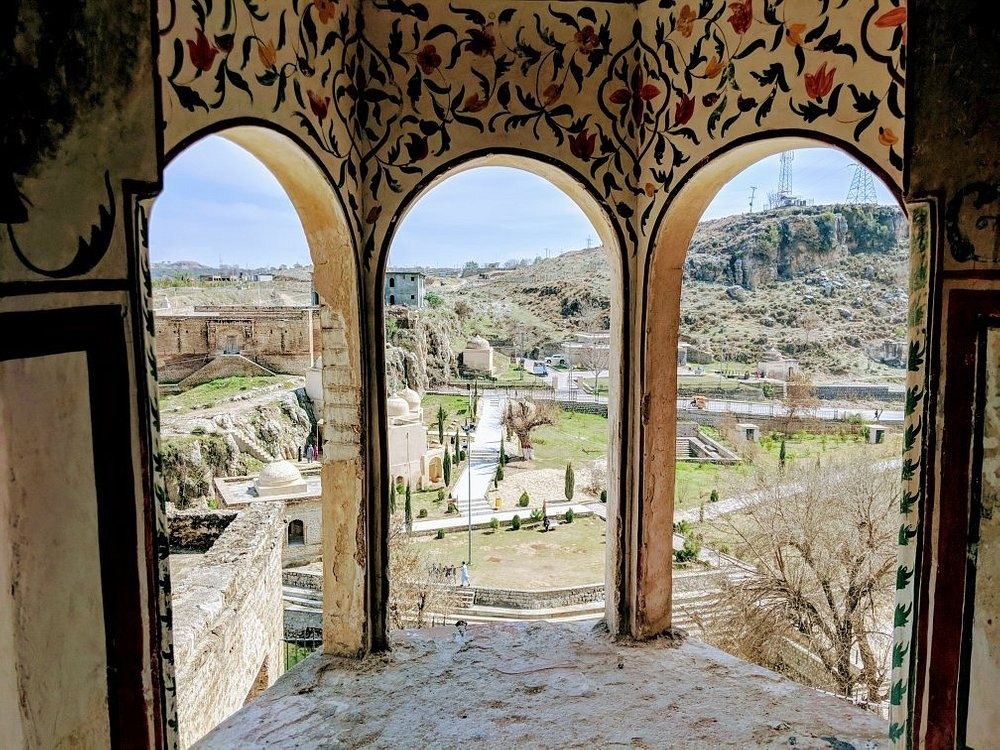
Decorated archways frame a view of the landscaped temple grounds and surrounding Salt Range hills.
The entire complex offers extraordinary photo opportunities with its greenish-blue pond waters surrounded by lush green hills. The surrounding areas, including Khewra Salt Mine (the second largest salt mine in the world) and Kallar Kahar, enhance the appeal of this location.
For those planning a visit to Katas Raj, the best time is during the cooler months from October to March, when the weather is most pleasant for exploring the outdoor complex. The site is typically open from sunrise to sunset, although specific hours may vary.
While there are basic facilities for visitors, it's advisable to bring water and snacks, as options near the temple complex may be limited. Modest dress is recommended out of respect for the religious significance of the site.
Photography is permitted throughout the complex, though visitors should be mindful when photographing any active worship. The panoramic views from various vantage points make for spectacular photographs, particularly in the golden light of early morning or late afternoon.
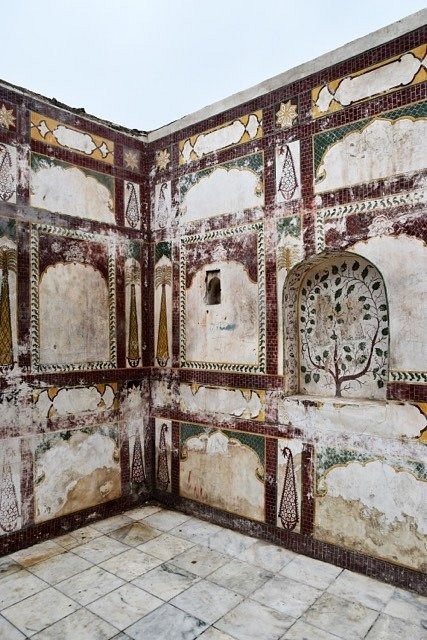
Intricately decorated interior walls of a Katas Raj temple showcasing geometric patterns and ornate framing designs.
Katas Raj represents more than just a collection of ancient temples; it's a living symbol of South Asia's diverse religious heritage and architectural accomplishment. From its mythological origins in the tears of Lord Shiva to its continuing relevance as a place of pilgrimage and historical interest, the complex offers visitors a unique window into centuries of spiritual and cultural evolution.
As Pakistan continues efforts to preserve this precious heritage site, Katas Raj stands as a reminder of the rich tapestry of civilizations that have flourished in this region, and the importance of protecting such treasures for future generations. For travelers seeking to understand the depth and complexity of the subcontinent's religious history, few destinations offer as profound an experience as the sacred temples of Katas Raj.
You may also like: