Written by: Saram Maqbool
Posted on: February 13, 2026 |  | 中文
| 中文
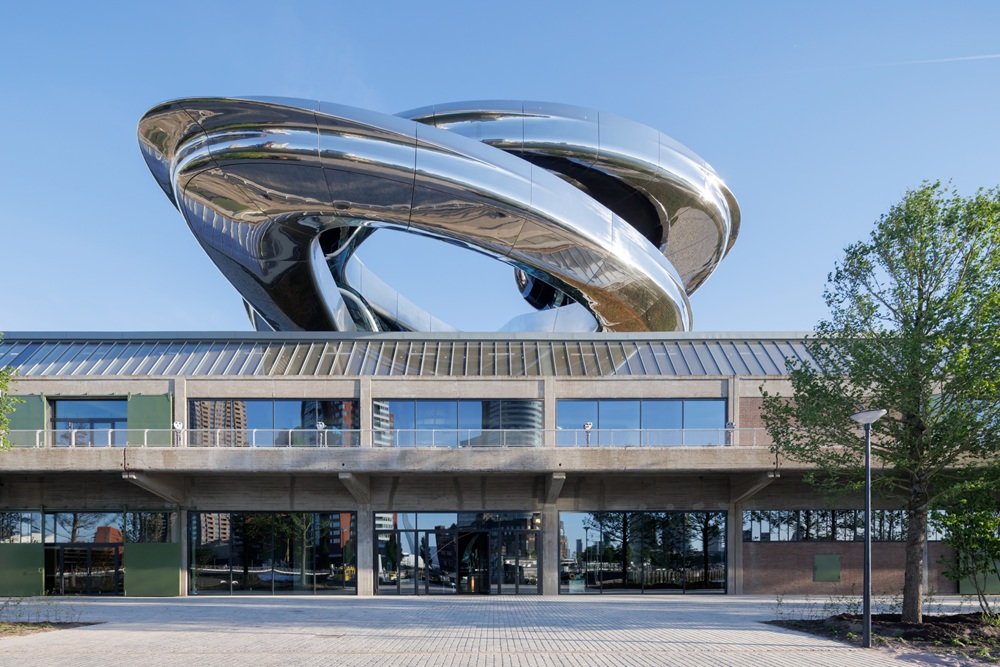
Fenix Museum of Migration in Rotterdam
Being part of the creative industry, MAD Architects really stands out just by its name alone. However, founded and led in 2004, in Beijing, by Ma Yansong, the studio is recognized for far more than its name. At the heart of the firm’s work is a synthesis of nature, emotion, and urbanism that rejects the idea of rigid, box-like architecture and aims to reconnect the built space with organic rhythms of landscape and human experiences. MAD Architects often relies on traditional Chinese concepts in their work, such as Shan Shui, which literally translates to Mountain and Water. This philosophy envisions cities where psychological well-being and a relationship with nature are central. Ma Yansong believes that architecture should do more than just provide shelter. It should influence mood, memory, and the human connection with a place.
One of the firm’s earliest and most notable projects, the Absolute World Towers in Canada, remains a testament to the architect’s vision. The two towers twist in curving profiles that deliberately avoid the rectilinear geometry of conventional high-rise buildings. By doing so, the tall structures echo natural forms and align with the firm’s belief that architecture should mirror the spatial fluidity of nature. Another project that becomes a visual metaphor for cultural continuity in cities that are rapidly expanding is the Ordos Museum in China. It is a fluid, shell-like form that was inspired by the undulating sand dunes and vast sweeping landscapes of the Gobi Desert. The form evokes local geography and holds within itself art and heritage, blurring the boundaries between architecture and landscape to communicate identity and context.
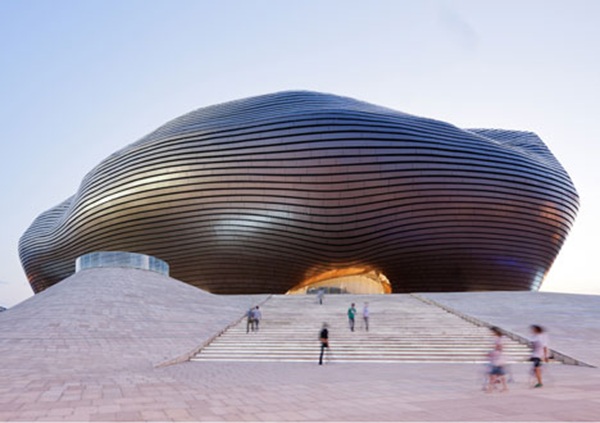
Ordos Museum in China
Another landmark project that has defined MAD’s trajectory is the Harbin Opera House in Heilongjiang Province. This performing arts center rises from the ground with sweeping curves that seem to be carved by wind or water. The exterior, especially when viewed from above, reminds me almost of an octopus with its arms out, holdings what’s within it safe while beckoning visitors into the space. From eye-level, the building looks alive, with its undulating form taking the viewer’s eye from one point to the next, seamlessly and ultimately connecting with the ground.
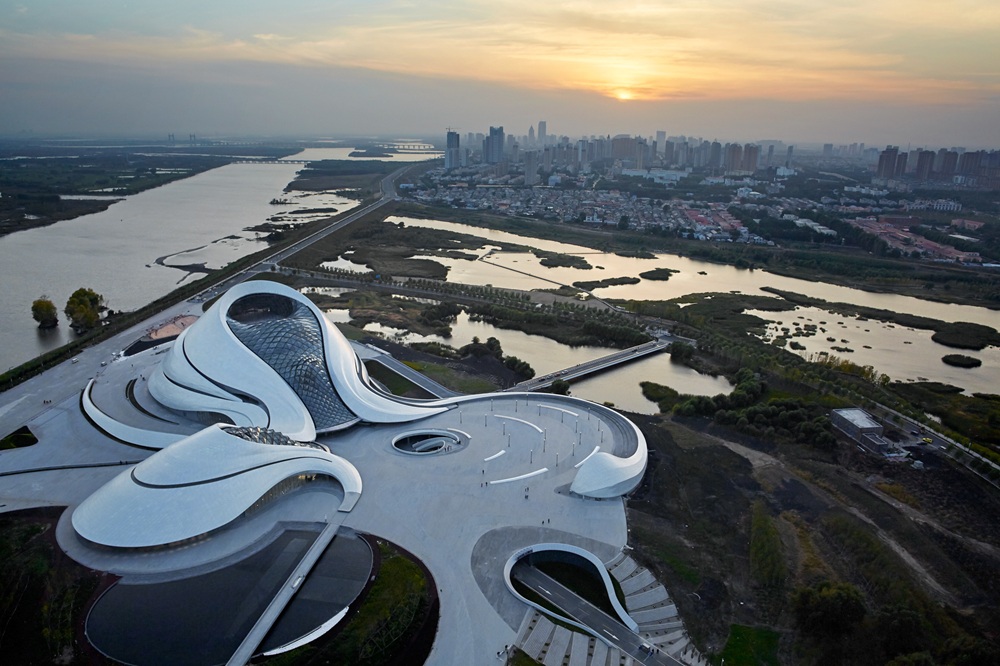
Harbin Opera House in China
In recent years, MAD has applied these principles to more civic-oriented public architecture. The Quzhou Stadium in Zhejiang Province, completed in 2021, rethinks the traditional sports arena. Rather than treating the stadium as an isolated object, it is integrated into the land. The building’s fluid roofline echoes the silhouettes of nearby mountains and its public spaces weave into green networks that encourage interaction even outside event days. Similarly aligned with cultural engagement is the Shenzhen Bay Cultural Park in southern China. Designed as a venue for art, education, and public gatherings, the complex is designed along the idea of water receding to reveal rock. This project reinforces MAD’s recurring theme that architecture should engage with cultural stories as much as it engages with climate and context.
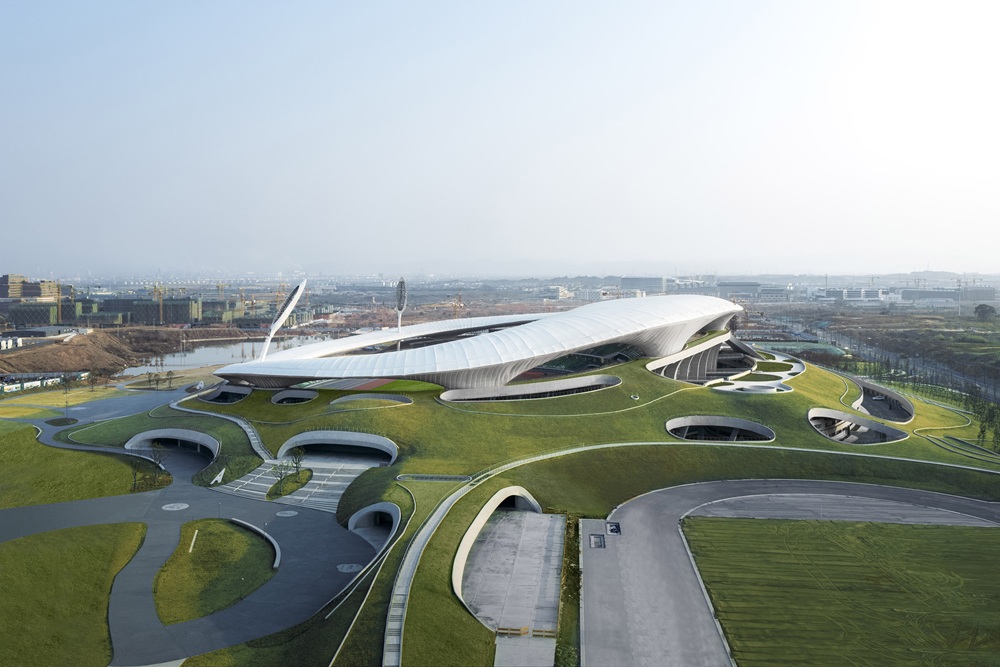
Quzhou Stadium in China
Beyond China, MAD’s work has also gained international recognition, signaling the global influence of its philosophy. In Rotterdam, the Fenix Museum of Migration combines historic preservation with contemporary design. A new double-helix stainless-steel tornado staircase provides a striking new focal point. And at the same time, the project respects the original 1923 warehouse form, weaving together past and present. As the firm’s first European cultural commission, Fenix reflects MAD’s commitment to creating architecture that bridges history, culture, and collective memory in global contexts. International projects like these underscore a core aspect of MAD’s philosophy, that architecture cannot be detached from cultural and environmental narratives. In a 2004 interview reflecting on China’s rapid development, Ma spoke about projects like Beijing 2050, a visionary concept exploring green urban futures where trees, rather than monuments, become the dominant element in political space. This illustrated the depth of his commitment to rethinking not only how cities look but what they represent.
Critics of MAD’s work sometimes point to a tension between poetic expression and ecological realism. Organic forms, by their nature, can carry high construction and maintenance costs, since parametric design and advanced digital modeling tools are indispensable for translating those forms into buildable realities. MAD’s embrace of technology enables this translation while also pushing questions about sustainability, lifecycle impact, and material choice to the forefront of architectural debate. Yet, even with these pressures, MAD’s architecture offers a compelling envisioning of cities that resist the boxy, transactional form of much contemporary urbanism. Its work consistently asks whether architecture can be more than infrastructure, whether it can be emotional, reflective and rooted in cultural memory. By focusing not only on what is built but how people experience it, the firm broadens the conversation about architecture’s role in a world that’s increasingly defined by rapid urbanization.
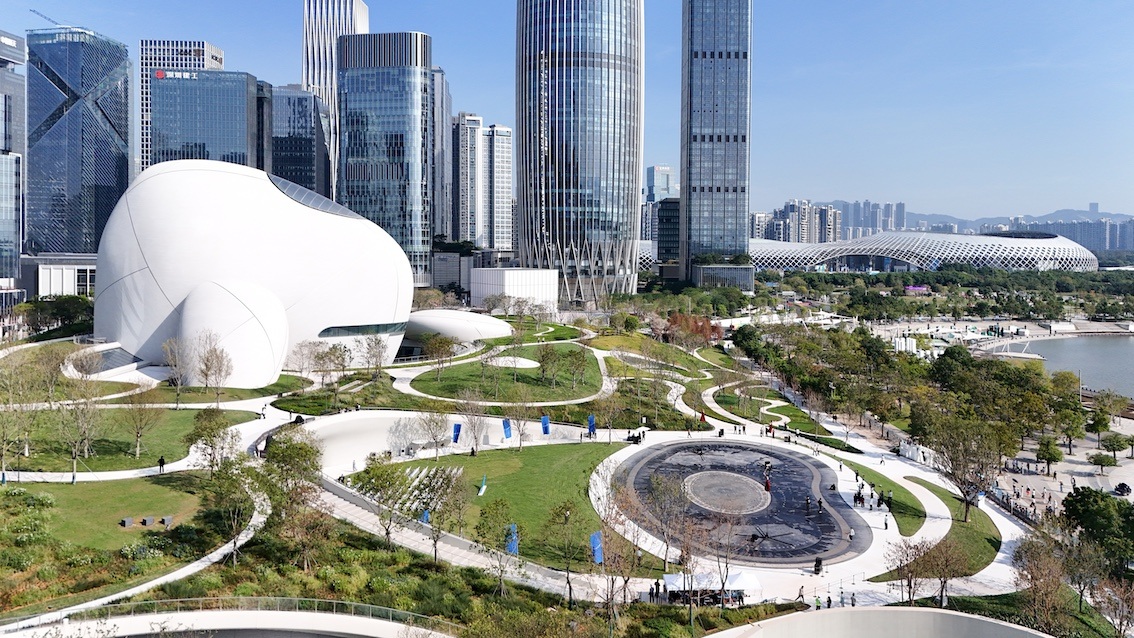
Shenzhen Bay Cultural Park in China
In an era where global architectural discourse often swings between minimal neutrality and parametric spectacle, MAD Architects stakes out a third path that aims to redefine what contemporary architecture can mean for China and the world, whether through soaring performance halls, landscapes that fold into the edges of a city, or cultural institutions that celebrate heritage and migration.
You may also like: