Written by: Prof. Dr. Mamoona Khan
Posted on: October 13, 2025 |  | 中文
| 中文

Ocean Art Gallery Lahore, has the privilege to display the Ode to Sadequian; a unique tribute dispensed by three artists/friends of Lahore, Rawalpindi and Islamabad; Lubna Jahangir, Zarrar Babary and Geytee Ara, respectively. Sadequian, one of the prolific artists of Pakistan, a self-taught, without formal art education, but creativity imbued in his spirit that led him to devise uniqueness in the creative endeavours, shaped with brush or with pen. Inspired by ingenuity of his aesthetic pursuits, the trio delved deep exploring his concealed truths with which he views modesty of his own-self. Although famed for distinct fecundity of his artworks, a few are acquainted with his Rūbāʼīyāt (poetic quatrains) that formulated framework of the three artists. Apart from paintings of Sadequain his quatrains provided auxiliary motivation, unveiling the hidden within the humble soul of the world renowned.
Rūbāʼīyāt or the sobriquets concealed within his poetry or their time-to-time usage in his audio-video recordings became inspiration of the triad. Comprehending the philosophy behind the vibrant but humble soul, divergent expressions emerged, distinct in their representations but linked with the main-string of Sadequain. Lubna illustrated the attributes of Qalandar (dervish, mystic) or Malang (sanity in his insanity). She selected the theme of irony behind apparent piety, and sanctity behind the apparent irreverence. Keeping the quatrain to interpret the truth behind outer and inner, believer and infidel, she took the symbol of swan; white and black, as a representative of human soul, placed within two bubbles. The blacker one has golden outer aura, unaware of the cobwebs and cacti growing around, celebrating his golden expression on the outer world, though his inner is black. The whiter swan, emotionally bloomed by red circle has affinity with the truth of the universe symbolises inner purity of soul, represented in the quatrain as Sadequain’s own-soul linked with the eternal truths of the upper spheres. By using elements from Sadequain’s murals Lubna commemorated both, the blatant truths of his poetic verses which are equally overt in his art.
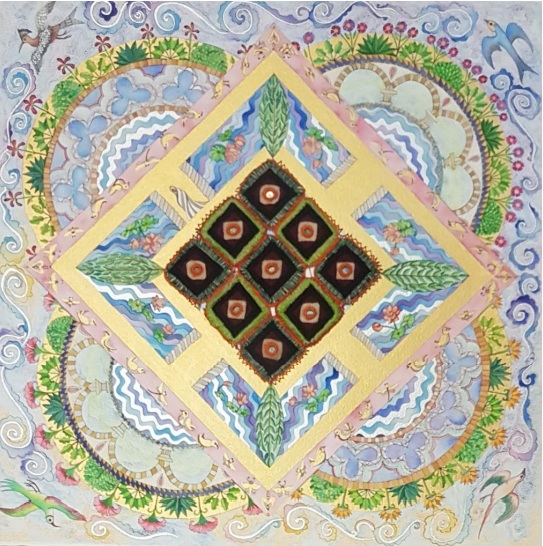
An Ode to Lahore Lubna Jehangir
Another satire on the artist community working as commercial contractors, Sadequain calls him a Qalandar. Lubna represents him as very placid, though standing bare-footed on the Cacti-Globe, surrounded by cobwebs, still holding a huge brush and a pen in his arms, along with an ink-pot with qalam in the right hand with twisted fingers forming Arabic letters of Allah. Sadequains fingers of the right hand had automatically shaped into the name of Allah. Under the sway of Sadequain’s self-portrait done in ink and pen, Lubna used the countenance of an ascetic wearing a long shirt of patches, necklace and anklet of beads, while the entire universe roams around him like the dance of a mystic and Sadequain is solitarily at pace with the dance. Encircling his stationed globe are spears, arrows, knives etc. but the ascetic is engrossed in the universal circumambulation surrounding or lying under his feet. He defines in the quatrain that among the looters he steadily stands as a fire-temple and like an ocean before a small dirty drain, but just a qalandar among the art-merchants.
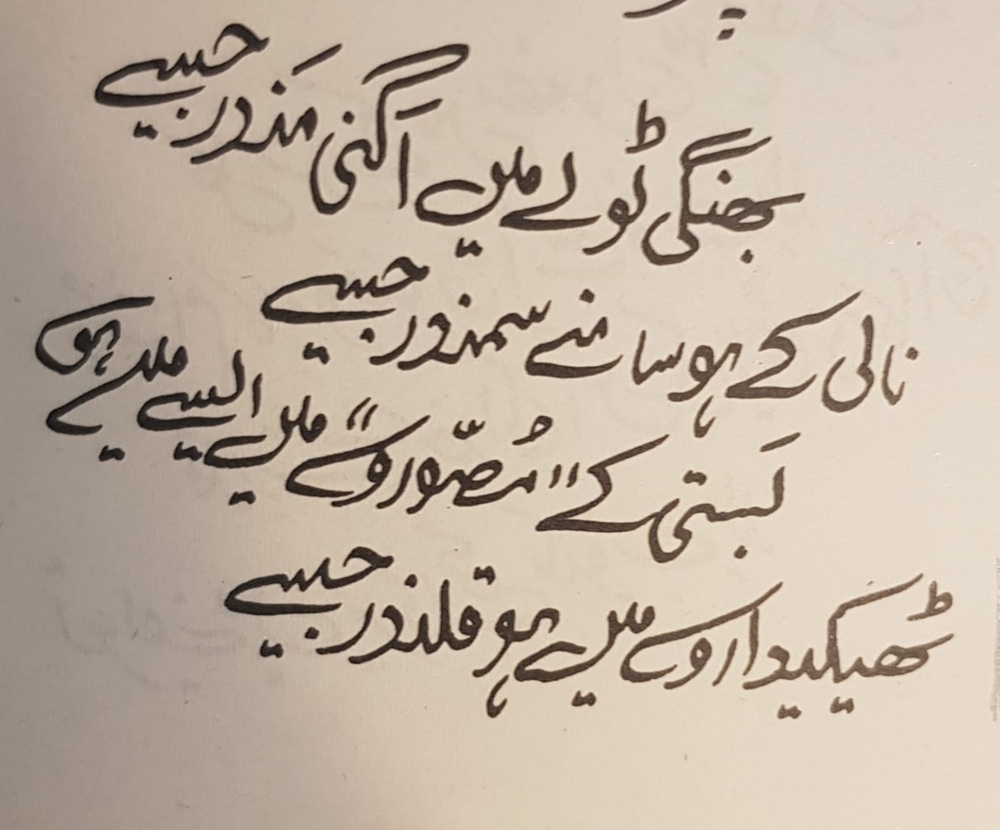
Excerpt from The Muse - 1 by Lubna Jehangir
Another unusual portrayal of Sadequian by Lubna, inspired by his quatrain is a figure of cacti, blooming with a variety of cacti-flowers, no apparent features of face but the hands of Sadequain with twisted fingers, over-lapped by Urdu alphabets: Qāf (27thlalphabet), Ṣuād (20th) and Nūn (32nd), like Harūf-i Mūqaṭṭaʽāṭ (disjointed letters at the opening of some of the chapters of the Holy Qūrʼān). In the quatrain Sadequain uses the metaphor of Qāf as common in the names of the two most famous Muslim calligraphers: Ibn Mūqalla and Yāqūṭ, who devised rules of calligraphy and invented six Khaṭ (styles), known as Khaṭ-i Sitta. Comparison of colorless flowers forming border of the panel with colorfully blooming cacti flowers, as Sadequain used to call him the painters of the desperate and detested, not a painter to be displayed in drawing rooms.

Al Majzoob by Geytee Ara
Geytee Ara, by comprehending Sadequain’s innate humbleness concealed within the sobriquets he attributed to his-self, saved as signatures on the huge canvases, conversing with those who adored him, or used in the quatrains. She took these monikers as the main subject and selected a medium closer to his modesty, that is clay, shaping pots, each personifying any attribute of Sadequain. Not only clay but shapes of the pots too are incarnations of the ascribed titles. Highly subjective in her expression Geytee probed her imaginative prowess to comprehend a sobriquet and shaped her visual image into a novel piece of art. As she says “by recontextualizing Sadequain’s work in new media, I aim to honor his poetic and artistic contributions.” It will “create a contemporary dialogue with his legacy.”

Al-Makhmoor by Geytee Ara
Like seven stages of spiritual elevation that a Ṣūfi (mystic) attains the highest rung of spiritual ladder, analogously Sadequain’s physical states are ascribed in his monikers like al Ghareeb, al-Masloob, al- Jareeh, al-Mugharam, al-Zaeef, al- Majzoob, al- Masloob, al-Mutashakil, etc., emphatically imprinted in the shapes, textures and techniques of the pots overtly associated with their connotations. For instance, Almasloob means gibbeted, is an elongated pot, entangled with rope like formation which is knotted too. Aljareeh is injured, has a stitched patch with ornamental string, while Al-Zaeef is real personification of the torn out, frail and feeble, and Al Majzoob has flakes of iron absorbed with the glazes, loosing separate identity. Al-Makhmoor, which means intoxicated, celebrates its state of insanity, rendered in an adorned bottle surrounded by twisted goblets. These shapes are candidly self-explanatory.
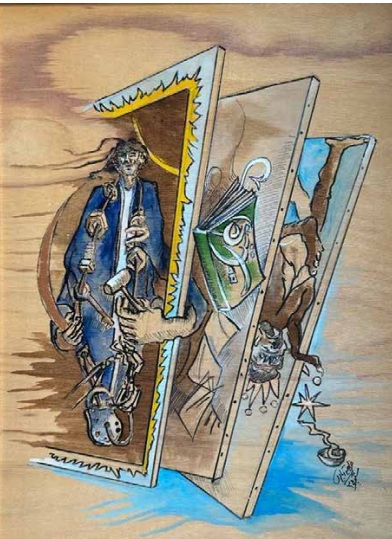
An Ode to Sadequain by Zarar Babary
Another contributor Zarrar Babary explores mystical contents of Sadequain’s Rūbāʼīyāt, leading from worldly to divine truths, concealed within the apparent. He is not after his asceticism or humble nature rather focusing intellectual aspect of the mystic, hidden in his Rūbāʼīyāt. He views physical beauty as a reminiscent of the Divine. Reproaching the deficiency of the artists’ community, restricting to the outer. Sadequain says proudly, “we are the ones comprehending the inner connotations hidden behind the physical”. Using the symbol of penetrating eye and two selves of a profile face, Babary uses the hand of Sadequain with freely flowing brush, creating firm fluent line, exploring layer after layer to reach the core of reality that ends at a Nuqṭʽa, held around the brush in the hand of Sadequain. Though the path defined is circular not straight but the brisk eye of intellect smoothly acquires the essence.
Another Rūbāʼiy focuses a mole on the face of beloved, called by Sadequain as the Nuqṭʽa of Bismillah. There is only one Nuqṭʽa in Bismillah. Zarrar illustrates the spiritual contents of the physical beauty taking the wheatish face as the universe and its mole as central to its existence. He renders resonance of creation of the cosmos, initiated from the One, the dot of Bismillah. It is like the theosophy of Ten Intelligences by Ibn Sina, each sphere of which is yearning to meet its point of creation; begins from and ends at the One that is the Creator of all creations.
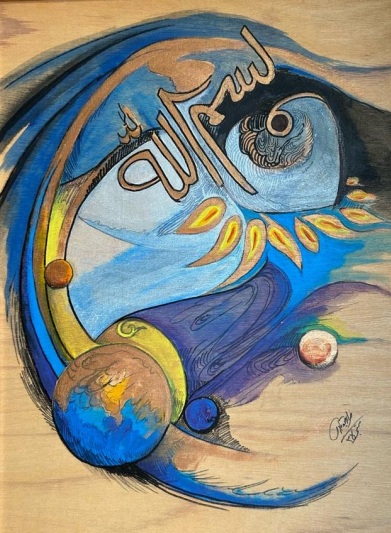
An artwork by Zarar Babary
Another painting by Babary is on a quatrain concentrating mole again, with which the beloved is deprived off. Again, stance of a mystic celebration, the depravity is placed akin to the Kalīma-yi Ṭayyaba having no dot, and also in Darūd for the Prophet (pbuh). This is how a mystic views his surrounding, where context of everything is the Supreme Lord. Keeping in view the elements of Sadequain’s imagery, he illustrates through his distinct aesthetic interpretation. Paintings of Babary are enriched with strong compositions, dominating firm-flowing line, displaying ease with which he moves his brush. In this respect, he seems a follower of Sadequain, but a clear glimpse of his style under the sway of Persian miniature painting, with dominating Lapis-blue & turquoise, calligraphic line of Ustad Muhammadi of the late Safavid Era. Mature and quick expression, his paintings bespeak his talent. It seems, he is enjoying the quatrains and equally in amusement moving his brush in a state of trans.
In the post-modern art, concept has substituted skill, but the three muses interpret significance of skill combined with the intellectual conceptualization. Best way to pay homage to the legendary Sayed Sadequain Rizvi.
You may also like: