Written by: Muhammad Suhayb
Posted on: August 04, 2025 |  | 中文
| 中文
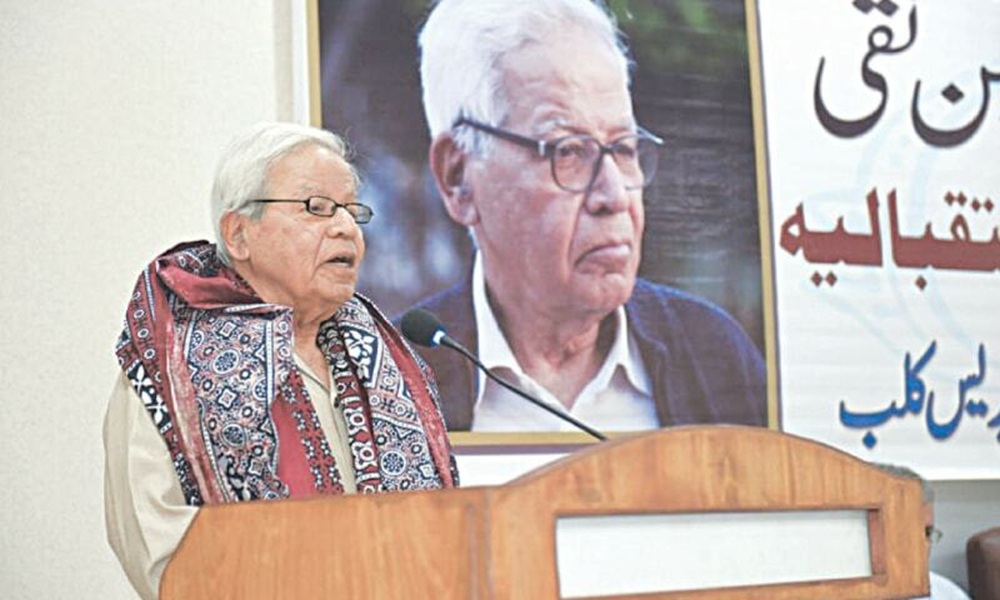
Hussain Naqi speaks at a reception at the Karachi Press Club in 2018.
Amid tightening media control, shrinking civic space, and increasing political conformity, Jurat-e-Inkaar (The Courage to Deny) emerges as a bold and timely response. This 184-page Urdu-language book is an extended interview with one of Pakistan's most fearless journalists and human rights advocates, Hussain Naqi. Compiled by noted historian and academic Dr. Syed Jaffar Ahmed, it was published in early 2025 by the Institute of Historical and Social Research in Karachi.
The book is neither a conventional biography nor a straightforward historical account, it is a compelling blend of both. It serves as a living record of over sixty years of resistance for democratic principles, press freedom, and the right to dissent.
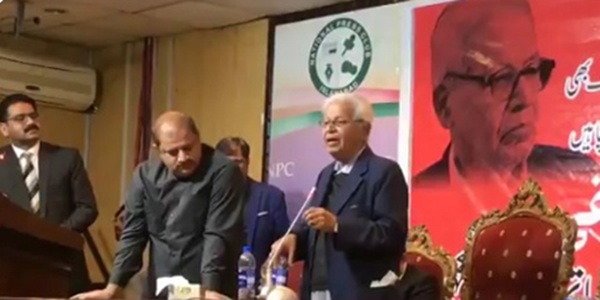
National Press Club hosts veteran journalist Hussain Naqi
As the title suggests, Jurat-e-Inkaar is about the courage to reject injustice. And who better to tell that story than veteran journalist, trade unionist, and lifelong supporter of democratic values, Mr. Hussain Naqi?
The book takes readers back to the 1940s, when Naqi was growing up in Lucknow, India. Since my parents were from the same city, many of the names were already familiar, Shia College, Taleem Gah, Aminabad, making the narrative feel like listening to a grandparent reminisce about a beloved hometown.
Naqi had been an activist since his student days in Lucknow. Two memorable anecdotes from that time, convincing the principal to apologize for mistreating a teacher and writing a ghost letter to a magazine, will resonate with anyone who ever stood up for something during their college years. Although his parents didn’t migrate, a teenage Naqi managed to cross the border into Pakistan in 1953.

Hussain Naqi in a Radio Pakistan podcast
From the mid-1950s through the politically charged 1960s, life in the newly formed Pakistan was a far cry from today. Naqi vividly recalls this formative decade, which laid the foundation for his activism. As a student at DJ Science College in Karachi, he was deeply immersed in student politics, so much so that he came close to being expelled for his outspoken views. Suspension was nothing new for him; he repeatedly put his education at risk to defend his principles.
His transition into journalism, amid the rift between APP and PPI, offers a revealing glimpse into the media landscape of that era. Known for asking difficult questions, Naqi was often transferred from one post to another, a common fate for reporters who refused to toe the official line.

Hussain Naqi in a PFUJ (Pakistan Federal Union of Journalists) meeting in 1985 with Nisar Osmani and Minhaj Barna.
Despite not being fluent in Punjabi, Naqi launched a newspaper in the language and was also the mind behind Punjab Punch, an English weekly that was shut down after just a few weeks in 1971. Later, he was associated with publications like Outlook and Viewpoint, and one is left astonished at how Viewpoint managed to get published even when the entire editorial team was thrown in jail by Zia-ul-Haq.
Although Naqi presents detailed accounts of Zia's predecessor Ayub Khan’s regime, one of the most revealing sections of the book covers the 1971 crisis—the civil-military impasse that led to the secession of East Pakistan. He also offers a behind-the-scenes view of the Bhutto–Mujibur Rahman standoff, drawn from personal interactions and firsthand reporting.

Hussain Naqi
His observation, that Bhutto hesitated to hand over power to the legitimate majority party, is a sobering reminder of how personal and institutional egos helped precipitate a national catastrophe. Naqi frames it not just as a political error but as part of a broader pattern in Pakistan’s political history—where democratic processes are routinely undermined by authoritarian impulses. His reflections on how military influence shaped national narratives, how editors capitulated under pressure, and how dissent was systematically criminalized remain profoundly relevant in today’s era of digital surveillance and state propaganda.
A pioneering figure in Pakistan’s resistance movements, Naqi was jailed numerous times but never wavered in his commitment to truth. The anecdote when he beat up a compounder but saved a life of boy is simply hilarious. He was influential in hiring and organizing Jang's English Newspaper and later joined the Human Rights Commission of Pakistan a few years after its formation. He remained a steadfast advocate for justice and accountability for many years.
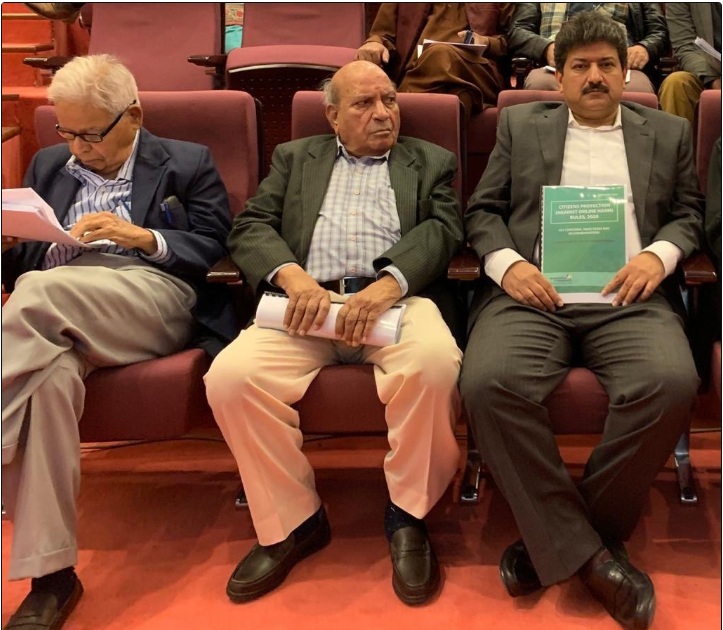
Hussain Naqi, IA Rehman and Hamid Mir
The final 40 pages of the book feature rare photographs and selections of his early columns. These writings, from a different era, remind us that the pen was once mightier than the sword, and perhaps still can be.
Jurat-e-Inkaar reveals the remarkable depth of Naqi’s political insight and lays bare the moral dilemmas faced by journalists working in a climate of fear, censorship, and manipulation. For media students and history lovers alike, this book is essential reading. It reminds us not just what journalism was, but what it still has the potential to become.
This is not merely the story of Hussain Naqi’s life. It is a call to defend democratic values, no matter how unpopular or dangerous that choice may be. It is not just a book. It is an act of resistance and a testament to the power of moral courage in practice.
You may also like:
From the Horn of Africa to Bahria Town: Habesha Café Brings Centuries of Coffee Culture to Rawalpindi
(October 15, 2026)