Written by: Nadeem Alam
Posted on: August 20, 2025 |  | 中文
| 中文
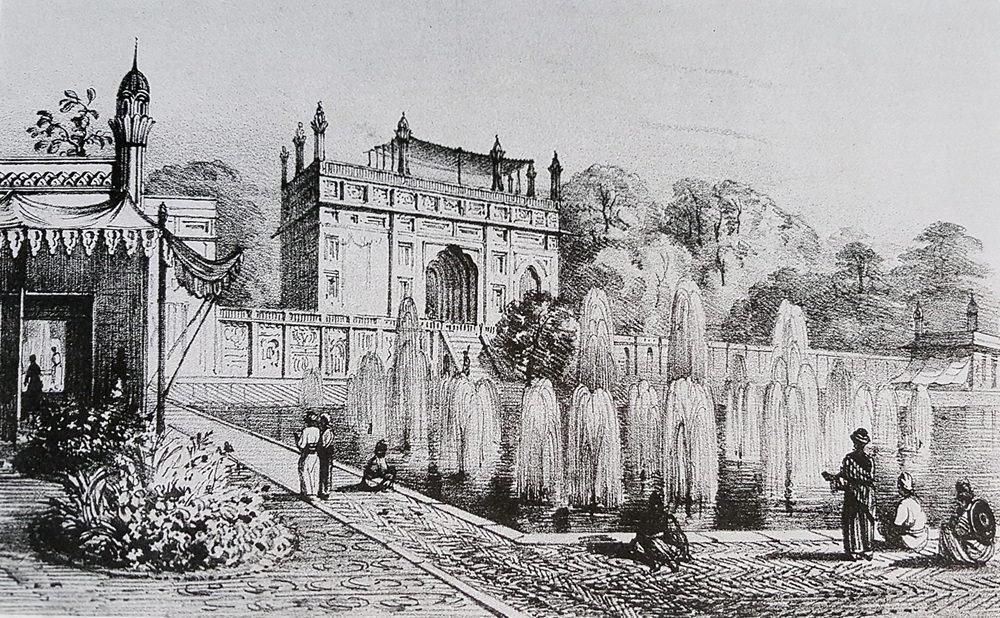
Gateway in the Shalimar Gardens (1838) by Frances Eden (Fanny Eden)
Lahore has remained a crucible of cultural diversification since its establishment as a major metropolis. It served as the capital during the regime of Akbar (1584-1598), and then under the Sikh empire (1799-1849). Eventually, the city served as a strategic stronghold after its annexation and incorporation into the British Empire in 1849. Later, this abode witnessed the struggle for freedom, culminating in the Pakistan resolution in 1940, and the Partition of 1947.
In the nineteenth-century, Lahore emerged as a beacon of the British colonial aesthetic canon, as during the Sikh era, numerous European artists were already working under the patronage of Ranjeet Singh. August Theodor Schoeff is best known for framing the court of Lahore, with his immaculately realistic and apparently European style of painting.
Alongside the male amateur and professional artists, there were many accomplished women artists, who travelled to the subcontinent in the company of their husbands, brothers or fathers; men serving the colonial administration or the British army. However, only a few are known by their name in the art history of this region.
“The largest number of illustrations of Lahore during this period [1840-1850] belongs to the delicate hand of an anonymous lady-artist, identified by her publishers only as being ‘the wife of an officer’.” (Ijazuddin 22)
The three notable and known women artists of that era are Emily Eden, Frances (Fanny) Eden, and Lady Charlotte Canning. These women added to the already existing Mughal legacy of female contribution towards art, literature and culture of this land, which has seen the lyrical allure of Gulbadan Begum, Zaib un-Nisa and Noorjehan, and the delicate brushwork of Nadira Bano and Sahifa Banu. If the former was rooted in the Persian tradition, the latter blossomed in the European legacy.
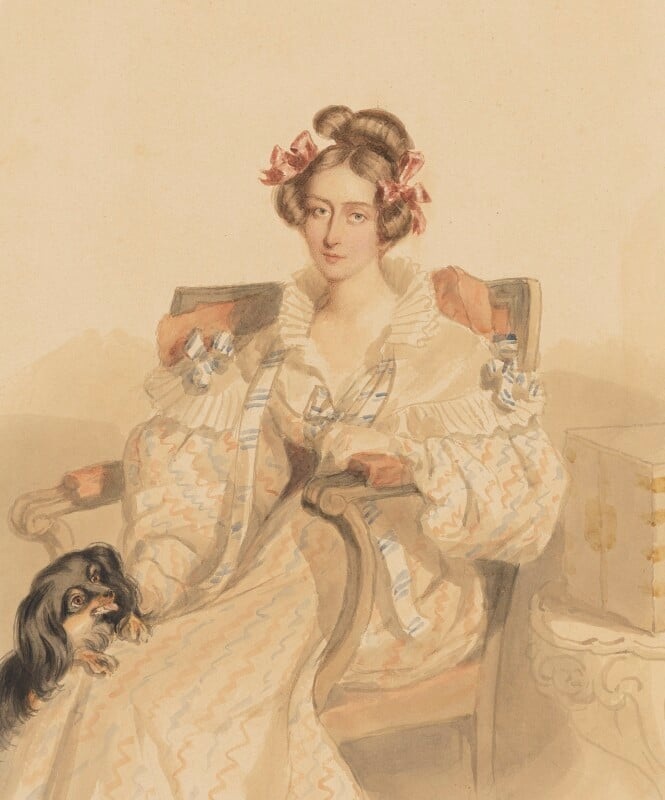
Emily Eden (1835) by Simon Jacques Rochard
Emily Eden is responsible for her ethnographic portfolio titled ‘Portraits of the princes and people of India’ published in 1844. However, her sister Frances Eden produced good quality sketches as a part-time practitioner; and most of the time she either helped Emily to compile her substantial work, or penned down the details of their visits, hunting expeditions and royal receptions. Lady Charlotte Canning, in her own right, is regarded as the most prolific and professional women artist of her time.
These three Muses visited Lahore from the 1840s to 1860s and documented the visual culture and ethnographic details of the Sikh empire and the colonial period Lahore. They focused on the visual documentation of this historic abode and narrated the pre-colonial grandeur and colonial transformation through the prism of imperial vision.
Emily Eden (1797–1869) is the well-renowned author and artist of the nineteenth-century, hailed from a distinguished aristocratic family of Auckland. Her father William Eden was the 1st Baron, whereas her brother George Eden was conferred upon the title of 1st Earl of Auckland, County Durham, England. From 1836 to 1842, George Eden served as the Governor General of India.
Emily Eden and her sister Frances Eden accompanied their brother to India and travelled through the length and breadth of imperial lands, from the vibrant shores of Calcutta to the enigmatic grandeur of Lahore. She recollected her experiences through letters, diaries, watercolours, and lithographs; where words, colours, and contours reflect her contemplation, in a tangible form.
In 1838, the Eden family travelled through northern India, and stayed in Lahore, where Maharaja Ranjeet Singh was their royal host. During her stay, Emily Eden encompassed the sites, life and people of Lahore under the Sikh rule in delicate watercolours, refined sketches and vivid portraits. Her focus was on the royal family and the courtiers; however, she also captured the portraits of common people and the working class.
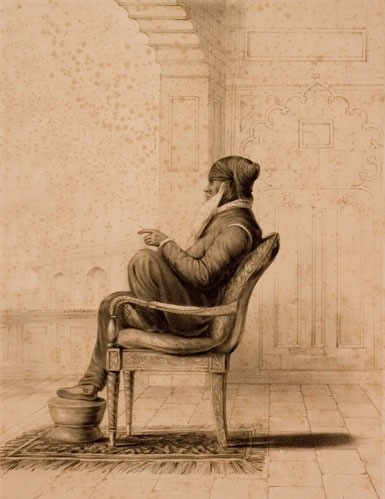
Ranjeet Singh (1844) by Emily Eden
Emily Eden’s compilation ‘Portraits of the Princes and Peoples of India (1846)’, published in England, is a valuable document to understand the royal court of Lahore. This pictorial is the most valuable visual record of the royal Sikh family of Ranjeet Singh with portraits of the young and old princes, along with the faces of viziers and notables of Lahore.
She recorded every detail of her visits and events in Lahore, whether through her crafty images, or in the descriptive letters. Reading her letters while gazing upon the visuals she produced, one is transported to the Lahore of Maharajas and princes; where royal processions enter the court and imperial receptions unfold for the regal guests. As one of her letters states:
“Yesterday evening Runjeet gave us a party in the Shalimar Gardens, which were illuminated in every direction. The party was like all the others, except that it was less crowded, and there was an introduction of Afghans.” (Eden 210)
Her access to elite social circles in both Britain and colonial India shaped what she painted and the eloquent writing style she developed.
Frances Eden (1801-1849), commonly known as Fanny Eden, is a lesser-known artist in the context of British colonial art in Lahore; specifically in comparison to her elder sister Emily Eden. Frances Eden sincerely indulged herself in support of Emily’s body of work; therefore, her own renderings and sketches were overshadowed by the prominence of the other sister.
Very little documentation is available on Frances Eden as a prolific artist; nevertheless, her sketches of few architectural patterns like that of the Shalamar Garden and Badshahi Mosque qualify her to be included in the female artists of the nineteenth-century Lahore.
Frances Eden is more known as a compiler, a diary-writer and recorder of the Indian wildlife, as well as the Eden family’s royal visits to different states and cities of the subcontinent. When she accompanied her brother George Eden, who was appointed as the Governor General of India (1836-42), she set all the adventures and experiences down in an illustrated journal; for which she rendered linear sketches.
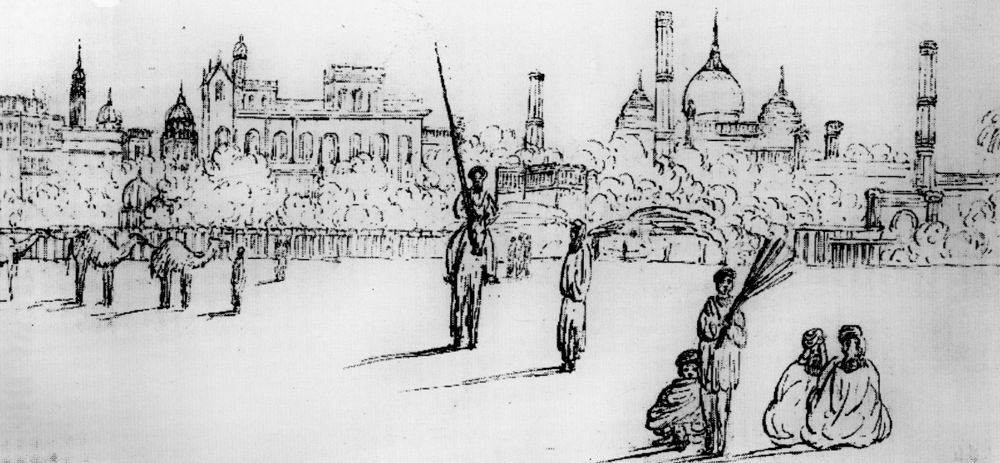
Badshahi Mosque (1838) by Frances Eden (Fanny Eden)
Their journey from Calcutta to Simla, with a state visit to Ranjeet Singh in Lahore, was meticulously documented in ‘The Illustrated journal of Frances (Fanny) Eden (1801-49)’.
“We went yesterday to Jehan Gher’s tomb – an alarming expedition as we had to cross the river on elephants, and there were quicksands to pass over…Jehan Gher’s tomb has four minarets and inside and outside is inlaid with coloured stones in small patterns. It covers an enormous space of ground, but like all fine buildings in this country is going fast to decay.” (Frances Eden 191)
Frances Eden narrated the details of her tours, receptions, and the character of the people she met and observed in such a way as if she were painting a landscape or rendering portraiture. Her letters provide pivotal information on the areas the Eden family stayed, not as a commentator, but as a promising observer, living and breathing alongside the people of that era.
“Major Wade went to see Runjeet today – he found him very low about himself as he always is when he is ill, sitting up in his little room, the faquir squatting at his feet, the Prime Minister, Dhian Singh, standing, and his son, Heera Singh, Runjeet’s favourite, seated in a chair by him. Dhian Singh is never allowed a seat. Heera Singh lives in a much more state than either of Runjeet’s sons, and has a very large military command though he is not yet twenty.” (Frances Eden 192)
Frances Eden was also engaged in the adventures of the colonial life in the subcontinent. She, alongside her nephew William Osborne, went on a tiger hunting expedition, riding on elephants through rivers, bushes and jungles. Nevertheless, she preferred sketching the landscape and people rather than shooting a tiger. She portrayed the local flora and fauna with a simplified, yet sympathetic approach, quite contrary to the expected aristocratic and colonial viewpoint.
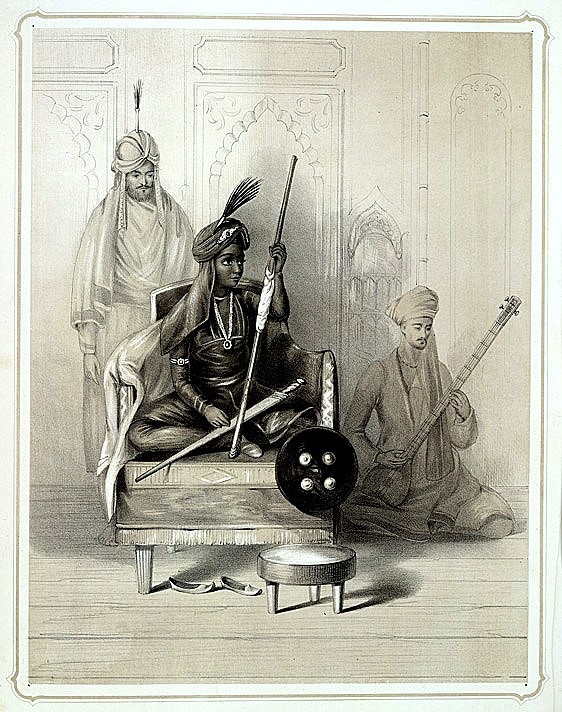
Purtaub Singh (1844) by Emily Eden
She expressed this experience as, “William handsomely went out with me this afternoon sketch-hunting instead of tiger-hunting, and you see what a treasure of a place it is and how happy he looks.” (Frances Eden 21)
Lady Charlotte Canning (1817-1861) stands alone as the most prolific and professional artist, amongst all the women practitioners of the British colonial era of the nineteenth-century. While travelling across the vast landscape and cities of the subcontinent, she masterfully framed the gardens, architecture and populace of this part of the world; mostly sitting in a small tent on the elephant back called Hawda. Albert and Victoria Museum London, shelves almost three hundred and fifty watercolours attributed to her. She was privileged to have imperial travelling facilities and artistic support, being wife of Lord Charles Canning, the first Viceroy of India (1858-62).
Her realistic approach and skillfulness in the western genre of watercolour made her prominent among all the amateur and professional artists. Furthermore, the expert guidance and support of William Simpson (1823-99), the renowned war painter of Europe, helped her select the most suitable subjects from the most accurate perspectives.
“A skilled watercolourist in her own right and one “devoted to art”, she was stimulated by the presence of the professional artist William Simpson who travelled in their entourage.” (Aijazuddin 169)
Both Simpson and Canning travelled through areas of visual interest throughout the subcontinent and painted extensively. The brief stay at Lahore made Lady Canning render a few sketches and watercolours of unmatched class; the Shalamar Garden is one such unique frame.
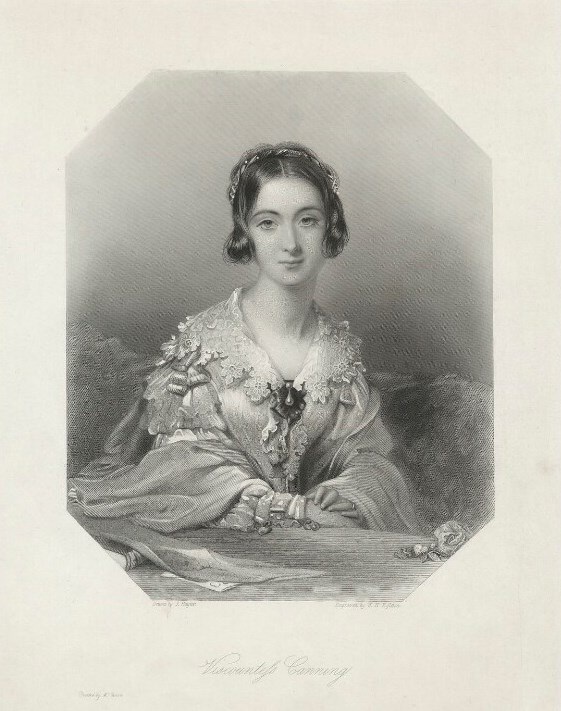
Charlotte Canning (1839) by William Henry Egleton
Her natural inclination towards garden spaces, flora and fauna, made her an artist of a delicate palette and refined renderings. Her paintings, illustrating atmospheric details and indigenous botanic patterns, contributed a distinctive visual language to the challenging medium of watercolour.
However, Charlotte Canning’s approach differed from that of Emily and Fanny Eden, who incorporated their subjects with objectivity, while infusing their artistic ventures with a sympathetic spirit. Whereas Lady Canning adopted a distinctly colonial and aristocratic attitude suitable for the imperial perspective, serving the Queen Victoria as a reporter with her sketches and writings, especially in times of unrest and revolt.
“She became the queen’s eyes and ears on India around the time of the rebellion, sending commentary on the unfolding revolt. Then in 1858 she joined her husband, now a viceroy, on his journeys around the country, painting, sketching and photographing as she went, and sharing some of her works with the queen.” (Taylor xxiii)
Apart from her artwork, Charlotte Canning is also known for her deep indulgence in charity, social diplomacy and services to identify and document the culture of the subcontinent.
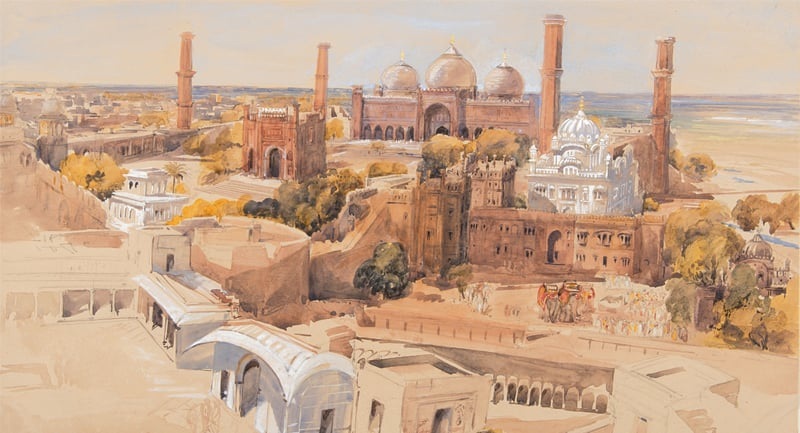
The View of Badshahi Mosque from Lahore Fort (1850s) by Charlotte Canning
All these female artists painted or wrote about their experiences; the exuberance of visiting a new place stirred their western sensibilities, and their work became submersed with a romanticised and so-called Oriental taste. Later, these creations proved to be an asset for historical insight and anthropological reference.
References:
• Aijazuddin, F. S. Lahore Recollected: An Album. Lahore: Sang-e-Meel Publishers, 2003.
• Eden, Emily. Up the Country: Letters Written to Her Sister from the Upper Provinces of India. London: Richard Bentley, 1866.
• Eden, Fanny. Tigers, Durbars and Kings: Fanny Eden’s Indian Journals, 1837–1838. Edited by Janet Dunbar, London: John Murray Publishers, 1988.
• Taylor, Miles. Empress: Queen Victoria and India. London: Yale University Press, 2018
(The writer teaches Art History and Criticism at the University of the Punjab, Lahore)
You may also like:
From the Horn of Africa to Bahria Town: Habesha Café Brings Centuries of Coffee Culture to Rawalpindi
(October 15, 2026)