Written by: Muhammad Asif Nawaz
Posted on: July 14, 2025 |  | 中文
| 中文

Takht-i-Bahi Monastery, Mardan
Tracing the footsteps of Buddha and his legacy, our voyage continues into the province of Khyber Pakhtunkhwa from the plains and plateaus of Punjab. The Buddhist legacy in this province shines through every stone, and is reflected at every nook of the region. From monastic retreats and dimly remembered stupas to fortified towns, Khyber Pakhtunkhwa can serve, stand alone, as a memento of the prime of the Gandhara civilization. Paralleling the supremacy of Taxila, in fact belonging to the same empire, the cities and places of the contemporary province of Khyber Pakhtunkhwa left a lasting impression on the Mahayana Buddhism and the culmination of the Gandhara art.

Sahr-i-Bahlol excavations
Arguably no other place in the province presents the finesse and detail of Buddhist history as the wonderful monument of Takht-i-Bahi does. Often claimed to be the jewel of Gandhara Buddhism, the site is perched majestically atop a solitary hill, easily accessible from both Islamabad and Peshawar. The elevation of site is pronounced in its name as well, with takht meaning throne and bahi for spring, roughly translated to spring from the top. Takht i Bahi has been on the UNESCO World Heritage Site list since 1980, and rightly so. As an avid traveler, I have to admit that visits to most heritage sites in this country are an exercise in disappointment - Takht i Bahi remains a welcome exception to that routine. It is exceptionally well-preserved, duly imposing, and a resource for learning; not to mention the famous chapli kababs offered right at the base of the site are quite the delicacy.

Rock edicts at Shahbaz Garhi
In the Takht i Bahi complex, with its impressive architectural lay-out, there are four main areas, each serving a specific purpose within the monastic community. These include the Stupa Court, the monastic chambers, the temple complex and the tantric monastic complex. The Stupa Court, the heart of the complex, features a grand central stupa surrounded by smaller votive stupas. The monastic chambers provided the living chambers for the monks, all arranged around a central courtyard. The temple complex is comparable to the Stupa complex, with a difference in timeline. The Tantric Monastic Complex comprises small, dark cells, with low openings, specifically designed for intense meditation practices. All the buildings are constructed in local stone and mortared with lime and mud, and the timeline of the complex is generally divided into four eras, thereby rendering different age to the different constructions. However, what is common to all the structures in Takht i Bahi is the security provided by its strategic location, safeguarding the complex against the swarms of invading armies through the times. The relics found in Takht i Bahi, emblems of the peculiar Greco-Buddhist art style, are now housed in museums elsewhere. Well worth a visit, Takht i Bahi is a sight to behold. So enchanting is the sight that it etches in one’s memory - or camera. A picture of Takht i Bahi that I took from the adjacent hill now hangs in the permanent Gandhara gallery in the Humboldt Museum, Berlin.

An aerial view of Takht-i-Bahi monastery
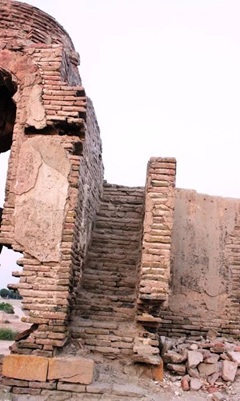
Besides Takht i Bahi that is frequented by historians, archaeologists and pilgrims alike, the nearby remains of Sahr i Bahol in the Mardan district are another way to remember Buddha by in present-day Pakistan. Included in the UNESCO World Heritage Site list, the place unfortunately doesn’t have much to offer to visitors today, but it is its history working in its favor. It was a small, fortified town built during the Kushan period, existing in contemporaneity with Takht i Bahi and serving as a supportive urban center for its monastic community, but can be rarely appreciated now owing to encroachments and neglect. The excavations haven’t been exhaustive in this site which is believed to be a treasure trove of Gandhara antiques including statues, coins and jewelry. Over the years, much of this has been looted owing to illegal digging.

Sahr-i-Bahlol in the center of Gandhara area
In the same district, a little far off, and meekly mirroring the splendor of Takht i Bahi, are the remains of Jamal Garhi. Serving as a Buddhist monastery from the first to the fifth centuries AD, the main stupa here is surrounded by chapels closely placed together. A number of Buddhist sculptures were excavated at the site in 1871, which are now housed in the Calcutta and British Museums. In addition, a Kharoshti inscription was also discovered here, now preserved in the Peshawar Museum.

Jamal Garhi
While echoes of Buddhism reverberate throughout Mardan and Khyber Pakhtunkhwa, some other places in the region also deserve a mention here. One of these is Shahbaz Garhi, which is of utmost importance due to its Ashokan Rock Edicts. The inscriptions, in the ancient Kharoshti script, are carved into two huge boulders, and are among the earliest evidence of writing in South Asia. The edicts outline moral principles and religious tolerance: a testament to Emperor Ashoka’s effort to spread dharma. Lastly, series of natural limestone caves known as Kashmir Smast also bear traces to a rich Buddhist past in the region. While the caves were later associated with Hinduism, they were used as Buddhist monastic retreats in the Kushan period. It is also hypothesized that these caves, along with the adjacent valley, comprised a sovereign kingdom within Gandhara that maintained its semi-independence, adding to the rich and complex tapestry of Gandhara history.

Shahbaz Garhi
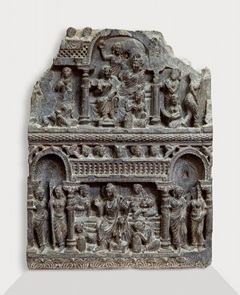
To top off the experience of Buddhish heritage in the said region, a visit to the Mardan Museum seals the deal. With its total collection of 413 artifacts, 258 are Gandharan sculptures. Of the various scenes related to the Buddha depicted in the Museum, some include the birth of Siddhartha, bathing scene, the great departure, the first sermon at Sarnath, Buddha with worshippers and monks and the wheel of law pose (Dharma charka mudra).
You may also like: