Written by: Amna and Yaver - Posted on: June 20, 2013 |  Comments
Google Translation: اُردو | 中文
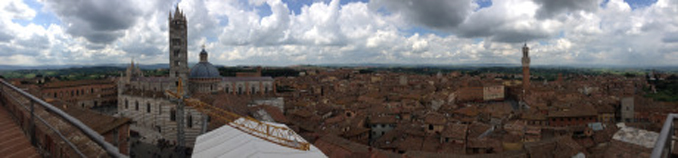
What a city! Best enjoyed by means of a leisurely stroll. The three ridges that form the city define its thirds or Terzi and give it a distinctive Y shape centred on the Campo. The streets are marked by lamp mountings decorated with the colours and symbols of the contradas, fiercely supported neighbourhood teams that feature in the Palio in July and August.
The preservation of Siena as a medieval town is attributed to its loss of stature and occupation by the Florentines in the 16th century and the fact that it escaped damage during the Second World War. Walking the streets is definitely a walk through history. Although tourists abound near the Campo and the Duomo, nearer the walls of the city, they are quiet, narrow and traffic free on the whole.
 |
We spent a whole day here, in addition to the sheer pleasure of walking through the streets, the highlights were the Archivo di Stato and the baptistery. We went to other attractions such as the Museo dell Opera and Santa Maria de Servi.
But the highlight was the Archivo di Stato. It is an archive of the city’s accounts and records from the 13th century to the 18th. Folders and bundles of records on vellum and paper are carefully stored in floor to ceiling shelves, each carefully labelled. You really get a sense of recorded history. But the fascination is really enhanced by the Tavollette di Biccherna. Wooden painted covers for the record books that show the changing shape of life in Siena over 600 years, forming a record of the world of the Sienese. The fascination starts with the name Biccherna – named after the Blacherne Palace in Constantinople, which was the Byzantine empire’s public records office. This provided the inspiration for the Sienese to start maintaining public financial records in the 13th century. By the 13th century the Byzantine empire was in its last throes, threatened by hostile Turks to the east, its trade controlled by the Venetian merchants who had wangled exclusive rights in return for financing its defence and pillaged by crusaders who decided in 1204 to take a detour and despoil the ancient seat of Christianity. The Sienese who went to Constantinople would probably have seen it, and Orthodox Christianity, as decadent, oriental and alien. But the practical lessons of the Byzantines were still carried back home.
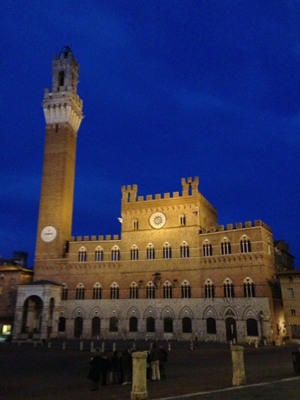
The Biccherne were fascinating, slowly transmuting over the years from book covers to wall paintings and from holy to secular subjects. Painted by leading artists of the day, they are snapshots of the times, showing trade, public events and later on, world events such as the Battle of Lepanto in 1571 against the Ottomans. Painted annually, but with gaps in the collection, we saw a dramatic shift from medieval styles to early renaissance use of perspective and humanist images in the late 14th century. We also saw two representations of the Campo from the 14th century, one showing a joust and the other the return of a victorious army. With the exception to two newer buildings, the square looks exactly the same today as 600 years ago.
Almost no one goes to the Archivo, the register showed an average of two visitors a day. One of its highlights is a balcony overlooking the Campo, which gives a unique perspective, see below.
The baptistery of St John is like an undercroft for the Duomo. It is richly decorated by Vechiette and his pupil Benvenuto di Giovanni. But it’s highlight is the font, decorated by Donatello, Ghiberti and Jacopo dell Quercia.
The Rough Guide says ‘Siena used to have a poor reputation for restaurants but over the last few years things have improved’ we agree with the first half of the sentence, the food in Siena was undistinguished compared to some of the excellent meals we had elsewhere.
Link to Amina's blog: http://amnaabidi.wordpress.com/2013/05/11/oh-siena/