Written by: Amna and Yaver - Posted on: June 06, 2013 |  Comments
Google Translation: اُردو | 中文
Day One
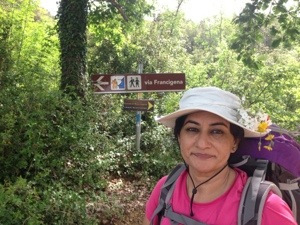
We met our first pilgrim in San Gimignano as we set out in the morning. We’d seen her on the bus the day before, a middle aged woman who spoke only Italian. She was headed to Monteriggioni, 29 km away. When we commented on this, she shrugged her shoulders and said she’d stop wherever she needed to. She wished us ‘Buon Camino’. So far she is the only pilgrim we’ve seen. I looked for her tracks in the wet paths we followed but I have a feeling she took shelter rather than brave the rain
 |
When we left after breakfast the waiter looked up at the sky and said it wasn’t a good idea setting out today; heavily overcast with a fair bit of thunder. It started to rain right away and rained through to the afternoon. The countryside was beautiful, much greener than I had thought, having visited in the past in the late summer. Looking back at San Gimignano through the mist, it still presented a spectacular sight.
We had to ford three streams and go over three ridges, mostly on farm tracks and field edges. Many of which had been helpfully ploughed up by tractors creating a sticky ochre mud which clung to our boots, made walking perilously slippery and slowing us down to a crawl. The rain was constant but our gear kept us dry. Boots filled with water, but woolen socks kept our feet comfortable even after a whole day. Our guide describes this as one of the most beautiful stretches of the VF and rightly so, the rolling countryside gave spectacular views in all directions. Later in the day I was in too much pain to really appreciate any of this beautiful countryside!
We saw two elaborate underground brick arched chambers with no purpose that we could divine and a road side mausoleum designed as a water feature, all were completely isolated from any habitation.
By the time we got to Strove, 24km away, the sun had come out,but we were exhausted, stiff and in pain. Amna had started saying after all it is a holiday and we should be enjoying ourselves.Our bed and breakfast was beautiful, set atop a small hill with a lovely view – of course the climb up and down was a challenge. Strove was a little gem, a tiny square with houses set very close to each other, full of neighbours meeting and talking. In the late afternoon when we arrived, it was mainly women, but later on, it was mainly men sitting and standing and talking as if it was an extensions their living room.
We had a wonderful dinner in the only restaurant in the village, a real foodie restaurant with a very innovative menu. Having decided to try wine while in Chianti, I must say I was not impressed, heavy, resinous and strong, chianti is for the experienced wine drinker. For anyone that wants to base themselves centrally to Siena, San Gimignano and Florence, this is a great stopping place.
Day Two
After yesterday’s tribulations, we woke amazingly refreshed and invigorated. But we had decided to limit our walk to 8 km today and take the train the rest of the way to Siena.
 |
A sunny day, perfect for walking, it seemed almost a pity that we had changed our plan. The route was mostly dry, some parts in forest and the rest through the fields. We were walking to the hilltop fortified town of Monteriggioni. It’s tiny, but nearly everyone we’ve spoken to has been there because it is so scenic and so close to the main highway.
The scenery along the way was beautiful again and the sun gave it that picture perfect quality of a Tuscan landscape. There were more vineyards and olive groves; it seems that olives are always grown in proximity to vines, perhaps on the drier or more well drained sections.
We encountered the little oratory of the Madonna de Nevi when we came out of the forest section. Now de-consecrated, it is in memory of a day in the fourth century when the snow fell in Rome in August, it outlined the foundations of a church that Pope Liborius was going to build.
Our next stop was at the Abbadia d'Isola, the abbey of the island, so called because it was probably surrounded by water or bog. We entered the beautiful Romanesque church, which Sigeric would have seen either newly built or under construction. Next to it was the abbey cloister, now a municipal office. We met an Italian speaking Nigerian man, married to an Italian, he's lived here for 20 years. He volunteers in the church to guide English speaking visitors. He said there were many visitors from over the world, but few pilgrims on foot. He spoke sadly about his homeland, where Muslim extremists are perpetrating violence against Christians. We spoke to him about religious violence over the course of history, the German invasion of this very area in Sigeric's time at the behest of the Holy Roman Emperor. On parting we pointed out the irony of Muslim pilgrims on the VF.
The fields around the abbey had a rich dark soil and we noticed deep drainage ditches, confirming the presence of poorly drained land around the abbey. Looking back, the abbey retains its medieval outline and beauty. Walking through the fields on a farm tack, there were wild flowers everywhere. A farmer stopped off at a couple of points along our way to speak to his prize pigs, rather like the Earl of Emsworth with the Empress of Blandings.
 |
Monteriggioni is a very cleverly located fort in a dominant location overlooking the narrowest point in the val d'Elsa. It has a foreboding look from outside and was designed to intercept Florentine armies attacking Siena. Internally, it is charming with a little square, a small church and houses with little gardens. We spent some time in the square watching people and then walked to castellini in chianti to take the train to Siena, a mere 14 minutes for distance that would have taken us 5 hours to walk.
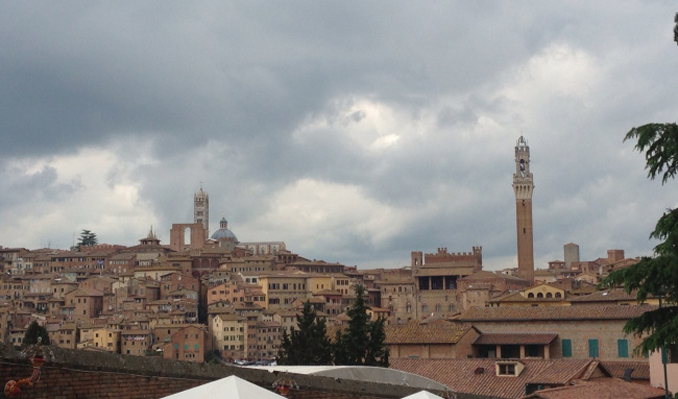
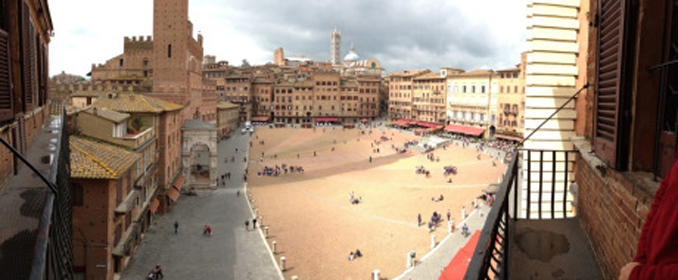
Siena is my favourite city in Italy. A marvel of how Italian design sense has given a pleasing warmth to gothic architecture. We walked through the Camollia gate towards the Campo, passing the famous banks of Siena including, the recently scandal-wracked Monte di Paschi, an ancient institution founded in the fifteenth century. Outside the bank is a pillar with a wolf suckling Romulus and Remus. Siena is believed to have been founded by a son of Remus and therefore shares this symbol with Rome. At the end of the via Camollia we descended by a flight of steps into the Campo – surely one of the most beautiful squares in the world. The beautiful scallop wheel shape and the arrangement of Sienese gothic buildings is perfect. Montaigne described it as the most beautiful square in the world. We arrived in the rain so it was even more beautiful without the crowds.
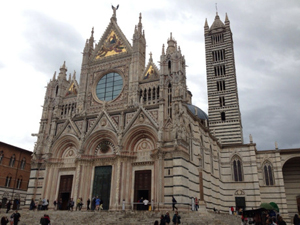
We visited the Duomo that evening, but only had 45 minutes before closing. It is much more beautiful from outside than inside. The exterior is a playful layer cake imposed on a gothic form. The austerity of the gothic design is made much less serious by the horizontal black and white lines ruining around the church. Inside, the art works are less than spectacular, Sienese art peaked in the 14th century before the Renaissance could have much of an impact. In 1348 the population fell from 100,000 to 30,000 due to the Black Death cutting short Siena's position as one of the leading cities of Europe and an economic powerhouse. The pavement of the church has some very interesting figurative panels and the Libreria Piccolomini is spectacular in colouring and detail. Named after a leading Sienese family which gave rise to several popes and built in memory of Pope Pius II the walls are decorated with 12 scenes by Pinturrichio.
Link to Amina's blog: http://amnaabidi.wordpress.com/2013/05/10/days-one-and-two/