Written by: Sadeem Shaikh - Posted on: November 27, 2014 |  Comments | 中国 (Chinese)
Google Translation: اُردو | 中文
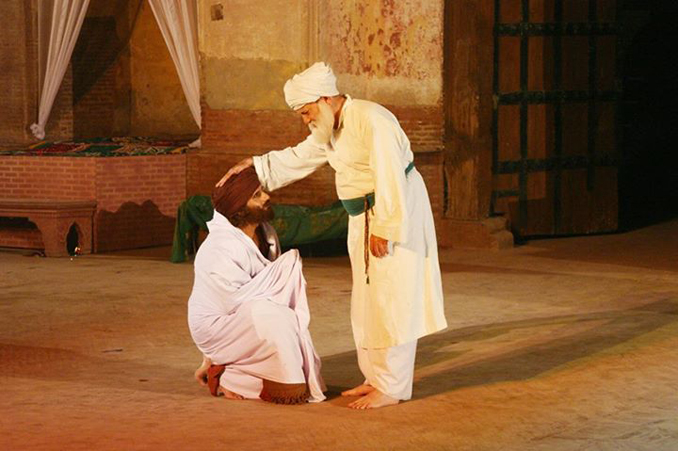
On 21st November, 2014, a jam-packed Alhamra was host to yet another splendid performance of Bulha, a theatrical play based on the life of the respected Sufi saint, Bulleh Shah. Written by the celebrated Shahid Nadeem and performed under the watchful direction of Madeeha Gauhar, Bulha perfectly marked the 30th Anniversary milestone of Ajoka Theatre, which has assiduously promoted high quality theatre since 1984, not only in Pakistan, but all over the world, including the next-door neighbor, India. The present-day situation of Pakistani society can be described as leaning towards extremist ideologies, rampant violence and intolerant modes of communal religious existence. The message of Islam has been twisted and turned inside out to fulfill subjective descriptions and understandings by hardcore extremists, simultaneously discriminating against minorities on all fronts of society. The overarching message of Bulha is to promote and instill tolerant channels of thinking and a passion for change amongst the youth of the country.
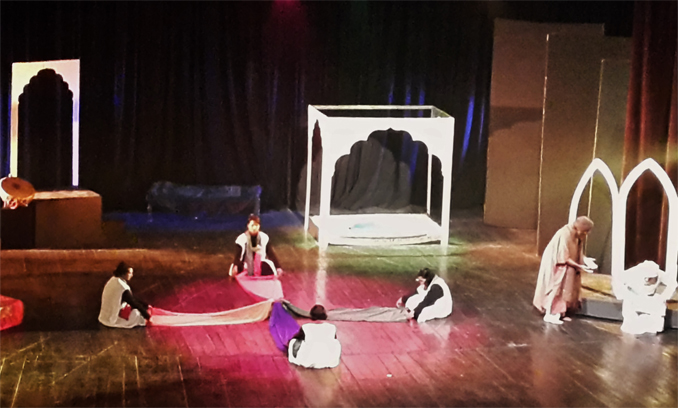 |
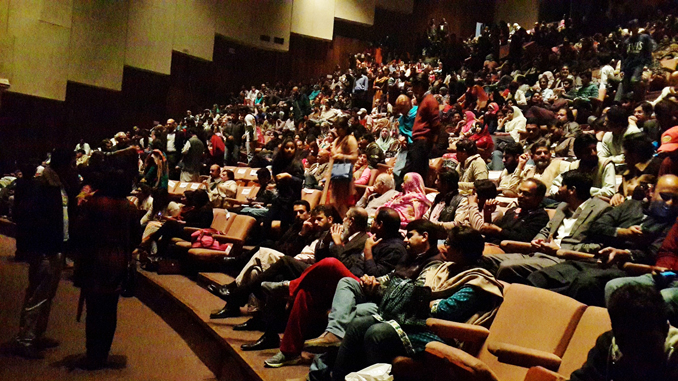
Due to the overwhelming turnout, many people proceeded to sit on the aisle steps. In the moments building up to the show, one could easily recognize a general feeling of excitement sifting through the Alhamra air. The message of the glorified saint was about to be conveyed in a determined and energetic theatrical performance. Only the welcome address by Madeeha Gauhar stood between an eager Punjabi audience and what they had rushed to the Mall Road for: learning about the life and times of the legendary Bulleh Shah. The revered Sufi lived in some of the most tumultuous times in South Asia, where the Mughal Empire had abandoned all previous concerns for togetherness, communal solidarity and religious freedom, substituting these for extremist understandings of Islam through violence and intolerance. It was during this period that Bulleh Shah began his spiritual journey to understand himself and the various sociological problems existing around him. Serving as what many historians describe to be a beacon of hope for the people of Punjab, the Sufi saint was known to eschew the practice of violence, intolerance and dishonesty, bringing in ideas of love, togetherness and community.
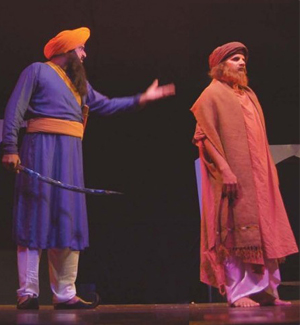 |
The message of Bulleh Shah was demonstrated in the truest form on stage, which left a resounding effect on the enthralled Punjabi audience. The transitions between scenes were marked by incredible smoothness and flow, providing a picture-perfect depiction of the life of Bulleh Shah. The characters present in the play included Bulleh Shah himself, his spiritual teacher, Shah Inayat Qadri, the repressive mullahs and muftis of Qasur and the Sikh warrior, Banda Singh Bahadur. The story was set against the backdrop of Aurangzeb’s rule of the Mughal Empire and the consequent death of Bulleh Shah, who was refused a proper funeral and burial in the graveyard of Qasur by the intolerant religious class, for espousing “non-Islamic” practices and methods of proclaiming God. The play took on a circular progression of scenes, beginning, as well as ending, with the death of Bulleh Shah. The major chunk of the 2 hour-long performance consisted primarily of his various experiences in life, his confrontations with Shah Inayat, his prolonged quest to find himself and other scenes leading up to his death.
To provide an ambient sense of progression to the story, most scenes were supplemented well with musically synchronized excerpts of Bulleh Shah’s poetry and songs, mostly sung by the performing cast, as well as a Qawwali group. Some of the most exemplary renditions of Bulleh Shah’s songs were heard by an ecstatic Punjabi audience, who were carefully listening, understanding, and nodding their heads to every single piece of poetry.
One of the most important reasons for including music in the play was to engage the audience, and thereby depict a wholesome picture of how music and poetry served as comforting tools, employed by Bulleh Shah at a time of political and societal turmoil. While the music and dance had several other connotations, it also established a strong symbolic passion between the murshid (teacher) and student. Quite often, local police and extremist mullahs would barge in on Bulleh Shah singing and dancing, simply providing a glimpse of the sort of opposition he faced along the way. To simplify the timeline of events as portrayed in the play, a pair of actors took on the additional role of narrators, presenting historical facts and setting the stage for the multitude of scenes to come.
In reality, although Banda Singh Bahadur and Bulleh Shah never met in person, the play altered this fact and had scenes where they have several confrontations. This was mainly done to show how opposed their views were about the prevalent injustice in society, where Banda Singh resorted to answer violence with violence, while Bulleh Shah favored non-violence and tolerance as ideal responses.
 |
The 13th performance of Bulha culminated with the keynote address by Shahid Nadeem, who paid tribute to the actors as, the “longstanding adherents of the Bulleh Shah message”. Kamran Lashari, a prominent businessman and politician in Pakistan, was also called on stage and expressed appreciation of this powerful play, individually congratulating the director, writer and acting crew for their brilliant performance.