Written by: Zulfiqar Ali Kalhoro
Posted on: May 04, 2026 |  | 中文
| 中文
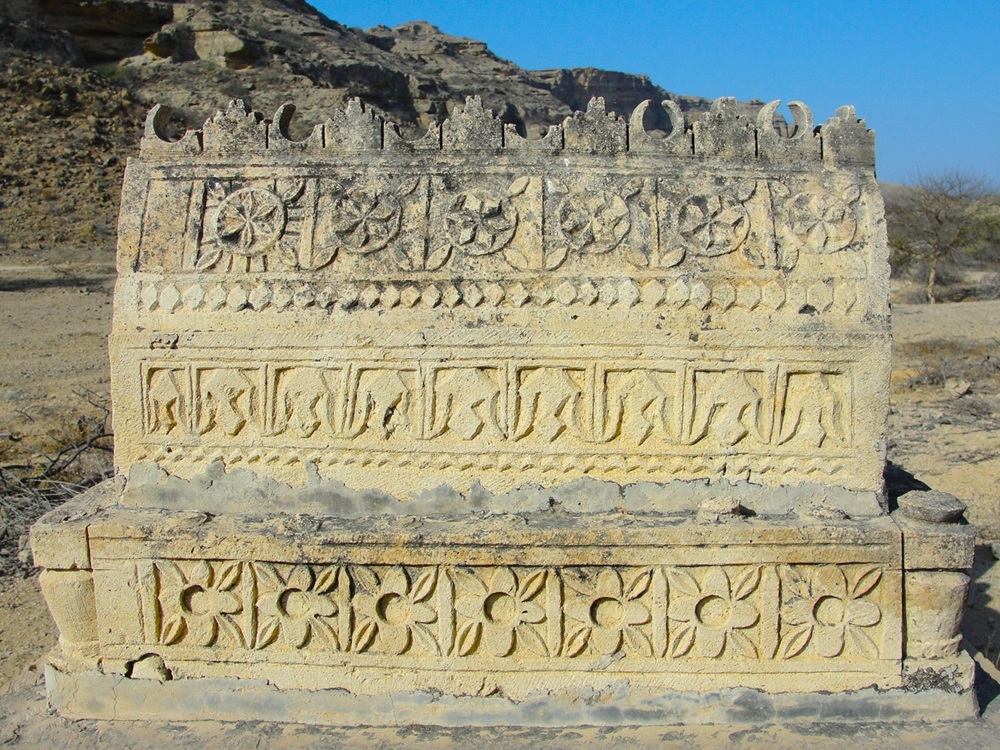
An intricately carved headstone of a stone grave (Picture credits to Zulfiqar Ali Kalhoro).
Gadap is home to several historical necropolises in Karachi’s Malir district, and I have been visiting these ancient cemeteries since 1998. One notable graveyard, located about 25 km north of Gadap town, is locally known as the Wagucha graveyard. It is surrounded by hills and belongs to the Waguja lineage of the Bura community, named after Wagu Buro. This graveyard is situated on the right bank of the Khar Nadi. It remains uncertain whether Wagu Buro is buried in this graveyard or elsewhere, though it is more likely that he is interred here.
To the north of the graveyard, there is a hill associated with the romantic tale of Marri and Mangthar, which I will discuss in another article. To the west of the graveyard lies Imam Bakhsh village, formerly known as Laskari village, the main village of the Bura community.
There are several simple, stone-carved graves in this cemetery. I first visited this graveyard in 2010 with my friends Amiruddin Jokhio of Konkar village and Master Yaqub Kanro of Maher valley. I revisited this graveyard in 2015. There are two whitewashed cement graves, each marked with an inscribed marble slab. The grave on the right belongs to Laskari, the namesake of the village, now known as Imam Bakhsh, while the one on the left belongs to Lakho Khan. In front of these lie two additional graves, each bearing the name of the deceased. According to Nawaz Ali Khaskheli from Bachal Khaskheli village, whom I interviewed, Laskari Buro had four sons: Muhammad Hasan, Muhammad Ibrahim, Haji Fazil, and Molvi Muhammad Ali. Among them, Muhammad Ibrahim is still alive, while the other three have passed away. Moreover, Lakho Buro had two sons: Molvi Abdul Sattar and Nabi Bakhsh.
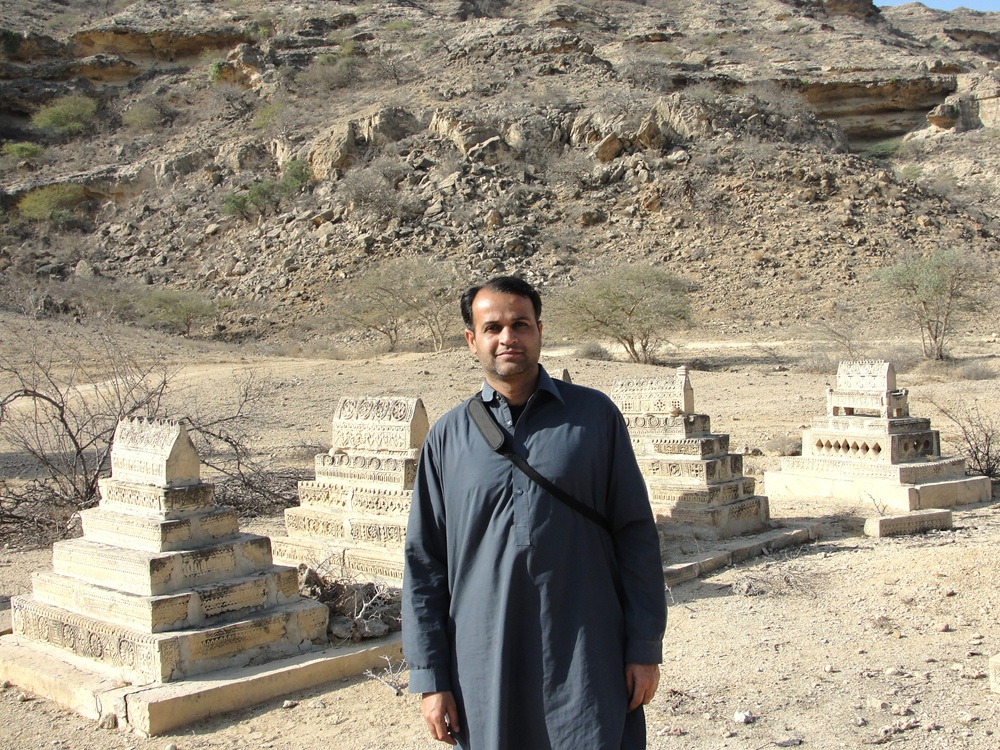
The author at the Wagucha graveyard in 2010.(Picture credits to Zulfiqar Ali Kalhoro).
There are about 20 stone-carved graves with decorative headstones. They are constructed of multiple horizontal tiers of finely dressed sandstone blocks. Most of the graves are two- to five-tiered, with each tier slightly receding upward, creating a stepped pyramidal form. The surfaces of these tiers are richly ornamented with geometric patterns, rosettes, and linear bands. The headstones of these graves are also noted for various floral and geometric designs. These graves date from different periods, the earliest being from the seventeenth century. One of the graves, a four-tiered one, is marked by a badly weathered, windswept headstone. It shows signs of erosion, reflecting that this is perhaps the oldest grave in the cemetery. A windswept headstone is placed on the fourth tier, shaped like a Khat (cot) style, with a bedstead at every corner of the grave. Local artisans most commonly used this khat or charpoy style in various graveyards in Karachi division, including Malir district. The base slabs of this grave are undecorated, while the slabs placed on top are adorned with geometric and floral patterns. To the west of this windswept grave, there is a row of four stone-carved graves at the foothill.
All of them are built on a common platform, and each features five tiers with headstones. The first grave on the left stands out for its distinctive headstone decoration. The headstone is divided into two sections: the lower part is adorned with geometric motifs, while the upper section features finely carved floral patterns. Crowning the composition is a decorative crest of crescent motifs and crenellated forms—a style widely seen on stone-carved graves in the Gadap and Thano Bula Khan talukas. The crescents may symbolise faith, the passage of time, or a link to the celestial order. At the same time, the battlement-like crest evokes ideas of protection, status, and architectural symbolism, lending the headstone both a sacred and monumental presence. Collectively, these elements highlight the remarkable skill of local artisans, who not only drew upon a rich regional repertoire of designs but also introduced their own creative innovations, carefully etched into the stone.
To the east and northeast of this row are four additional graves. Their notably smaller size suggests that they belong to children. The eastern two graves are two-tiered with headstones. Both are decorated with geometric and floral motifs. The northeastern graves are also noted for geometric and floral patterns. One of these is three-tiered with a headstone representing a series of diamond-shaped designs.
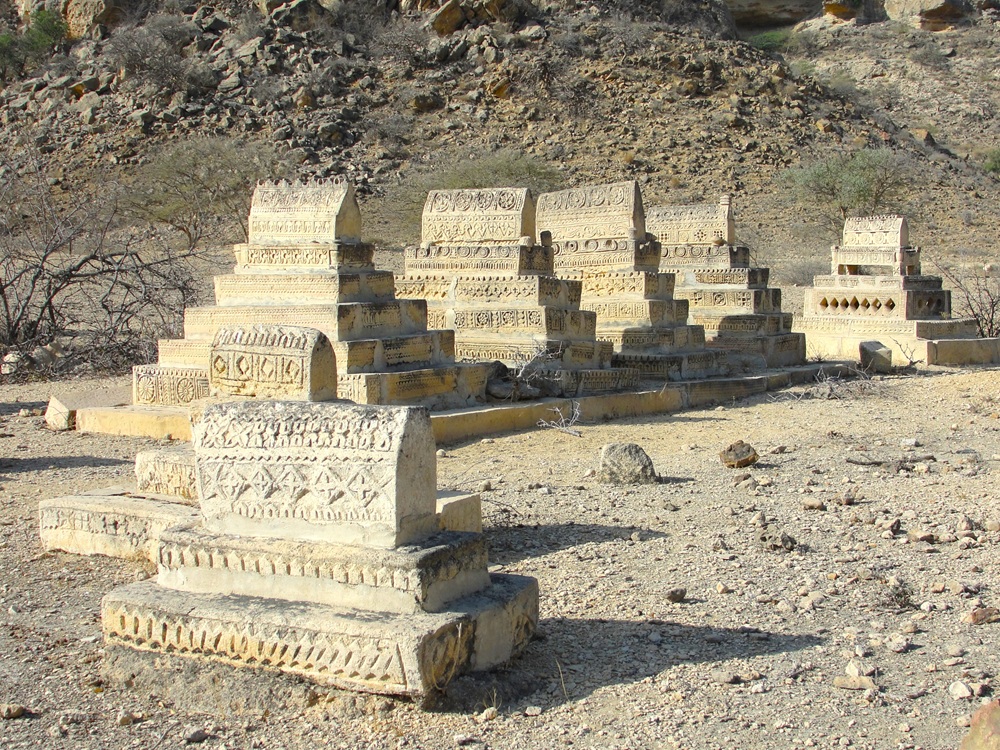
Tombs at Wagucha graveyard. (Picture credits to Zulfiqar Ali Kalhoro).
To the west of the row of four graves stands the most remarkable cenotaph, distinguished by its finely carved architectural composition and the prominent use of diamond-shaped perforations. The structure is built in multiple tiers. The lowest slab is simple and unadorned, serving as a solid base that supports the monument.
Above this, the second tier is more elaborate and supports the cenotaph's main body. This section is notable for its pierced stonework (jali), in which a continuous band of diamond-shaped openings is carved. These perforations not only enhance the structure's visual appeal but also feature a decorative element above, which consists of another slab richly adorned with geometric and linear motifs. This tier acts as a transition between the base and the upper structure. The superstructure resembles a khat or charpoy (traditional bedstead), a symbolic and architectural form frequently employed in Chaukhandi graves. It is supported by short, carved corner pillars, giving it the appearance of a Khat and a raised platform.
The headstone rises above this charpoy-like structure and is elaborately decorated with floral rosettes and geometric patterns. Its upper edge is crowned with a serrated or crenellated crest, further enhancing its monumentality.
Overall, the cenotaph reflects a sophisticated architectural vision, combining solidity with delicacy. The interplay of solid slabs, pierced panels, and an elevated superstructure demonstrates the artisans' high level of skill, as they skillfully integrated structural elements with intricate decorative schemes.
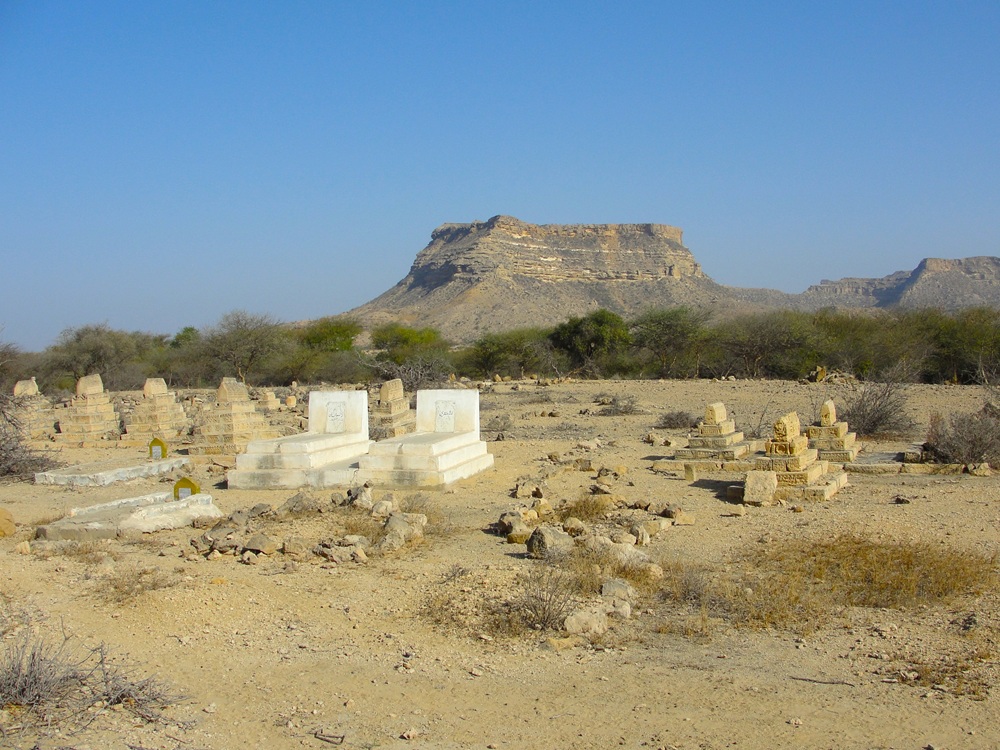
The graves of Wagucha set against Marri and Mangthar Hill. (Picture credits to Zulfiqar Ali Kalhoro).
To the southeast of a row of four graves, three intricately carved stone graves are erected on a shared platform. Each of these graves consists of five tiers. The grave on the left is in poor condition, while most of the others have been renovated using cement. It appears that the dislodged slabs were repaired with cement, which is noticeable on many of the graves.
The graveyard of Wagucha is one of the most notable burial sites in Gadap, known for its finely carved graves that feature floral and geometric motifs. Unlike many other cemeteries, it is characterised by the absence of figural representations. In this arid landscape, these stone monuments appear almost like a mirage from a distance, rising dramatically against the stark, undulating terrain. The graves, along with the surrounding hills, are among the few features that break the monotony of Gadap’s desolate expanse.
These stone monuments serve as an enduring testament to the rich tradition of stone carving in Sindh, reflecting the region's cultural practices and artistic expressions. The artisans who created these works drew from a diverse repertoire of designs and techniques, thereby contributing to a legacy of exceptional craftsmanship that embodies the collective identity of their communities. While this artistic tradition continues to exist in contemporary society, it is increasingly practised by a limited number of artisans, primarily in remote villages such as Thano Bula Khan taluka and certain areas of Gadap taluka. The persistence of this craft is often contingent upon the availability of patrons, underscoring the dynamic interplay between art, culture, and economic support within these communities.
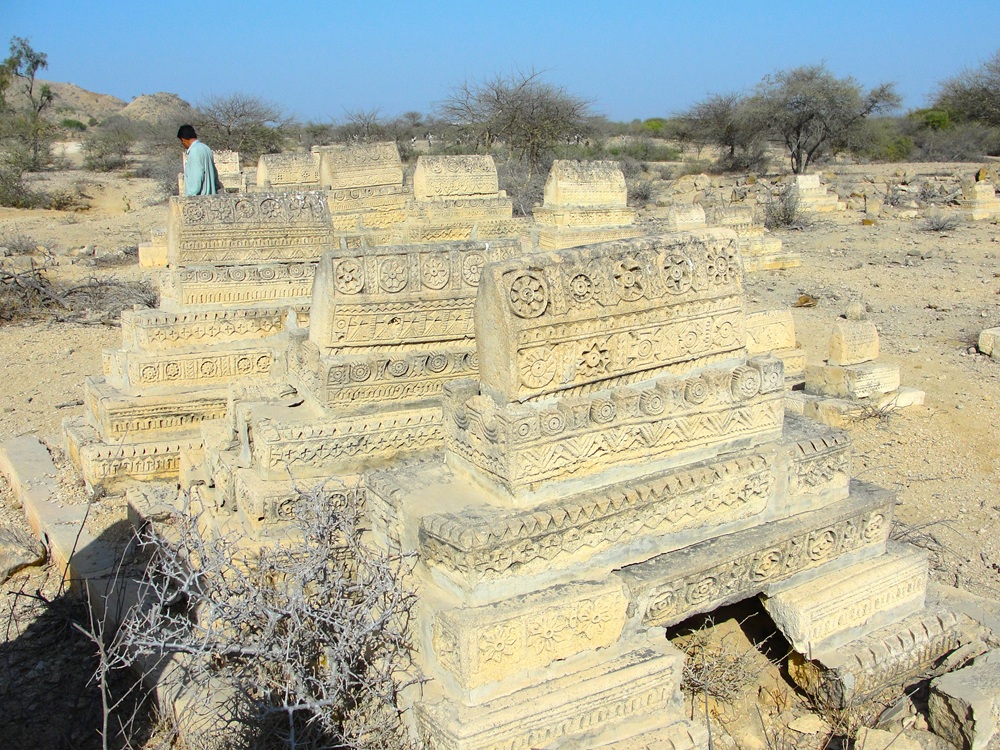
Stone-carved graves in the Wagucha cemetery. (Picture credits to Zulfiqar Ali Kalhoro).
These graves are deeply embedded in local memory, not merely as burial markers but as living points of reference within the community's cultural landscape. They are remembered, named, and revisited through oral traditions, stories, and everyday practices. Each carved stone preserves traces of identity; names, motifs, and symbols; that people recognise and relate to lineage, belief, and social standing. The recurring use of floral, geometric, and architectural designs forms a shared visual language that continues to resonate with local communities.
Set within a landscape still traversed by pastoral nomads and villagers, these graves are not isolated remnants of the past but part of an ongoing relationship between people and place. They serve as spaces where memory is recalled, narrated, and at times reinterpreted.
The writer is an associate professor and anthropologist at the Pakistan Institute of Development Economics, Islamabad. He has authored 18 books on Pakistan’s cultural heritage and anthropology. He tweets @kalhorozulfiqar. He may be contacted at zulfi04@hotmail.com
You may also like: