Written by: Aiza Azam - Posted on: August 13, 2013 |  Comments | 中国 (Chinese)
Google Translation: اُردو | 中文
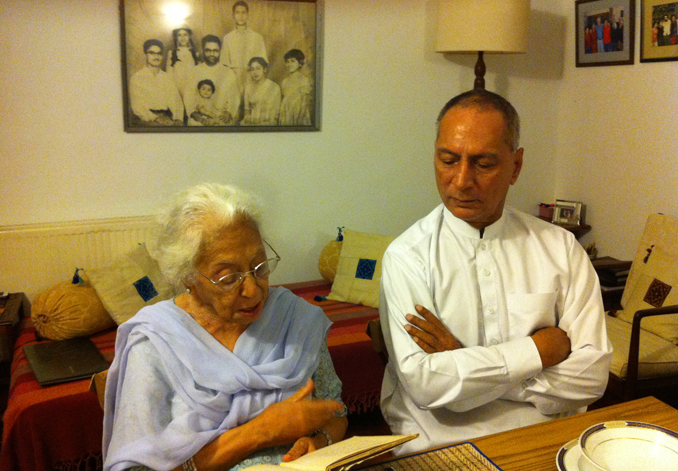
My father had this notion, that we should all know and understand other people’s religions. When he was posted in Meerut, he took my brother and I to enroll us in a Hindu school, and the headmaster happily accepted us. In class, the man would always sit us in the front row, ahead of and apart from the other children. I was 6 and a half years old at that time and my brother was 7 and a half. I thought it was a special favor that we were made to sit separately. But then during recess, when we tried to go play with the other children, they ran away from us, shouting out, ‘Achhoot, achhoot (Untouchable, untouchable)!’ After enduring three days of this horror, my brother took me aside during recess and said, ‘Come on Mashan, let’s go home,’ and we never returned to that school. It made a strong impression on me, the experience of being an ‘Untouchable’ because I was a Muslim.
10 million civilians were displaced at the time of the Partition. One million lost their lives.
In the summer of 1947, before the Partition of India took place, Mrs. Humyra Saiyid was in Simla with her mother, her younger sister, and her three children – 7 and a half year old Omar, 6 and a half year old Aamer, and a baby girl Bibi, who was only a few months old. Her husband, Mr. Jari Ahmed Saiyid, a Military Accounts officer in the British Army, had returned to Lucknow, where he was posted at the time. When news of the Partition was announced, it was received with some concern, but little alarm, as no one could have imagined the horror that was soon to unfold.
As news began to filter in about the Sikh jatthas (gangs) and their killing campaign, Mrs. Saiyid was the sole person responsible for her family’s care. The house they were in was on a hill. When night fell, she loaded her husband’s pistol, went out onto the verandah and fired twice into the darkness, a warning to anyone approaching that the inhabitants of the house were armed.
In the morning, she took her family to the Grand Hotel, a building with a heavily guarded perimeter which only housed the English. With the exception of their own family and that of the officer in charge of the guard, Colonel Masood, they do not recall any other Indian families. The hotel was placed under regular curfews. Aamer Saiyid recalls an occasion where a man tried to run into the security of the hotel, but was stabbed to death at the gate by one of the jatthas, while with the guards shouted at the playing children to run back inside. Later, peering out from their first floor suite, he and his brother saw Sikhs armed with swords, circling the perimeter.
At the hotel, Mrs. Saiyid made friends with the English families, and this became the source of their escape from Simla. They agreed to let them travel with them to Delhi in a military convoy, which was exclusively for the English. However, to conceal the fact that they were Muslims, Mrs Saiyid went out and bought clothing to attire herself and the other women of the family as Christian nannies accompanying the English. She gave each family member a Christian name to remember, if questioned.
The day the convoy was to leave, she and her family were almost all in the same truck, with the exception of Aamer Saiyid, who was told by an English corporal that the vehicle was full and he would have to be taken to a truck further back. A Muslim servant accompanying them took him to the luggage vehicles at the very end; but before they could board it, they were told no one could ride on them. It was at this time, Mrs. Saiyid remembers, that she instinctively felt her son was in trouble. She left her seat and raced up the road looking for him, and found him standing by the roadside. She grabbed his hand and ran back to the vehicle she had left, while the bugles announcing the departure of the convoy played insistently. They boarded the truck seconds before it moved off.
In Delhi, she and her family stayed at the Sher Shah Mess, one of several transit residences for the families of army officers who had opted to serve in Pakistan. Her husband had, till then, been in Lucknow, determined to carry out his duties as long as he was needed, until the Hindu employees of the office rebelled and went on strike, refusing to serve under a Muslim officer. Through military colleagues, he discovered his family was in Delhi and rejoined them there. In the meantime, Mrs. Saiyid had used her contacts to secure travel for her family to Pakistan on Dakotas carrying Muslim officers to their new country. Their flight landed in Peshawar, where they were met at the airport by an Air Force officer Major Bilgrami, who was an old family acquaintance. They were warmly welcomed and taken to stay at his home. The following day, they took a train to Lahore, and were allotted housing in St. John’s Park, a part of the Lahore Cantonement. Mr. Jari Ahmed Saiyid’s position as a Military Accounts officer allowed them to overcome most obstacles with more ease than other displaced families.
The Mian Mir railway station was in the cantonment, and every day they would hear stories of refugees pouring in by the trainloads. Mrs. Saiyid would send her two sons to the train station with buckets of tea for the weary travellers; there, they would find other families doing the same, everyone helping out however they could. Aamer Saiyid recalls that after the refugees had been watered and fed, and the whistle would sound for the train’s departure, the travellers would climb aboard, and as the train left the station, a unanimous shout would go up: ‘Pakistan Zindabad! (Long live Pakistan!)’