Written by: Mubashir Hassan
Posted on: July 20, 2026 |  | 中文
| 中文
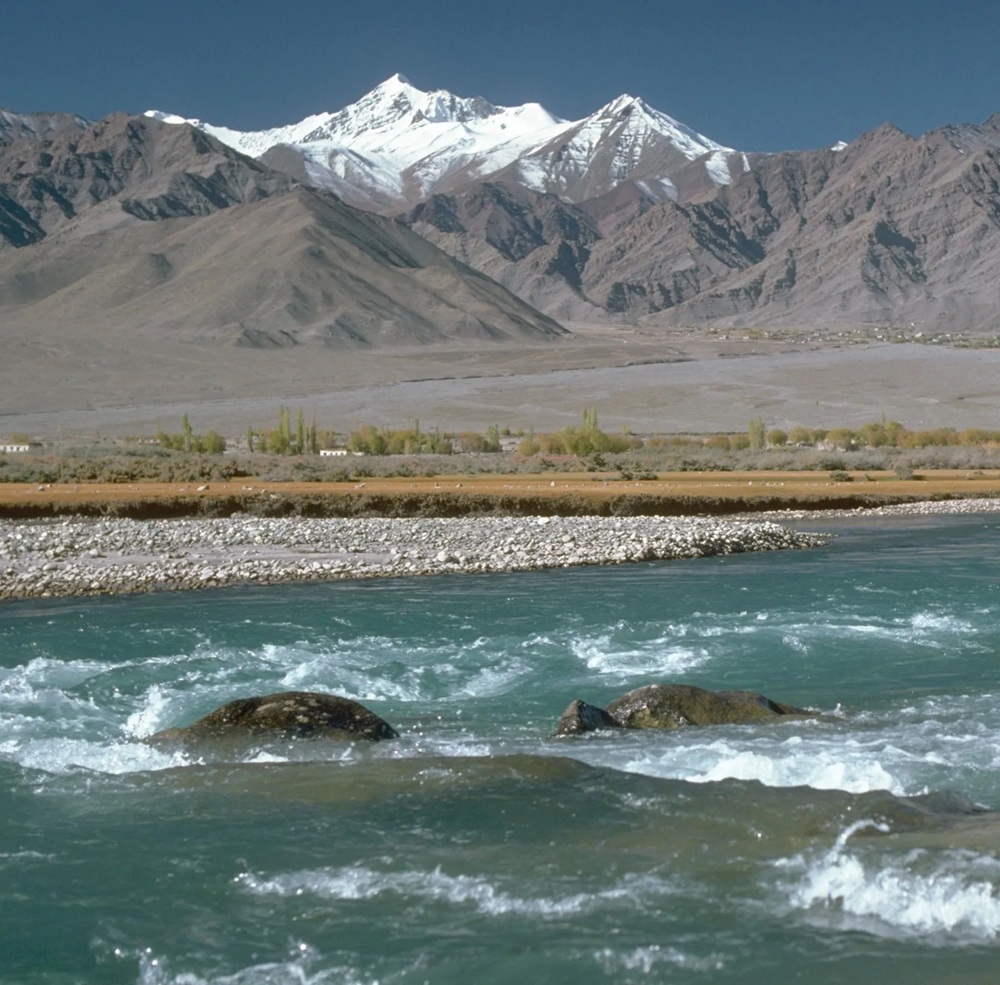
River Indus flowing through the Karakoram Range
Originating near Lake Manasarovar in Tibet, the mighty Indus River embarks on a majestic 3,180-kilometer journey before it finally merges with the Arabian Sea. However, its course across Pakistan’s diverse landscapes is no less spectacular. It flows through the rugged peaks of the Karakoram and the Himalayas of Gilgit Baltistan, the lush valleys of Khyber Pakhtunkhwa, the fertile plains of Punjab, and the vast expanses of Sindh. Among these, the Gilgit Baltistan episode is the most amazing, noteworthy, and adventurous. The Indus, touching almost all major populated areas of Gilgit Baltistan, tells the story of culture, beliefs, time, and some of the most breathtaking landscapes on earth. Here, we will explore this incredible Indus trajectory within Gilgit Baltistan.
Kharmang is the last district of Gilgit Baltistan, where Pakistan’s territory ends at the India border, and the Indus enters Pakistan’s territory. The very name “Kharmang” is a Balti language word, which means the “Valley of Forts”. The Indus is also famous in this region with its local Balti name, i.e., “Singay Rigyam-Tsuh”. It mainly consists of two Balti/ Tibetan words. The word ‘Singay’ means Lion, while ‘Rigyam-Tsuh’ is used for rivers. In sum, the Indus River is known as the ‘Lion River’ in the Baltistan region.
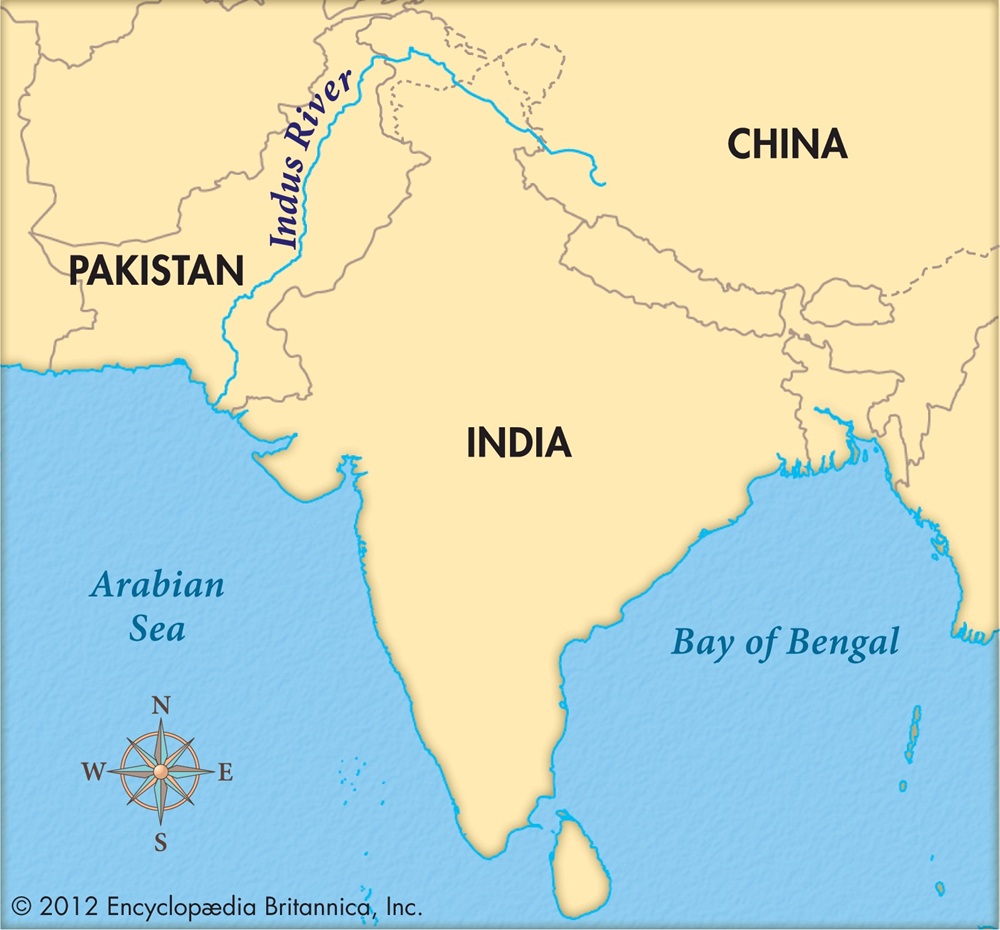
Indus River
As Kharmang’s landscape is comparatively rough, the river’s volume begins to grow substantially as it gathers momentum. The valley is also famous for some remarkable attractions that owe their existence to the river’s life-giving waters. For instance, the Manthokha Waterfall is situated at its periphery, which crashes into a crystal-clear stream surrounded by lush greenery and towering peaks. Similarly, another famous waterfall, the Khamush Waterfall, with breathtaking views, offers a mesmerizing display of water and mist. Furthermore, across the valley, suspension bridges and traditional pathways tell the story of thrilling perspectives of the valley below.
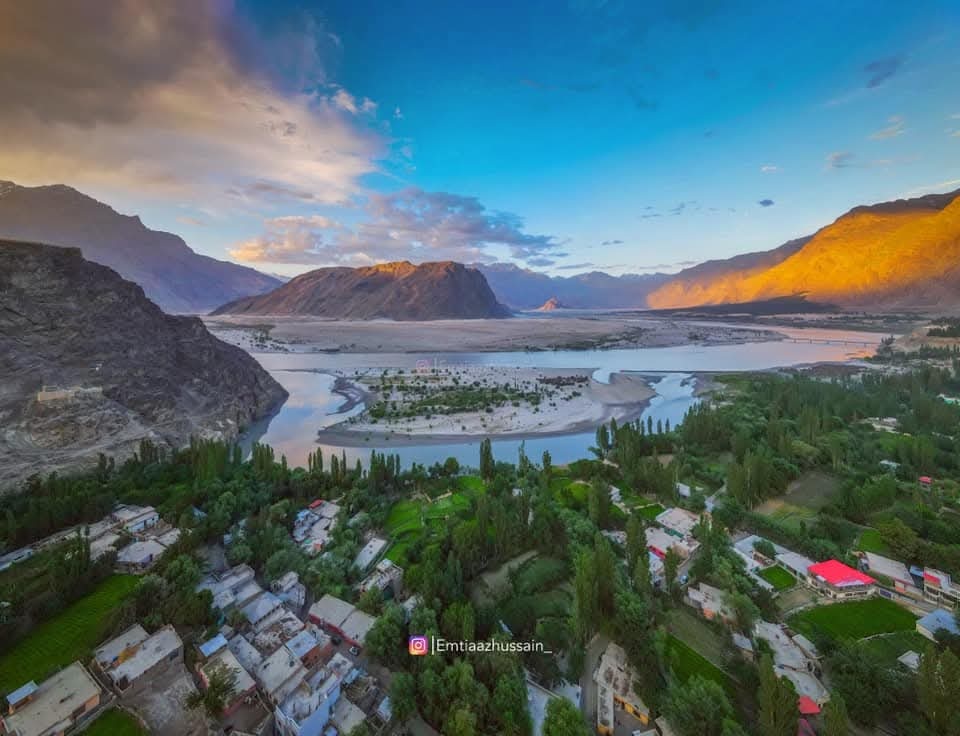
Skardu and Cold Desert seperated by Indus (picture credit - Emtiaaz Hussain Photography)
After passing through the Kharmang valley and before entering Skardu city, the Indus is joined by the Shyok River near a small and beautiful village, Keris. Afterwards, continuing its journey northwest, it reaches Skardu, the largest city in the Baltistan region, often referred to as Pakistan's tourism hub. Skardu lies along the wide banks of the Indus at the confluence of the Shigar River and the Indus River, which meets just beneath the famous Kharpocho Fort. Skardu owes much of its development to the Indus River, for the Indus has supported trade routes and human settlements for centuries while attracting travelers from around the world seeking adventure in the Karakoram Mountains. The historic Kharpocho Fort, lying on a hilltop, occupies a significant rocky position, overlooking the Indus valley. From its top, one can trace the river’s thread-like pathways as it rounds through the valley. This scenic view notably includes the Sarfaranga Cold Desert, which lies along the banks of the Indus, creating a rare landscape where dunes exist against a backdrop of mountains, and snow during the winters. Just passing a few miles away from the Kharpocho Fort hill, the river meets the Kachura Village, which is iconic for the Lakes and luxury resorts like Shangrila Resort.
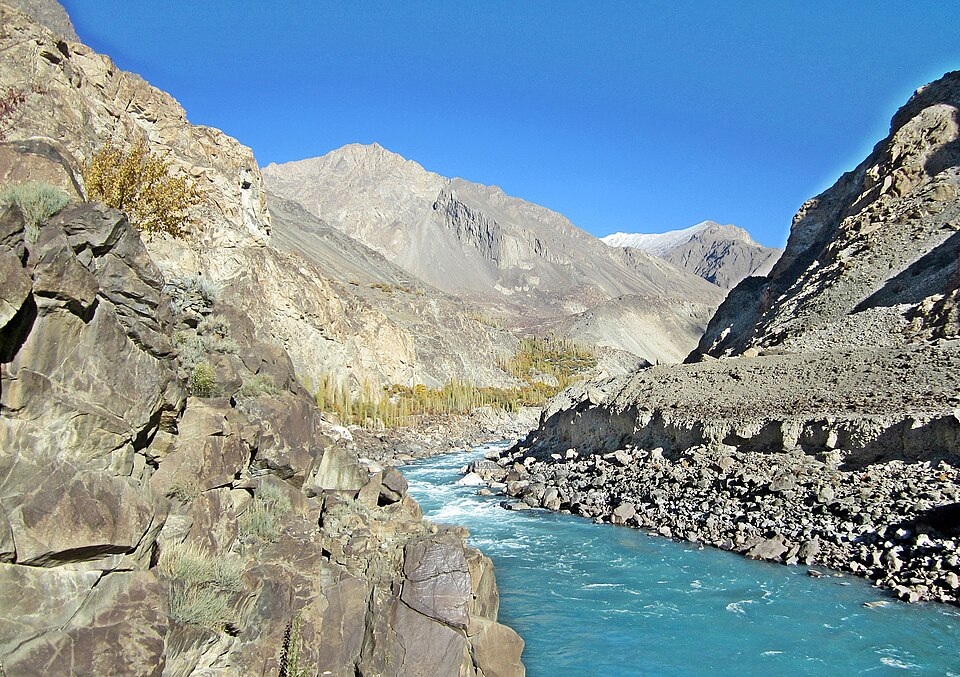
Indus near Chilas Kharmang
As soon as it completes its voyage around Skardu, the Indus heads towards Gilgit Valley, the capital of Gilgit Baltistan. However, before reaching Gilgit, there lies the picturesque Roundu Valley, between Skardu and Gilgit. On the right bank of the Indus lies Stak Valley, which is also known as Stak Nala.
The Indus continues to flow towards the west, and just a few miles away from Gilgit City, it merges with the Gilgit River near Jaglot village. Before making confluence with the Indus, the Gilgit River is joined by the Hunza River at the southeast of Gilgit town. Combinedly, they join the Indus. This meetup is more than just a more than a meeting of waters, for the three of the world’s great mountain ranges, the Karakorum, Himalayas, and Hindukush also converge at the same location. Such a scenic view is no less than spectacular. The ninth-highest mountain in the world, Nanga Parbat, also dominates the skyline of Indus. It is also famous for the name “The Killer Mountain” for its adventurous reputation.
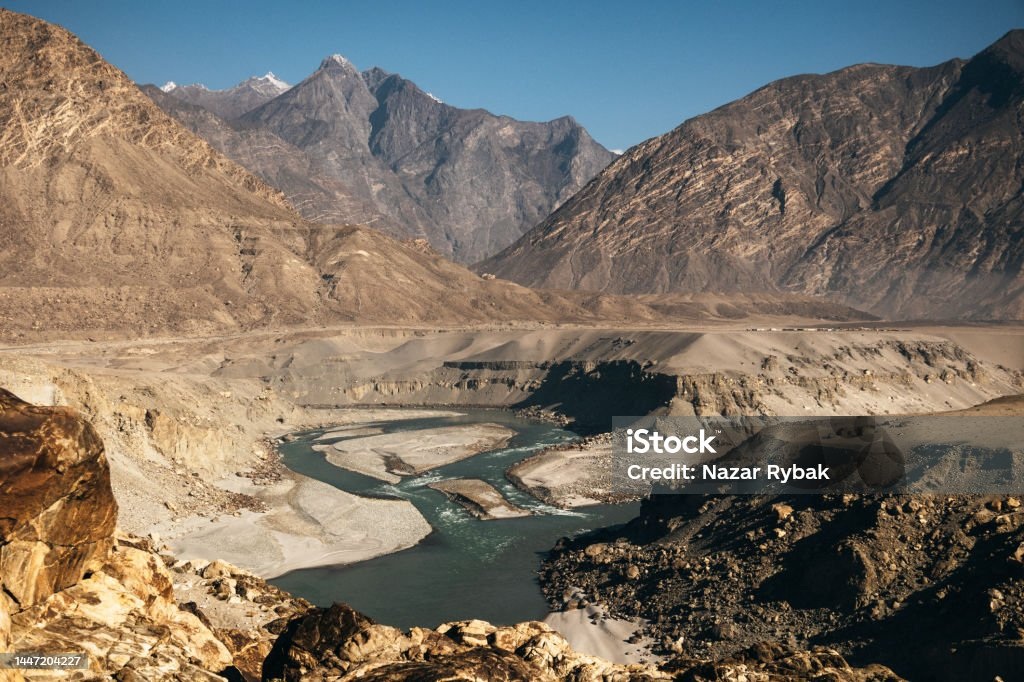
Confluence with Gilgit River (picture credit - Nazar Rybak)
This merger point has long served as a strategic crossroads connecting Baltistan, Gilgit, Hunza, Chitral, and Central Asia. The meeting of these rivers has historically supported trade caravans traveling along ancient Silk Route connections.
Beyond Chilas, the Indus flows through the lower peripheries of Diamer District. Here, also exists the under-construction Diamer-Bhasha Dam. The Karakoram Highway continues to accompany the river until the territory of Gilgit Baltistan ends. From the roadside of the Karakorum Highway, the Indus gathers itself for the last time within this region, sliding out of the high mountains and into the green hilly region of Khyber Pakhtunkhwa.
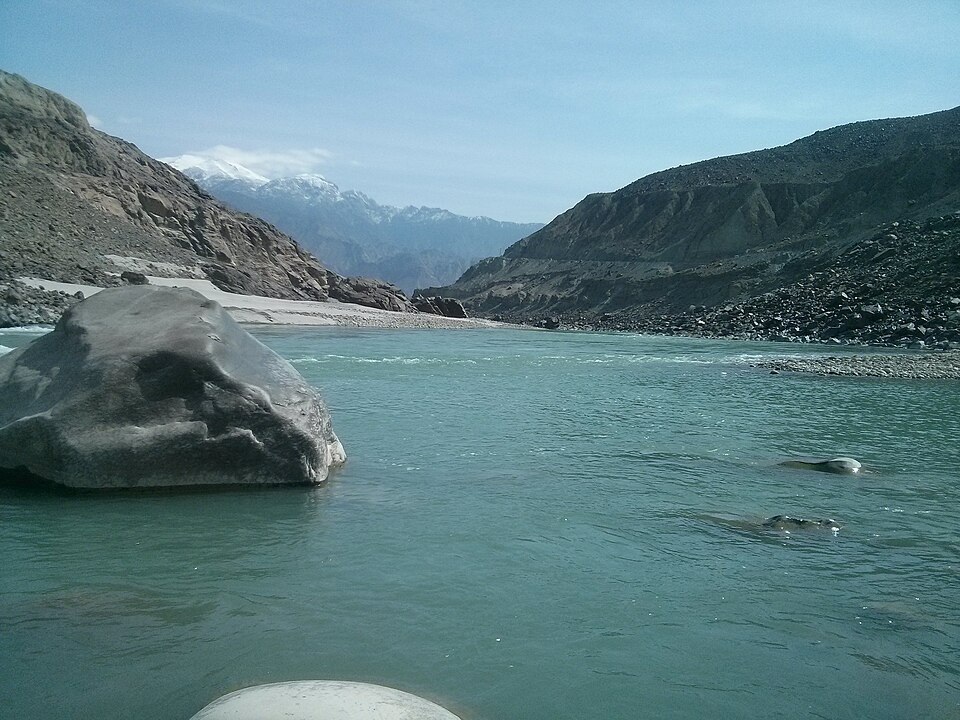
Indus near Chilas Kharmang
In sum, the journey of the mighty Indus River’s passage through Gilgit-Baltistan is one of the most scenic journeys of a river anywhere. From its gentle entry into the stunning valley of Kharmang to the majestic confluences at Skardu and Jaglot, through the peripheries of Gilgit city, under the breathtaking shadow of Nanga Parbat, and finally out towards Khyber Pakhtunkhwa, the river binds together a gallery of natural and cultural wonders. Travelling this route of wonder certainly leaves an indelible impression on one’s memory.
You may also like:
From the Horn of Africa to Bahria Town: Habesha Café Brings Centuries of Coffee Culture to Rawalpindi
(October 15, 2026)